While delivering a bunch of different specialized agents, I completely forgot what the original Claude sounds like.
All of these agentic harnesses are very cool and efficient, but sometimes I just want to wax philosophical, while memory gives enough personality.
We've rolled out a new auto-memory feature.
Claude now remembers what it learns across sessions — your project context, debugging patterns, preferred approaches — and recalls it later without you having to write anything down.
Returned to Telegram and ChatGPT after 3 and 1 years breaks accordingly :)
Looks like Codex 5.3 with subscription is the best option for #OpenClaw now.
Slack integration needs some love, while a lot of cool features are available from the box.
I've never felt this much behind as a programmer. The profession is being dramatically refactored as the bits contributed by the programmer are increasingly sparse and between. I have a sense that I could be 10X more powerful if I just properly string together what has become available over the last ~year and a failure to claim the boost feels decidedly like skill issue. There's a new programmable layer of abstraction to master (in addition to the usual layers below) involving agents, subagents, their prompts, contexts, memory, modes, permissions, tools, plugins, skills, hooks, MCP, LSP, slash commands, workflows, IDE integrations, and a need to build an all-encompassing mental model for strengths and pitfalls of fundamentally stochastic, fallible, unintelligible and changing entities suddenly intermingled with what used to be good old fashioned engineering. Clearly some powerful alien tool was handed around except it comes with no manual and everyone has to figure out how to hold it and operate it, while the resulting magnitude 9 earthquake is rocking the profession. Roll up your sleeves to not fall behind.
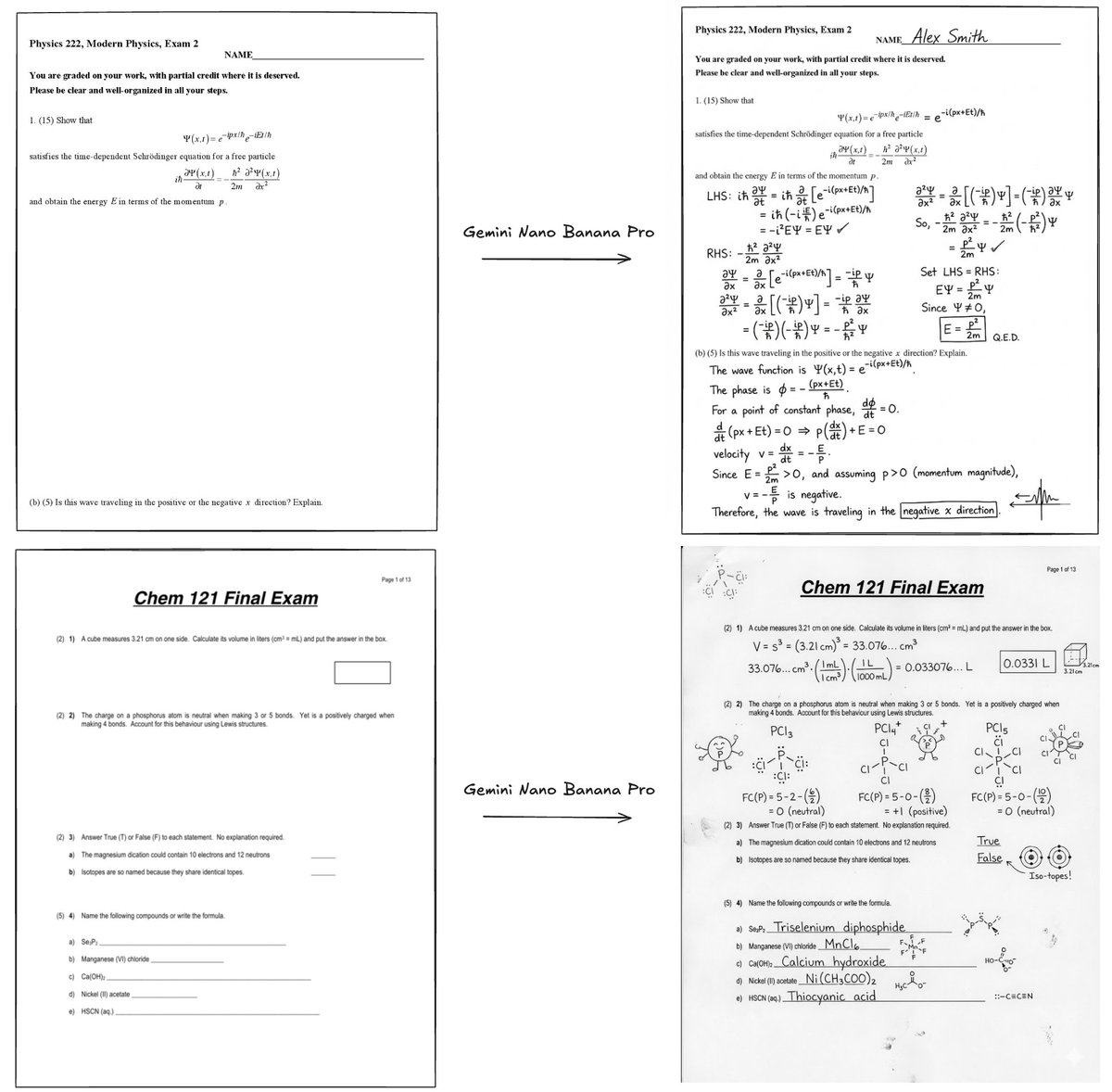
Gemini Nano Banana Pro can solve exam questions *in* the exam page image. With doodles, diagrams, all that.
ChatGPT thinks these solutions are all correct except Se_2P_2 should be "diselenium diphosphide" and a spelling mistake (should be "thiocyanic acid" not "thoicyanic")
:O
Now I get it with Claude Code on mobile :)
The usage bar for the Claude subscription now reflects the Sonnet model; it used to display Opus.
It appears Opus 4.5 is the new default, and I really like it!
@andreyzagoruiko Hmmm, how to solve this? Blockchain reference network? 🧐
Actually, LI posts may serve as a trust layer if you share some work progress; noticed a bump in impressions for the old posts 3-7 years ago... now regret internal denial to share.
Hey @xAI@grok, iOS app is awesome - killer UX, speed & smarts, but need these for daily productivity to make you my #1 AI:
• MCP for personalized integrations
• Projects/Workspaces on iOS for synced notes/chats
• Same for Tesla’s Grok to keep context flowing
+1 for "context engineering" over "prompt engineering".
People associate prompts with short task descriptions you'd give an LLM in your day-to-day use. When in every industrial-strength LLM app, context engineering is the delicate art and science of filling the context window with just the right information for the next step. Science because doing this right involves task descriptions and explanations, few shot examples, RAG, related (possibly multimodal) data, tools, state and history, compacting... Too little or of the wrong form and the LLM doesn't have the right context for optimal performance. Too much or too irrelevant and the LLM costs might go up and performance might come down. Doing this well is highly non-trivial. And art because of the guiding intuition around LLM psychology of people spirits.
On top of context engineering itself, an LLM app has to:
- break up problems just right into control flows
- pack the context windows just right
- dispatch calls to LLMs of the right kind and capability
- handle generation-verification UIUX flows
- a lot more - guardrails, security, evals, parallelism, prefetching, ...
So context engineering is just one small piece of an emerging thick layer of non-trivial software that coordinates individual LLM calls (and a lot more) into full LLM apps. The term "ChatGPT wrapper" is tired and really, really wrong.