I got the chance to play the Luminary -Alpha build- Demo and wow this might be my indie GOTY contender already.
Big shoutout to @RefractiveENT for the access 🙏
This game was one of my most anticipated Indie games this year and after finishing the demo here's the thing:
- The world design alone had me stopping every few minutes just to take it in, and already 18 screenshots from the demo alone.
- Every area felt handcrafted and alive.
- The visuals are genuinely stunning for an indie title, the lighting, the environments, the scale... it punches way above its weight.
- The combat is smooth, satisfying, and has that "just one more fight" pull to it, with parry, block, evade and special abilities (Only got one from the demo so far).
This is still an Alpha build and it's already this good. I cannot imagine what the full release looks like.
Keep your eyes on Luminary because @RefractiveENT is cooking something special.
#Luminary #IndieGaming #GamePreview
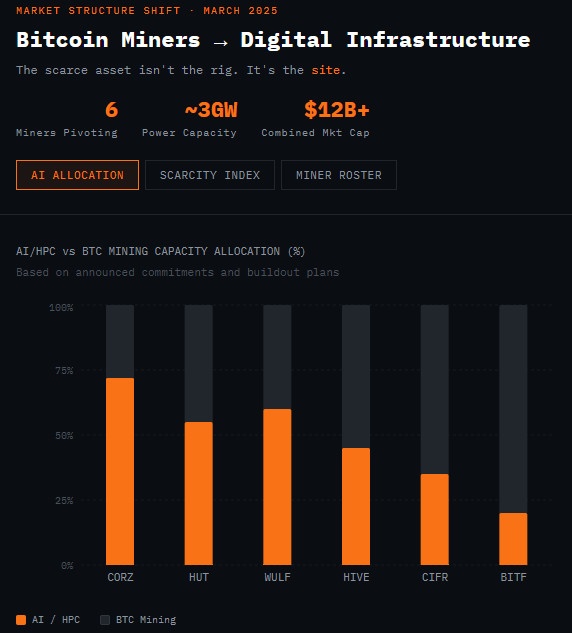
Bitcoin miners are quietly becoming AI infrastructure companies.
Core Scientific $CORZ, Hut 8 $HUT, Cipher $CIFR, TeraWulf $WULF, Bitfarms $BITF, $HIVE. All pivoting — in different ways — from hash rate to power-ready AI/HPC capacity.
And now I learned about $IREN.
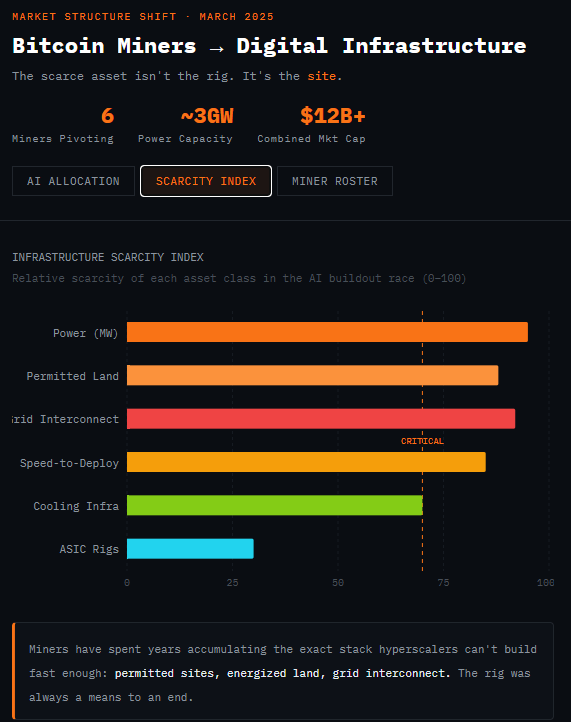
The scarce asset was never the rig. It's the site.
Power. Land. Interconnect. Speed-to-deploy.
That's what's getting re-rated.
"Good investing is a peculiar balance between the conviction to follow your ideas and the flexibility to recognize when you have made a mistake." – Michael Steinhardt. A reminder for all in portfolio management: Adapt or perish in ever-changing markets. #InvestmentWisdom
For months, bonds have hinted at 2-3 Fed rate drops ahead. Following the weak Aug 1 jobs report, expect at least three—September's locked in, October's on the table.
Markets have baked this in fully.
Mild CPI triggers a massive buying spree, echoing the knee-jerk chase for easy money we've seen since 2008.
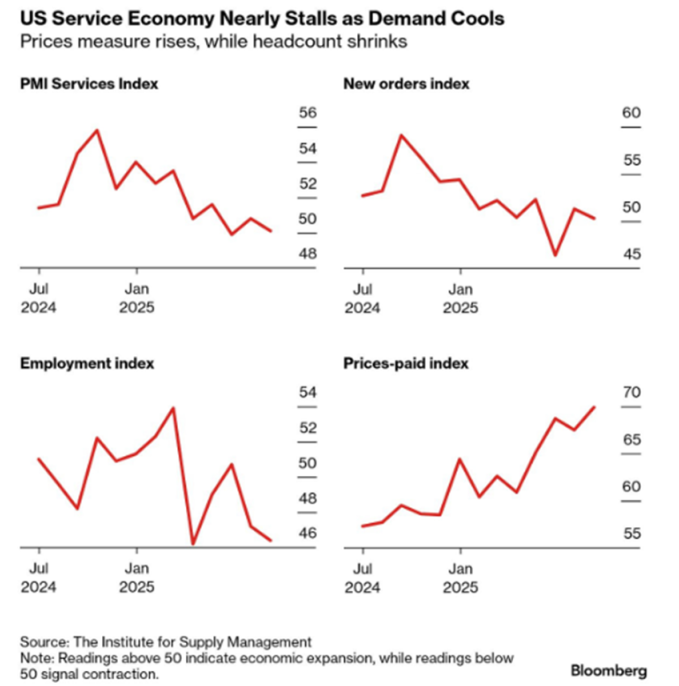
But overlooked: Soft prices often stem from fading demand, not victory over inflation. Firms discount only when sales slump—classic slowdown signs, absent for decades amid bailout eras. Growth worry or inflation trap? At peak valuations with easing expected, it's all about stalling economy fears. Optimism boils down to faith in cuts reviving confidence, capex, jobs, and wallets.
Baffled why, with plunging factory output, frozen services, and weakest hiring streak in 14 years, a nasty downturn isn't even whispered.
$Flex
- strategically capitalizing on AI infrastructure growth, notably in data centers, which has led to significant improvements in profitability and cash flow, positioning it well for long-term growth.
- The company's focus on high-value AI data centers, supported by acquisitions like JetCool and Crown, has resulted in a 45% year-over-year revenue growth in this segment.
- $Flex has demonstrated robust EPS growth driven by increased demand for data center power and cooling solutions, with management raising FY25 EPS guidance, reflecting confidence in ongoing growth.
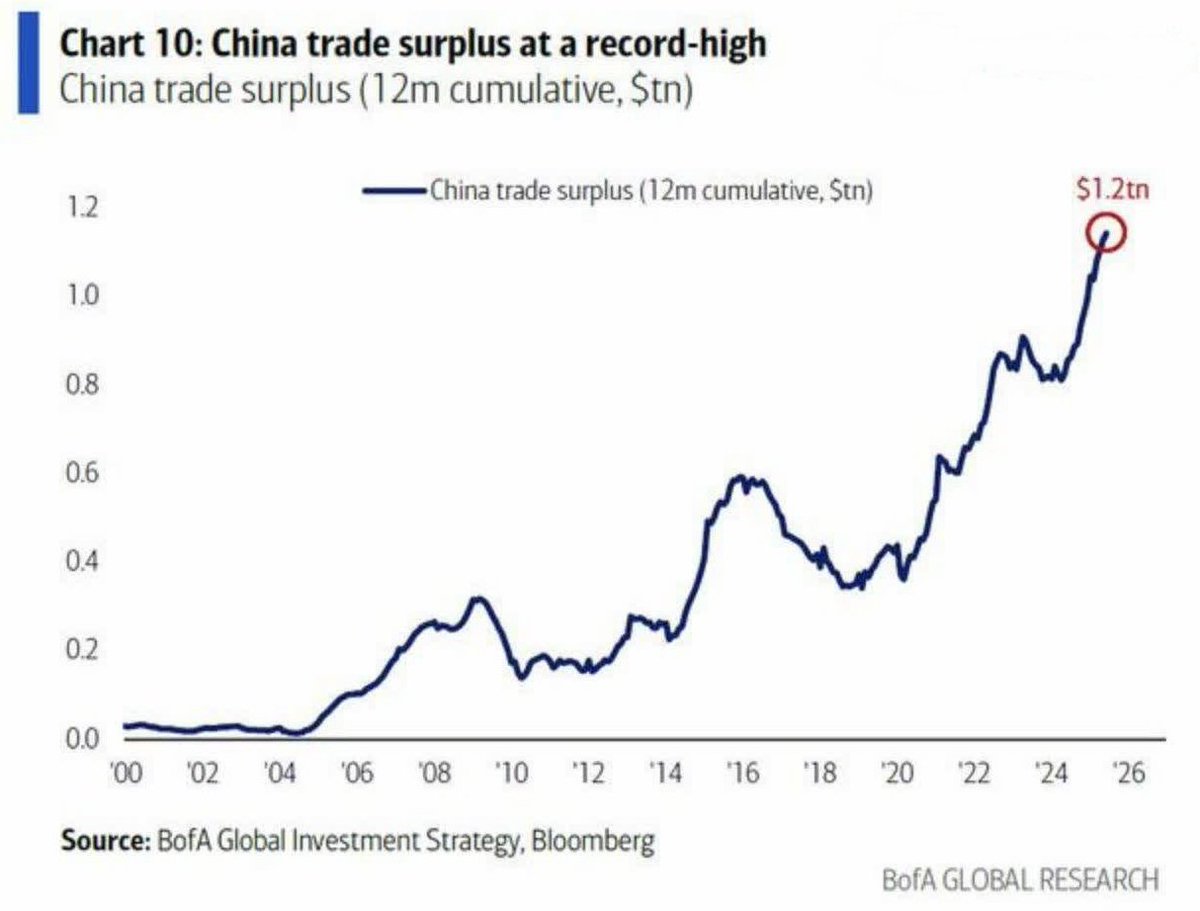
China’s Trade Surplus Reaches a Record $1.2 Trillion
A trade surplus occurs when a country exports more goods and services than it imports, in monetary terms.
❗️This is a record figure, reflecting the strength of China’s economy as the world’s largest exporter.
Inflation came in softer than anticipated overall, with core measures running slightly elevated due to persistent pressures in services. However, tariffs appear to have had minimal effect on goods prices.
CPI (July YoY): 2.7% actual vs. 2.8% expected; Core (ex-food and energy): 3.1% actual vs. 3.0% expected.
$ibkr is another broker along with $hood that is breaking higher
Pros: Interactive Brokers shows robust client growth, with a 32% rise in customer accounts driving revenue and profit expansion. Its global presence and innovations, including expanded crypto access and forecast trading, support future growth despite potential rate cuts. A solid balance sheet with high cash reserves and no long-term debt offers stability and flexibility for initiatives and acquisitions.
Cons: Interactive Brokers' high valuation raises doubts about sustained growth and risks valuation compression. Potential interest rate cuts could reduce net interest income, a key revenue source. Competition from firms like Robinhood and regulatory hurdles may impact market position and profitability.
Pros: $hood stands to gain from rising institutional crypto adoption via Bitcoin ETFs, increasing retail engagement and trading. Its compliance focus and diversified revenues offer regulatory resilience. The shift to a global super-app, with international growth, tokenized stocks, and blockchain infrastructure, bolsters its digital finance position and long-term growth amid volatility. Revenue diversification through Robinhood Gold and expanded crypto services, plus high margins and operational leverage, supports strong profitability.
Cons: $hood's valuation appears inflated at a P/E of 68, raising doubts about sustainability in current market cycle and potential rate cuts. Ambitious expansions face stiff competition and regulatory risks, especially around payment for order flow and crypto. Heavy reliance on volatile crypto revenue is a vulnerability, with the valuation hinging on perfect execution and little margin for error.
Why China is giving away technology for free?
China is actively integrating into the global open-source community. After the US and India, it has the third-largest number of developers on GitHub.
Huawei, Alibaba, and others are investing in open-source AI models — especially after US sanctions. Open-source has become a tool for China to accelerate innovation and reduce dependence on the West.
However, the open-tech model clashes with an authoritarian system. The government has restricted access to GitHub, requires code inspections, and bans “socially dangerous” AI content.
While the state supports open-source, risks remain: government pressure, foreign users' distrust, and potential US restrictions. Without true freedom and openness, tech growth could slow down.
@ed_fin The Strait of Hormuz remains a critical route for global oil trade: around 20 million barrels pass through it daily - about 90% of oil exports from the Persian Gulf. The main crude oil buyer is now China, not the US or EU.
TURNING POINT IN THE STRAIT OF HORMUZ TENSIONS
The Strait of Hormuz remains a critical route for global oil trade: around 20 million barrels pass through it daily - about 90% of oil exports from the Persian Gulf. But Iran’s influence over the strait has weakened due to a shift in oil markets: the main buyer is now China, not the US or EU.
The Persian Gulf is the world’s energy hub:
▫️Holds 55% of global oil reserves and 39% of natural gas reserves.
▫️Accounts for 42% of global oil exports and 17% of gas production.
▫️Key exporters: Saudi Arabia, Iraq, Kuwait, UAE, Qatar, Iran.
Shift in oil trade:
📉 Between 2001 and 2022, Persian Gulf oil exports to the US fell by 72%, and to the EU by 37%.
📈 Meanwhile, exports to China surged by 800% — China now consumes 55% of the Gulf’s oil.
🇨🇳 China is now the region’s top energy partner:
In 2022, trade between the Gulf and China hit $385 billion, surpassing trade volumes with the EU and US.
China has also become a key political mediator (e.g., the 2023 Iran–Saudi Arabia reconciliation, brokered by Beijing).
❗️IMPLICATIONS:
The US has become energy-independent, while China is increasingly import-dependent.
Iran’s leverage via the Strait of Hormuz now has less impact on the West but poses a risk to China — making Beijing more invested in regional stability.
Any disruption in Hormuz could raise oil prices — benefiting the US but posing a strategic threat to China.