This is one of the rarest Elon Musk rare lost Interview - from 2007.
He was 36. Almost no one took SpaceX seriously yet. Tesla was just about to release its first Roadster.
And Musk was already saying this:
The three things that will change the future of humanity: the internet, space, and the transition to solar energy with electric vehicles.
We’re not running away from Earth. We need to become a multi-planetary species.
The Moon is “been there, done that.”
The real goal is Mars.
About Branson, Bezos and the rest:
“We have no serious competition. None.”
Almost 20 years ago he already saw the entire picture.
And almost everything from that interview later came true… even though almost no one believed him then.
UPD: SpaceX is about to attempt something no rocket has ever done: catch an orbital-class upper stage out of the sky.
Flight 14 will send Ship 41 all the way around Earth - the first fully orbital Starship flight - then try to land it back on the launch tower's arms.
Why now: Ship 40's splashdown on Flight 13 was precise enough that Musk confirmed it "would have been caught by the tower arms." That cleared the engineering bar SpaceX set before risking a catch over land.
The hard part isn't the booster (already caught multiple times since 2024). It's the ship - it has to bleed off full orbital velocity, survive plasma reentry, then flip from a horizontal belly-flop to a vertical hover with centimeter-level precision between two steel arms.
Booster 21 will still splash down in the Gulf - no tower catch for the booster this time, until SpaceX nails down what went wrong on Flight 13's landing burn.
If it works: full reusability gets real. If it doesn't: still the most ambitious catch attempt in spaceflight history.
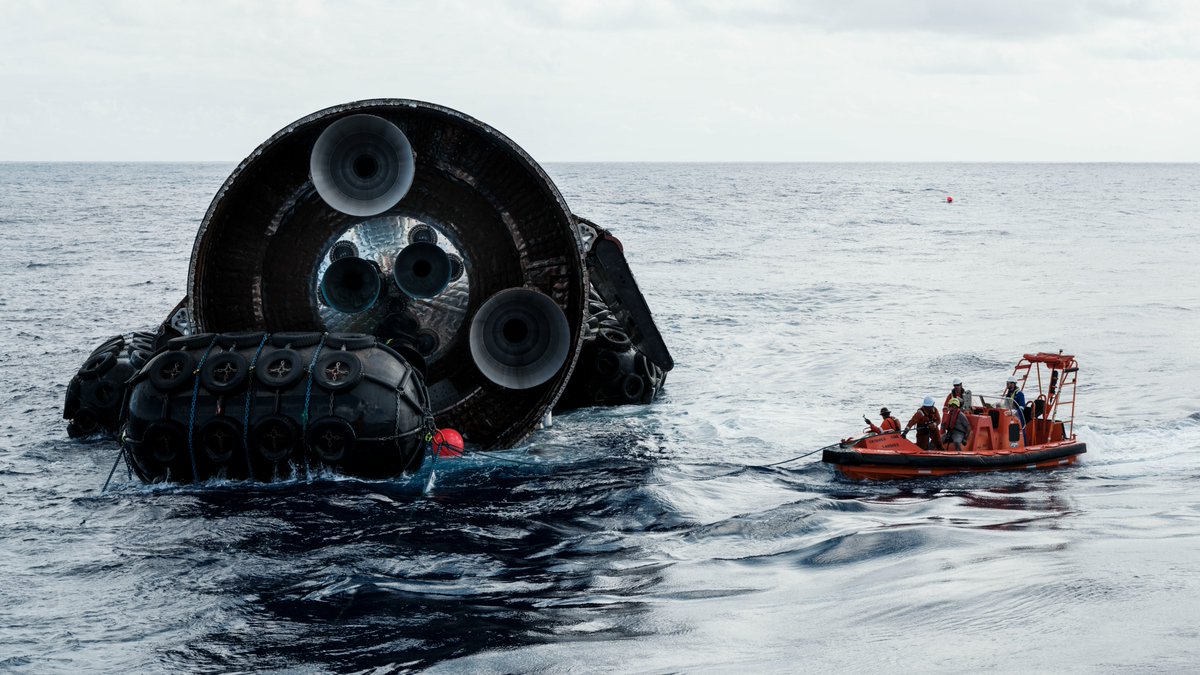
The SpaceX Recovery team is still working to recover Flight 13’s Starship from the Indian Ocean. They’ve been overcoming challenging conditions and increasingly rough seas as they attempt to guide the 52m long spacecraft to port
Yes, SpaceX's FCC filing for Flight 14 explicitly states the booster will RTLS this time. Musk said on the earnings call they're also going for the ship catch on the same flight.
So: first double-catch attempt. High confidence on paper, but V3 booster's landing burn just had an engine relight issue on Flight 13, so it's not a lock.
Slightly different picture, flight 12's booster crashed after engine failures. Flight 13's booster didn't crash, it hit the Gulf hard (only 5/13 engines relit), but that was a deliberate water landing, not a catch attempt. SpaceX is keeping the new V3 booster on splashdowns until it proves the landing burn is reliable. That's exactly why Flight 14's booster is staying in the Gulf too - one more data point before they risk it near the tower.
Space Highlights🌌:
An Earth-like planet is roughly 10 billion times fainter than its star, and sits right next to it in the sky. That's the problem NASA's Habitable Worlds Observatory has to solve just to take one picture.
The fix: a coronagraph that has to hold contrast at 1 part in 10 billion, on a telescope stable to the width of an atom. They're also still studying a 50+ meter starshade - a giant flower-shaped spacecraft that flies 100,000 km away just to cast a precise shadow.
The payoff isn't the photo. It's the spectrum hidden in that one pixel - water, oxygen, maybe the first real evidence life exists somewhere else.
Launch target: sometime in the 2040s. They're still choosing the mirror size.
FULL: https://t.co/RJ7cf5Pjij
NASA’s Habitable Worlds Observatory: the telescope designed to search for another Earth.
NASA is already developing the technologies for what could become one of the most ambitious astronomical observatories ever built. The Habitable Worlds Observatory, or HWO, is being conceived as NASA’s next major flagship astrophysics mission after the Nancy Grace Roman Space Telescope. Its defining objective is extraordinarily simple to state and extraordinarily difficult to achieve: directly photograph rocky planets similar to Earth around nearby Sun-like stars and analyze their atmospheres for evidence that some of them might support life. NASA’s current science goal is to directly image and characterize roughly 25 potentially habitable worlds.
HWO is not simply a larger version of Hubble or Webb. It combines lessons from Hubble, JWST and Roman with technology developed during the earlier LUVOIR and HabEx mission studies. NASA is currently exploring several possible architectures rather than committing to a final telescope design. The engineering concepts being studied include a 6-meter segmented off-axis telescope, another 6-meter configuration using a central keystone-shaped mirror surrounded by segments, and an 8-meter on-axis design. NASA explicitly warns that none of these should yet be interpreted as the final appearance of HWO.
The reason such a large telescope is required becomes obvious when we consider what HWO is trying to see. An Earth-like planet observed in reflected visible light can be approximately ten billion times fainter than its host star. Worse, from tens of light-years away the planet appears extremely close to that star in the sky. HWO must therefore separate two sources that are both enormously different in brightness and separated by only a tiny angle. It is rather like trying to detect an extraordinarily faint point of light immediately beside a searchlight, except that both are light-years away. NASA’s technology development is consequently aimed at contrasts approaching 10⁻¹⁰.
The baseline solution is an extremely advanced coronagraph located inside HWO. A coronagraph suppresses the light from the star while allowing light from surrounding planets to reach the detector. This sounds straightforward, but at a contrast of one part in ten billion, tiny imperfections in the optical system become important. Minute distortions of a mirror can scatter enough starlight into the image to imitate or completely hide a planet. HWO will therefore combine coronagraphic masks with deformable mirrors, precision wavefront sensing and active wavefront control to create an exceptionally dark region around the stellar image where planets can be detected. NASA refers to the process of creating this high-contrast region as digging a coronagraphic “dark hole.”
This is why HWO also needs to be one of the most optically stable spacecraft ever constructed. NASA says its optical system may need to remain stable at scales comparable to the width of an atom, while wavefront control requirements reach into the picometer regime. Thermal changes, mechanical vibration, reaction-wheel disturbances, structural creep and even very small motions between individual primary-mirror segments can destroy the contrast required to see an Earth analogue. Technologies under development therefore include ultra-stable mirror assemblies, extremely stiff structures, millikelvin-level thermal control, low-disturbance mechanisms, precision segment sensing and control, vibration isolation and microthrusters.
One of the most visually striking technologies associated with HWO is the huge flower-shaped starshade seen in many NASA demonstrations. The flower shape is not decorative. A starshade is an external occulter: instead of blocking the star inside the telescope, an independent spacecraft places an enormous opaque screen between the telescope and the target star. The telescope then sits inside the extraordinarily dark shadow created behind it while the light from planets located slightly to either side of the star continues past the shade and reaches the telescope.
A simple circular disk would not work well enough because light diffracts around its edge. In fact, diffraction would partially refill the shadow with stellar light. The strange elongated petals are engineered specifically to manipulate that Fresnel diffraction pattern. Their carefully calculated edges make the transition between opaque and transparent space gradual from the point of view of the propagating wavefront, dramatically suppressing diffracted starlight in the central shadow. In other words, the “flower” exists because of wave optics: each petal contributes to shaping the diffraction field so that the telescope occupies a region where the stellar electric field is almost cancelled. NASA laboratory demonstrations have already achieved broadband starshade contrasts below approximately 10⁻¹⁰ at flight-like Fresnel numbers.
A flight starshade for an observatory such as HWO would be enormous. Different concepts range from roughly 35 to 60 meters or more in diameter, while experimental NASA concepts have investigated sizes approaching 100 meters for other applications. It would fly tens of thousands of kilometers from HWO; current technology studies commonly consider separations of order 100,000 km, depending on starshade diameter and wavelength. Both spacecraft would have to maintain extremely accurate alignment with the target star while effectively operating as a single optical instrument across an enormous baseline.
There is an important distinction, however. NASA currently plans HWO around an internal coronagraph, not around a starshade. Coronagraphs have major operational advantages: they are integrated into the telescope, can move rapidly from one target to another and do not require a second giant spacecraft to reposition itself across interplanetary-scale distances. A starshade, by contrast, would require substantial propulsion every time it moved between target stars and would introduce another complex spacecraft and formation-flying system. Nevertheless, NASA continues to study starshades because they have attractive properties. They suppress starlight before it enters the telescope, are relatively insensitive to many telescope optical imperfections and could extend HWO’s scientific capability, potentially including wavelengths where internal coronagraphy becomes particularly challenging. NASA has even studied launching such a system separately and allowing it to rendezvous with a telescope later in its mission.
Once HWO has isolated the light from an exoplanet, simply obtaining a photograph will not be the most scientifically important part. The crucial information will come from spectroscopy. By separating the planet’s reflected light into its constituent wavelengths, HWO could identify absorption produced by molecules in its atmosphere. Water vapor could provide information about habitability, while gases such as oxygen, ozone and methane could become part of a search for possible biosignatures. No single molecule would constitute proof of life: atmospheric chemistry has abiotic pathways capable of producing potentially misleading signals, so HWO will need to study combinations of gases together with the planet, its star and the wider planetary environment.
Its wavelength coverage is therefore fundamental. HWO is being developed as an ultraviolet, optical and infrared observatory. In addition to visible and near-infrared measurements of exoplanets, ultraviolet capability can reveal species such as ozone and provide information about stellar radiation and atmospheric photochemistry. NASA is consequently developing high-efficiency UV detectors, advanced mirror coatings, ultraviolet gratings and filters, low-noise visible detectors and photon-counting technologies capable of extracting extremely small numbers of photons from distant planets. Some of the relevant observations will be so photon-starved that obtaining a useful spectrum of a single world could require very long integrations.
The telescope will also be a general-purpose astrophysical observatory. Just as Hubble became far more scientifically important than any single problem it was originally designed to solve, HWO is intended to study everything from nearby stellar and planetary systems to galaxy evolution and the distant universe. Its combination of a large aperture, diffraction-limited imaging and ultraviolet-to-near-infrared spectroscopy would give astronomers capabilities unavailable from either Webb or ground-based observatories.
Another unusual aspect of the architecture is longevity. NASA is planning HWO to operate near the Sun-Earth L2 region and to be robotically serviceable. Instruments could potentially be repaired or replaced and consumables replenished, allowing the observatory to evolve technologically rather than remaining frozen in the configuration it had at launch. That capability could also make a later-generation coronagraph, new detectors or potentially complementary technology such as a starshade scientifically relevant decades after HWO first begins operating.
HWO remains in its technology and mission-maturation phase. NASA is deliberately exploring the trade space before fixing the final architecture, with major work continuing on coronagraphs, deformable mirrors, telescope stability, detectors, UV instrumentation, deployable structures and servicing technology. Current NASA planning aims to mature many of the enabling technologies around the end of this decade, while a launch is generally discussed for around 2040 or in the 2040s rather than as a fixed launch date. In January 2026 NASA awarded additional industry contracts specifically to advance key HWO technologies, showing that the project has moved beyond a purely hypothetical observatory even though its final design has not yet been selected.
If HWO succeeds, its most memorable image may not initially look very spectacular: perhaps only a tiny pale dot beside a carefully suppressed star. But contained inside the spectrum of that dot could be water, clouds, atmospheric chemistry and, potentially, the first observational evidence that biology is not unique to Earth. The central technological problem of HWO is therefore not simply building a bigger telescope. It is learning how to remove almost every photon from a nearby star while preserving the vanishingly small number of photons arriving from a planet beside it. The coronagraph, the picometer-stable telescope and perhaps one day that enormous artificial flower flying tens of thousands of kilometres away are all different solutions to that same problem.
Video: This is one of the technologies being investigated for future direct imaging of Earth-like worlds and potentially for use with HWO. Not necessarily the final design.
The future has arrived 🦾
Cybercab now has Starlink built into the roofline- official, not a prototype rig anymore.
Why it matters: no steering wheel, no pedals, no human fallback. If the car loses cellular in a dead zone, Starlink is what keeps it talking to home base.
Also apparently doubles as a 4K theater on wheels, according to Musk.
Even Florida's governor was showing it off at a press conference this week.
Update on this: FSD V14.3.7 just started rolling out in waves, ~1,200 vehicles at a time on AI4 hardware.
The "perimeter awareness" in this clip just got sharper. New in this build: Start Self-Driving from Park, Speed Profiles, and a still-unexplained "v14 Lite" tag showing up in the logs.
Hardware 3 owners - your version is still coming, separately.
This clip shows what FSD actually "sees" not one forward camera, but full perimeter awareness at once.
8 cameras, zero blind spots. Human vision is built to focus on one point at a time - that's not a flaw, it's just biology. Meanwhile the system is tracking every vehicle around the car in parallel, including the one merging in from the side while you're still looking at the light.
This isn't "an assistant that occasionally chimes in." It's continuous background monitoring that doesn't blink and doesn't fatigue by hour eight of a shift.
Vision-only, the approach Tesla's been betting on since 2021 cameras instead of lidar, but genuinely 360° coverage.
Coretail line, for 30 years he stayed short because of a thesis that was right but way too early. Now he's flipping - long fixed income, short 30yr. because the debt math (7% of GDP on interest by 2043) has finally arrived.
Being right too early cost him more than being wrong ever would.
Throwback: in 2018, University of Tokyo students built Lunavity - a backpack drone that amplifies your jump.
You jump, the rotors kick in mid-air, and you get 2-3x the height with a slow-motion moon-gravity landing. The pitch: replace wheelchairs, jump across streets, maybe even train for lunar EVAs someday.
It never made it past prototype - no commercial release, no updates since. But the clip still resurfaces every few years because it's just that good a concept.
Researchers at the University of Tokyo developed Lunavity, a drone backpack designed to help people jump higher.
Its rotors provide upward thrust, allowing users to jump two to three times higher than normal.
It also helps them float down slowly, creating a feeling of reduced gravity.
Elon Musk personally gave a tour of the Tesla factory in Fremont, California to Israeli Prime Minister Benjamin Netanyahu and his wife Sara.
During the visit:
- They walked through the production lines
- Discussed Tesla’s latest developments
- Took a ride in a Cybertruck prototype
- Later held a public conversation on artificial intelligence (which was broadcast live)
This spring and summer, a neural network - not a human - planned the night observations on the 4-meter Víctor M. Blanco telescope at Cerro Tololo.
It controlled the 570-megapixel Dark Energy Camera, decided where to point it, and rewrote the schedule mid-night when conditions changed. Two full sessions. Both successful.
The model was trained on 13 years of Dark Energy Survey archive data with no hardcoded rules. It independently learned how moonlight and atmospheric conditions ruin images.
Right now it plans at roughly human level - a solid baseline, not a revolution. The real goal is to discover observation strategies that astronomers themselves would never invent.
This becomes critical once the Vera C. Rubin Observatory starts flooding the community with alerts that need faster response than any human can deliver.
source: phys org news
video: NOIRLabAstro
Elon Musk on the Mars trip (Joe Rogan Experience #1609):
The standard transfer takes about 6 months. You time an elliptical orbit around the Sun so that its tip intersects with Mars.
There’s only a roughly 6-month launch window every two years when Earth and Mars are properly aligned. Miss that window and you have to wait.
Musk also mentioned a faster option:
Potentially around 3 months - by intersecting Mars not at the tip of the ellipse, but on its edge. The downside? The tip of that ellipse would stretch out near Jupiter’s orbit. Miss Mars, and you’re heading a lot farther than planned.
Yep: Reusable rockets already solved low Earth orbit. Falcon 9 proved that. Now the real leverage play is the Moon.
Vehicles like Falcon 9, Vulcan, New Shepard, and Electron handle the initial infrastructure. But heavy-lift, fully reusable systems - Starship and New Glenn - are what let you land serious mass on the lunar surface.
That's the difference between a flag-and-footprints outpost and something that eventually looks like an actual city.
Reusable rockets changed access to space. Now they’ll help us build @NASAMoonBase.
As heavy-lift vehicles come online, we’ll be able to deliver the infrastructure needed to grow from a small outpost into something much bigger.
This is how we build the next chapter of American exploration.
Awesome video! 🚀
Here are a few stats:
People start lining up at 9 PM the night before, just to get a spot on a beach 6 miles from the pad. Gates open at 1 AM. By sunrise, that stretch of South Padre Island is packed shoulder to shoulder — locals, tourists, families with kids who skipped school for this.
No ticket. No guaranteed launch — scrubs happen constantly. They show up anyway, sometimes for the third attempt in a row, because when it does go, nothing on a screen comes close.
That's the real metric no dashboard tracks: how many people will lose a night of sleep for 7 seconds of fire.
p.s. I hope to see this in person someday. It's honestly become one of my dreams. 🌙
Así se vio el segundo lanzamiento de la Starship desde México.
🇲🇽 🚀
Ni Obama tiene esas vistas.
Video por Juan Correa desde la frontera con Estados Unidos en Faro Bagdad en Tamaulipas.