I'm not sure who needs to hear this... but most things in life are more achievable than we think. If you decide what you want and go after it with full effort and intensity... the world will bend to your will far more easily than you might expect.
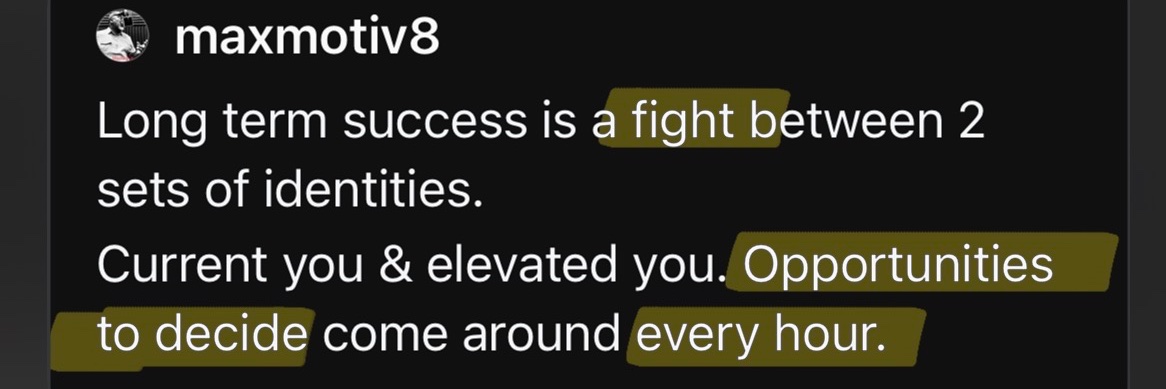
Your identity is rented, not owned.
Nothing is permanent in this world. You don’t deserve it today because you had it yesterday. You have to do the thing. Chop wood, carry water. Show up and do the work. Rent is due every single day.
I can’t call myself a writer if I don’t write. I can’t call myself a leader if I don’t lead. I can’t call myself a builder if I don’t build.
Author Derek Sivers has a great line:
“Keep earning your title, or it expires…Holding on to an old title gives you satisfaction without action. But success comes from doing, not declaring.”
Who you were yesterday is not guaranteed. You have to earn it.
Without enemies around us, we grow lazy.
An enemy at our heels sharpens our wits, keeping us focused and alert.
It is sometimes better, then, to use enemies as enemies rather than transforming them into friends or allies.
Treasury Bills vs. Equity Portfolio Allocation under the Current Monetary Environment
This review is a response to a subscriber’s enquiry. It evaluates competing investment strategies against Nigeria's complex monetary policy landscape. While Treasury Bills offer attractive nominal rates (21% gross, 19% net), the Central Bank's decision to maintain elevated rates despite falling inflation reveals underlying stability concerns that warrant defensive positioning.
The analyst recommends locking in 21% TB rates now and deferring equity allocation until monetary policy clarity emerges (earliest Q2 2025). Find below the rationale for this position.
The Question We Sought To Answer
The fundamental investment question that was raised to our Chief Economist was:
“Whether to pursue a 70% equity / 25% Treasury Bill / 5% cash allocation or adopt a more defensive posture given current Nigerian monetary dynamics.”
The core issue centers on a critical policy contradiction, i.e. why the Monetary Policy Committee (MCP) maintains elevated rates (MPR at restrictive levels) despite headline inflation showing moderation toward single digits.
This dissonance between observable inflation trends and central bank behaviour reveals information asymmetry that investors ignore at their peril.
CBN’s reluctance to cut rates signals either scepticism about inflation data durability (see Proshare and Rencap’s recent report on Data Integrity) or prioritisation of other policy objectives, most notably protecting $25 billion in record portfolio investment inflows that depend on maintaining attractive interest rate differentials.
Analyst View on Why CBN Isn’t Cutting Rates
1. The Portfolio Investment Stability Imperative
From a risk assessment lens, the CBN is protecting $25 billion in portfolio flows. This represents the largest foreign investment position in Nigerian financial assets in recent history. The dynamics are critical, as portfolio investors entered Nigerian assets (primarily fixed income) attracted by the carry trade: borrowing in low-rate currencies (USD at ~5%, EUR at ~4%) and investing in naira assets yielding 20%+. This arbitrage depends entirely on exchange rate stability and interest rate maintenance.
If the MPC cuts rates aggressively (say, 400-600 basis points to align with moderating inflation), it triggers two immediate consequences:
1.Narrowing carry spread makes Nigerian assets less attractive relative to other emerging markets (Kenya at 12.75%, Egypt at 27.25%, South Africa at 7.75%), and
2.Signals potential policy instability, prompting defensive exits by portfolio managers operating on quarterly performance cycles.
We posit that the CBN cannot risk a sudden $25 billion outflow. At current reserves levels (~$40 billion), this would create catastrophic exchange rate pressure and potentially undo two years of stabilisation efforts.
2. The Inflation Scepticism Question
Again, from a risk management lens, the right question to ask is: does the MPC trust the inflation numbers?
Nigeria's inflation calculation methodology has faced credibility challenges, some of which we captured in our recent January 2026 commentaries – Nigeria’s Inflation Rate in December 2025: Technical Options and Matters Arising, Nigeria’s Inflation Eases to 15.15% in December 2025 Based on Revised Calculation, and Setting the Record Straight: Resolving @NBS_Nigeria’s #CPI Base Rate Question in Nigeria's December 2025 Inflation.
The MPC likely recognises that recent headline inflation moderation may reflect transitory factors (base effects, harvest season impacts, temporary naira stability) rather than durable disinflationary trends. Cutting rates prematurely based on potentially misleading signals could reignite inflation expectations, a mistake the @cenbank cannot afford after the credibility damage from previous policy inconsistency.
3. Election Liquidity Concerns
The anticipated ₦1.2 trillion election spending represents 10% of M3. While most risk management models correctly note this is already 'captured' in current money supply figures, the concern isn't the stock, it's the velocity.
Election cycles systematically increase money velocity as dormant deposits (including the 40% in FX accounts) get mobilised. This creates temporary demand-pull pressure and exchange rate volatility. The CBN's rate maintenance is a pre-emptive sterilisation strategy: high TB rates provide an absorption mechanism for this activated liquidity, preventing it from immediately translating into inflation or FX pressure.
Why Lock in 21% TB Rates Now
The case for maximising TB allocation is compelling. The recommended strategy strongly favours locking in current 21% Treasury Bill rates (19% net) rather than pursuing equity concentration at this juncture. An 85% TB / 10% gold / 5% cash allocation provides exceptional absolute returns by global standards while eliminating market timing risk and equity volatility exposure.
If inflation moderates to single digits as projected, real returns will reach 10-11%; extraordinary for risk-free instruments. Even under less optimistic scenarios where inflation stabilises at 12-13%, investors capture 6-7% real returns with zero principal risk.
READ MORE>>>>> https://t.co/IAAWA7apnU via @proshare
A relevant section from Atomic Habits for anyone building a new habit this year:
People often think it's weird to get hyped about reading one page or meditating for one minute or making one sales call. But the point is not to do one thing. The point is to master the habit of showing up. The truth is, a habit must be established before it can be improved. If you can't learn the basic skill of showing up, then you have little hope of mastering the finer details. Instead of trying to engineer a perfect habit from the start, do the easy thing on a more consistent basis. You have to standardize before you can optimize.
The One Month Life Reset: Go dark for one month. Turn off all notifications. Don’t explain yourself to anyone. Wake up early. Walk. Lift weights. Eat simple foods. Work. Think. Write. Read. Embrace cognitive friction and struggle. You’ll unlock 10 years of progress in one month.
@hubermanlab speaking his truth around his belief and experience of a higher power and how it empowers him to live a happier life.
This isn’t new. But the connection to science feels fresh. Should we research this?