@dieworkwear Those Aldens are beautiful. I‘m trying to figure out whether it’s worth it to take a gamble ordering these online (from Europe) or go to a store and get a normal Alden Indy or split toe. Tough to figure out how different the EG garments are from the photos.
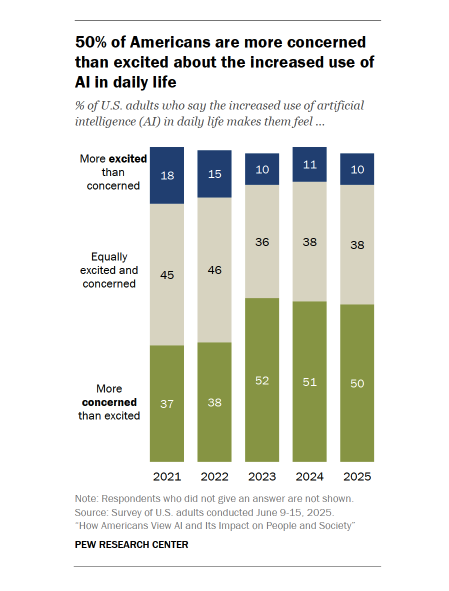
AI is very weird for me because normally I'd be the guy who'd argue that it's crazy we're not more excited about this miracle technology, but I completely get this sentiment.
AI companies have clearly botched telling the story. That's a big piece of this. Telling people, "We built this thing that is definitely going to take your job and hopefully we can figure out how to give you handouts or something on the other side, or come up with even better jobs or whatever, say thank you" is clearly terrible messaging.
Part of the issue is that what you need to say to raise tens of billions of dollars is very different from what you need to say to get the public excited. "This is definitely a better Google, it does some other cool stuff, too, and we think it's going to really help make you and your loved ones healthier" doesn't fund data centers.
Then there's the gap between hype and the average person's experience with AI. Models are getting more useful for a small number of people - if you're a coder or a mathematician or someone who wants to make software but never learned to code, the last few model upgrades have felt really big. That's like ~5% of people, maybe? 2%?
If you just want it to answer your questions or do your homework, it's gotten a little bit better, but it's also gotten better for everyone else, so it's not like you have a magic A+ machine all to yourself.
Meanwhile, that very small group for whom it's more useful (or who at least say it's more useful because they don't want to be the one who admits it's not) is flooding the zone telling people, "If you don't use these tools as much as / as well as I do, you are completely screwed. You're going to lose your job to me and my army of bots. You (and your kids) are going to be part of the permanent underclass." If you dare question how incredible it is, you are told that you just don't get it, either because you're not smart enough, are too low agency, or don't pay for the latest paid models, which are the really good ones and don't even bother with the free stuff, you dumb poor.
And you hear stories like the guy making an mRNA vaccine to fight his dog's cancer, which is awesome, and you're told that everyone will be able to have personalized medicine like that in the future, which sounds great. But like, are you, who can't even make a website with Claude Code, going to start using AlphaFold to whip up your own peptides? Are those dickbags telling you that they're going to be so much richer than you also going to live so much longer than you?? Plus, you hear creepy stories about AI encouraging people to kill themselves, and you know those people were probably unstable anyway and that AI is just a tool and it'll tell you whatever you want, but is it worth the risk?
Pretending to be afraid of it might be the best way to stop it from taking your job, which, remember, all of the leaders at the big labs are promising it will do, unless you want to go be a plumber or something, work with your hands (they will not, of course, but you, you should probably seriously consider getting your hands dirty).
Or maybe you're not pretending about being afraid, you actually are, which would be totally justified because the leaders of the big labs have told you to be afraid, that they're afraid, that these things are like nuclear weapons in the wrong hands and that there's a 10%? 25%? higher? chance that they'll kill us all, but it's worth the risk, because this is how society progresses. There's no turning back.
"We have achieved Recursive Self-Improvement!" they squawk. "This is the big one! Humans are really and truly useless meatbags now! Ha ha!"
And you're so confused, because most of the AI you actually encounter is slop. Poorly written social media posts, fake images, etc. Some of it is very funny, but if this is the stuff that's definitely going to take your job and then probably kill you, you don't quite see how? Are you that replaceable?
Would you be more excited than concerned? Or would you be more concerned than excited?
Personally, I'm excited, because I think LLMs are overhyped.
We'll spend bajillions of dollars on inference in a Red Queen's Race, the slop will runneth over, some people will certainly lose their jobs, but a lot of things will genuinely improve, and a lot of people will end up being able to do more at their job than they can now.
Plus, the non-chatbots, the models that power embodied AI and help crack biology, are showing early signs that they're going to be magical. In the past week or so, Travis Kalanick, Bob McGrew, and RJ Scaringe all said they're going to be building AI-powered factories. Yann LeCun raised $1 billion for world models to accelerate AI's impact on the physical world.
Robots can play tennis now. We'll all have personal tennis coaches or coaches who teach us anything we want when we're around, and spend the rest of their days making our beds, doing our laundry, cooking healthy, delicious meals.
The near future is going to be insanely cool, and different in all sorts of ways, some of which we can predict, and some of which we can't.
But my god you weirdos need to stop shilling your dystopian fantasies to the people if you ever want them to feel more excited than concerned.
The hyperscalers collectively agreeing to bring their capex numbers down 30% together simultaneously to preserve their way of life
No more turf wars. No more endless suffering
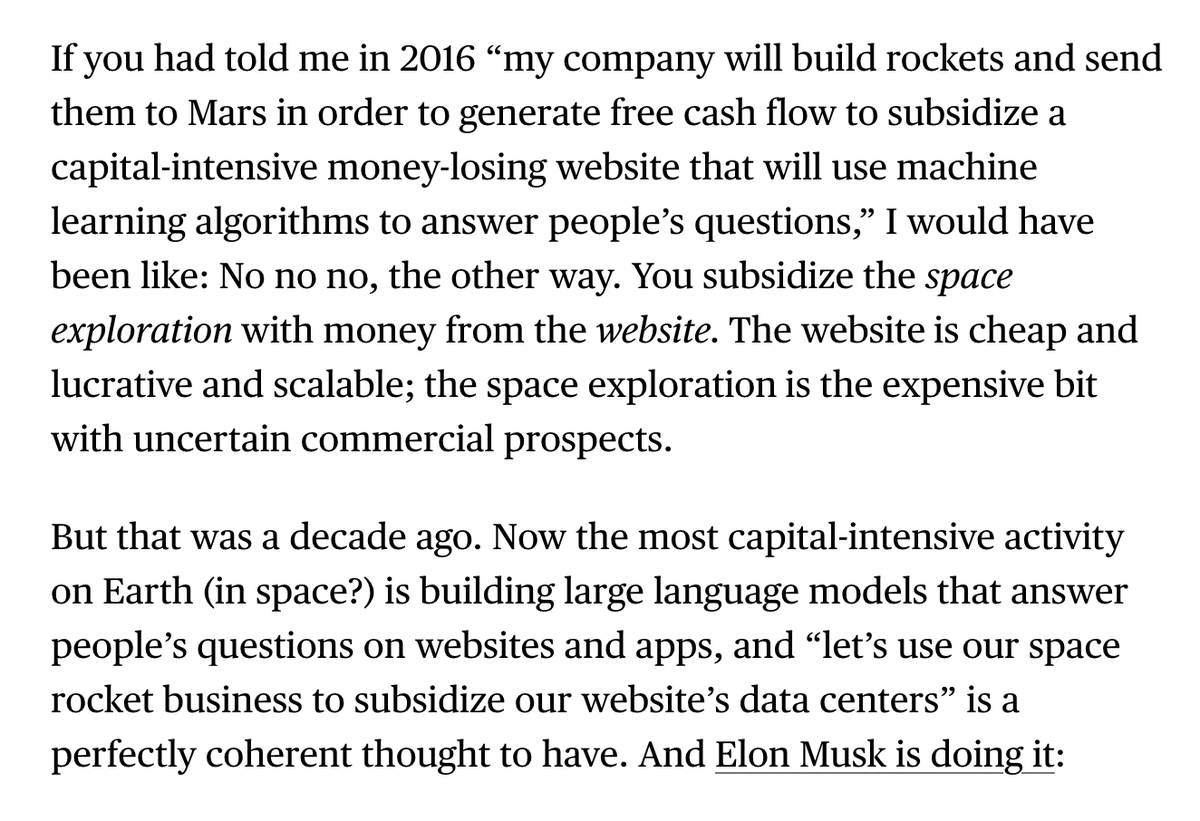
This thought from Matt Levine is funny: Elon famously used Paypal winnings to fund his hardware firms. Software is supposed to be capital light, and hardware capital-intensive.
Now it's come full circle, this deal is the reverse: Profitable rockets to fund cash-burning websites
Anthropic just took a big swipe at OpenAI's decision to put ads in ChatGPT. Anthropic is airing ads mocking ChatGPT ads during the Super Bowl, and they're hilarious 😅 Anthropic is also committing to no ads in Claude https://t.co/LR1v4xz9ds
This is what I worry Europe will get negatively polarized into: an ideology taking pride in a neat, sanitized online environment free of evil corporate and fascist pathogens.
I hope European govs do not go this way, and instead take a Pirate Party approach of user empowerment.
First, what's wrong with the tweet I'm quoting:
The idea that there should be "no space" for something you dislike is fundamentally a totalitarian and anti-pluralistic impulse. It's incompatible with being in an environment that you do not fully control.
This is especially true for categories that are subjective and controversial, because you end up trying to fully remove things you think are pathogens, when other people have good faith disagreements, and because you give yourself the maximalist goal of not even giving them breathing room, you create conflict and end up building the machinery of technocratic authoritarianism to impose your victory in the conflict.
So sorry, if you want to be a free society, you have to bite the bullet that some people, somewhere, will be selling things that you consider dangerous and saying things you consider disinformation and vicious lies.
What is the goal to shoot for?
You want to create an environment where those things don't dominate. This is the problem with twitter today: not that it's a safe space where 1000 people talk to each other in a corner about how heritage americans are the master race and putin is good or whatever, but that that crap gets shoved in our face on a mass scale, and the algorithms actively favor it.
The right metaphor is not castles and walls, but biological - think, why European forests don't have tropical lizards.
Having incentives for social media platforms to have less of those things instead of more is fundamentally reasonable, @audreyt has talked about how Taiwan has done something similar.
You also want to do this in a way where it's clear what the underlying principle is, so it's not a vehicle for imposing arbitrary and frequently changing expert-consensus agendas.
You also want to empower users, rather than working against them. People want to see and buy good things instead of bad things. Often the problem is that competition is too difficult in the current market. I actually supported the USB-C standardization mandate; it created more interoperability and thus improved competition and convenience. I would support incentivizing social platforms to be more open, and to be more transparent (eg. my proposal to require algorithms to be continuously published with a 1-2 year delay, with zk-proofs to ensure that the algorithm being used in real time exactly equals the one that gets published later)
Being able to better identify what messages are coming from what communities is also good, though I don't support the direction of banning anonymity of individual posters, rather I would want to see more macro-scale analytics, eg. seeing what communities are most strongly saying and amplifying content that semantically matches a particular idea; this can be done in privacy-preserving ways.
There is a real opportunity to reaffirm freedom of speech in a unique and different way, that emphasizes pluralism and pushes against unbalanced attempts to manipulate the discourse by individual powerful actors. We want to do this, not go down the dark path of having something that claims to support fundamental rights but actually is not trusted by anyone to be anything other than the fundamental right to follow the footsteps of a few technocratic experts.
In may ways banning phones at schools seems like a more practical solution for kids than social media age restrictions.
Easier to enforce, less problems with definitions and creates a shared downtime which should help practice constraint the rest of the day.
Ah! You see, the story is almost too perfect. The man encounters her in the museum, in front of Rothko. And what is Rothko? A black void, a red abyss, the silent scream of modernity. It is a demand for stillness, for confrontation with nothingness. And what does he do? Instead of confronting the void, he runs from it. He fills the silence with himself. He goes home, finds her blog, and writes: “we share interests, I read your post, I disagree.” Already, the act is obscene. The Rothko asks for silence, and he answers with a DM.
This is the Hegelian trick. On the surface, he performs philosophy. He frames his words as serious critique. But in truth, it is abstract negation. It is like Coke Zero, you know. Disagreement without the sugar of real engagement. He does not move the thought forward, he re-presents her own words back to her, only stamped with his authority: “I disagree.”
Now comes the reversal. She screenshots it. She posts it with the caption, “I am begging the men of the world to be normal.” Here, the dialectic achieves its completion. His attempt at recognition collapses into objecthood. He wanted to be interlocutor, he becomes exhibit. His seriousness is aufgehoben into comedy. He thought he was engaging in philosophy, but he is transformed into what Lacan would call the objet petit DM, the tiny kernel of humiliation now circulating in the meme economy.
And this is the paradox. The message was never private. Every DM already carries within it the possibility of its public unveiling. The truth of the DM is not in what it says, but in what it becomes. By posting it, she does not betray the interaction. She reveals it.
The Rothko was the warning. The void demanded contemplation. He could not endure it. He rushed to fill it with pseudo-philosophy. And so his words fell into the same abyss, only to return as content.
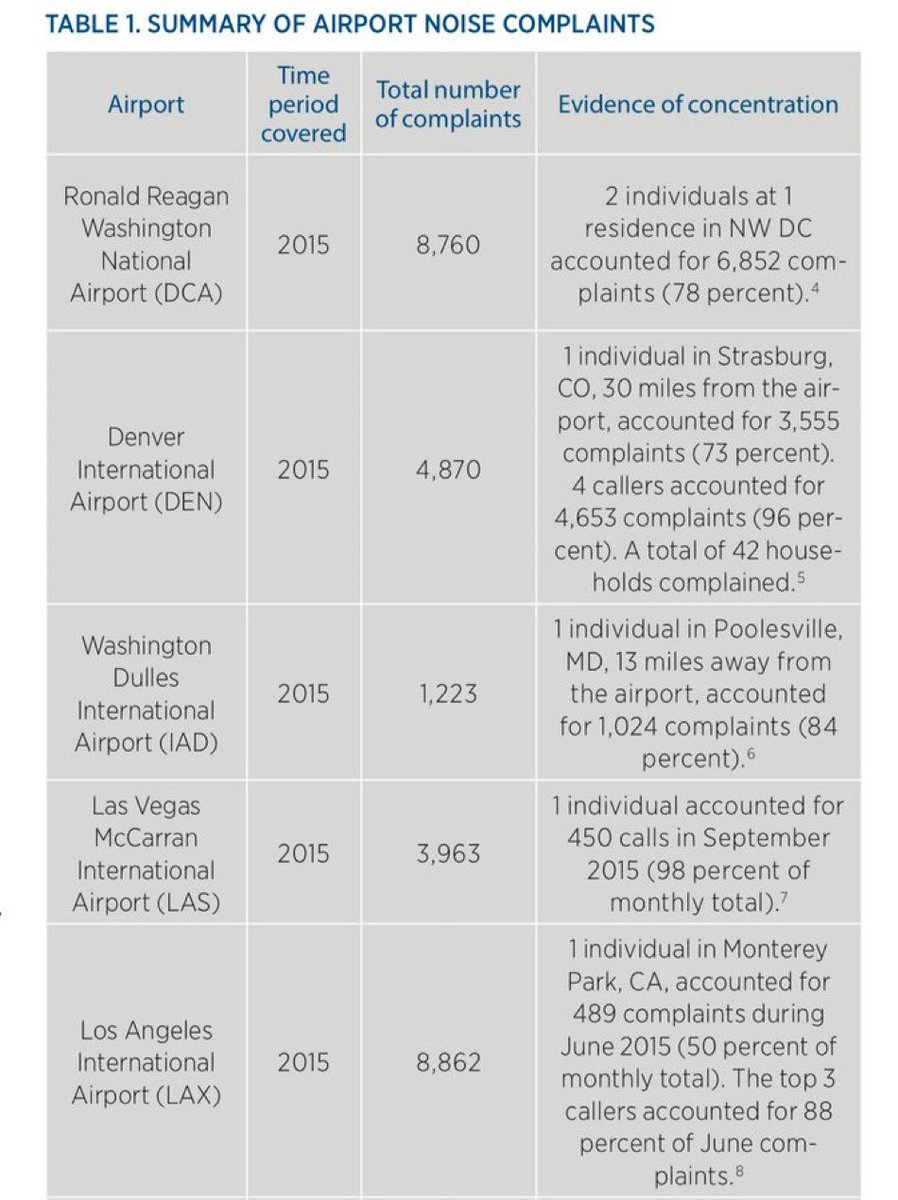
This reminded me of another insane stat:
78% of noise complaints lodged against Ronald Reagan Washington National Airport were made by a single household.
Some amazing statistics in the NYTimes
1 China installed more robots each year from 2021 through 2023 than the rest of the world combined, and 7 times as many as the US
2 China has 700,000 clean energy patents, more than half of the world's total
3 More wind turbines and solar panels were installed in China last year than in the rest of the world combined
4 In 2008 the US produced half of the world’s polysilicon. Today, China produces 90%
5 The 10 largest solar facilities in the world are in China
6 BYD is building 2 EV factories that will each produce twice as many cars as the largest car factory in the world
7 China exports 21 times as many batteries as the US
8 China exports 580 times as many solar panels and modules as the US
9 China exports 3 times as many EVs as the US
10 China’s biggest automaker, its biggest battery maker and its biggest electronics company have each introduced systems that can recharge electric cars in just 5 minutes
https://t.co/eQUsZMsTcy
*Slavoj Zizek sniffs loudly touching his nose* Ah yes yes the corporate pastoral. This is a perfect ideological object. You see, you see here Sam, he pretends to give us a modest, one could say intimate conversation between two friends. No. This is a mythopoetic act of ideological laundering. *Sniff*
This is not, you see, this is not a product announcement. No. Sam is giving us a myth, you see. *Sniff* This film, if one can call such a thing a film, is a strategic myth making artefact to construct an origin story. This is a biopic about themselves played by themselves, you see. Masturbation. *Sniff* The hubris is astounding. *Sniff*
This opens, what do we see, what do we see first? *Sniff* We see the power shot, the money shot yes? Looking up from the ground up into the towering city. We are small. Silicon Valley is big. Money you see, technology, forbidden sex, and so on. San Francisco to be precise. Yes? *Sniff*
Then what? Soft lighting, yes, soft focus, flowers in the city and so on. Two friends. No. *Sniff*
These are not two friends. These are the ideologues of techno capital, you see. *Sniff*. The priests preparing you for the sacrament of their new device. *Sniff*
They smile, you see, "We know we are building godlike machines, but we are such nice people!" *Sniff* Yes very good Sam. And thank you. They shake our hands and smile, while the machine, you see, the machine takes our jobs and our soul, or what have you. *Sniff*
Yes? But the cafe, what a nice cafe I must say. The cafe invites us in. Not just two friends together, you see. We are, as the viewer, we are also their third friend. *Sniff* Perhaps lover, or some such. We will see how the night goes, you know? *Sniff*
But Sam, yes, he does not care about money. Power? No. *Sniff* This boy king, the caring sovereign, he worries about us. The little people you see. *Sniff*
The master holds the weight, the original sin, so we may enjoy without guilt. *Sniff* Sam is our Jesus, so we can ask the computer our little questions and not worry. Not to worry about the labor, or the exploitation, or the environmental costs and so on. *Sniff*
So you see, this is, you see this is to build a moral legitimacy around leadership figures at at a time when, you know *Sniff* AI is taking our jobs, and "How will I feed my family" and "Oh no we are all going to die" and so on. *Sniff*
Notice. Notice they do not talk about technology you see. Values. *Sniff* This is the hand of ideology that distracts you while the other, the other hand you see, it takes from you.
But thank you for the coffee Jony, and yes the iPhone. *Sniff* Jony is the great thinker Yes? And Jony gives us emotional connection, yes? And the family man stands hand in hand with Sam, as deliberate contrast to the tech overlord he pretends not to be, you see. *Sniff*
The European family man with the children and, you know, the forbidden sexual desires of San Francisco and what have you. *Sniff*
We have our origin story, the myth you see, chance encounters in the cafe. *Sniff* "It is funny running into you here Jony!" Yes it must be nice what are the odds of such an encounter. *Sniff*
And what? Personal anecdotes they give us, yes, some shared vision to reinforce authenticity in a film which, let us be honest for a moment, this could very well be in the post credits scene of a marvel movie or, you know *Sniff* some such profane act of capitalist entertainment, a mickey mouse adventure or what have you. *Sniff*
And for what? For what is all of this labor and AI and devices and so on *Sniff* So we can find ourselves in a moment, lost, "Oh no" we say, "Oh no I wonder. I have a question to which there is no answer, I cannot think for myself?" *Sniff*
No. Let us go to the phone yet again. We must ask the device. But no. You see. *Sniff* My phone is in my pocket. We need a new device you see. Yes? *Sniff*
A device which, a device which always listens, you see. *Sniff* An all knowing god who can answer my questions, and tell me what to think, and what should I say, *Sniff* what should I do, and I am afraid and oh no who am I and I am sad and who should I fuck and so on. Yes? *Sniff*
So you see *Sniff* This film is not a documentary yes? *Sniff* What we see here is christ carrying the cross alone through the streets. *Sniff* But not a cross you see. Jony. Jony gives us the iPhone and Sam puts AI inside the device. *Sniff* And now? Now we don't need to think *Sniff* We can just have the AI and the AI, you see, *Sniff* It's wonderful.