PhD Student at EPFL's CREATE-Lab - Researching novel mobile robots with applications in extreme environments like (agricultural) slopes, forests or glaciers.
Thank you, @mashable. That's a terrific article/video about our robot.
Inspired by nature, this robot morphs to overcome almost any obstacle https://t.co/KGy4xPw9wh
In a new Science #Robotics Focus article, @nana_obayashi and colleagues propose a research model that would blend long-term “slow science” and short-term “fast science” to promote progress in soft robotics. https://t.co/5egVfw8nqK
We are glad to share our work on the GOAT robot in @SciRobotics. By harnessing "environmental computation," GOAT adapts its shape to let the terrain help guide its navigation—an approach that allows it to work with nature rather than against it. #Robot#Robotics@OpenRoboticsOrg
Scientists have designed a flexible, #bioinspired#robot that can switch between a flat rover form and a sphere to travel through rocky, mountainous, and urban terrains autonomously. @EPFL_CREATE@maxpolzin12019
Learn more in Science #Robotics: https://t.co/8849X1UiHx
Congratulations to the team @EPFL_CREATE on their shape-shifting #robot and the publication in @SciRobotics!
The project received support from @SwissPolar Technogrants.
👉https://t.co/K9BLtP9lzz
👉https://t.co/hlZKJRW3o5
Scientists have designed a flexible, #bioinspired#robot that can switch between a flat rover form and a sphere to travel through rocky, mountainous, and urban terrains autonomously. @EPFL_CREATE@maxpolzin12019
Learn more in Science #Robotics: https://t.co/8849X1UiHx
📔#Fieldnote#PolarAccessFund
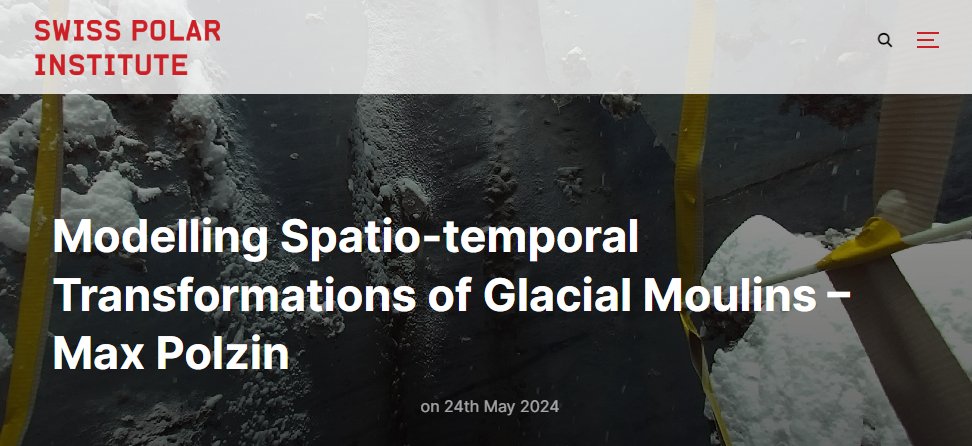
"Moulins can form complex geometries and are an important element for predicting the evolution of our glaciers."
@maxpolzin12019@EPFL_CREATE tests robotic systems for safer #data collection & modelling of #glaciers.
👉https://t.co/B6SjmLSrGF
The Apple Vision Pro enables excellent head/hand tracking!
Here is a #ROS2 wrapper to display tf2 transforms: https://t.co/NHWx9buEgV
All thanks to the awesome streamer app by @younghyo_park, which works seamlessly out the box😁
Our article "Into the Ice: Exploration and Data-Capturing in Glacial Moulins by a Tethered Robot" has been accepted for publication in the Journal of Field Robotics.
This was made possible with support of @SwissPolar.
Good news: just in time before this year's field campaign.
Want to use efficient shared memory transport between #docker containers and #ROS 2 nodes running on the same machine?
Here is our template repository how to build #ROS2 images and run them with --net=host and correct uid/pid: https://t.co/auu40f6xbL
@OpenRoboticsOrg@rosorg
Here is your #ROS news for this week:
🇮🇳 ROSCon India announced!
🇮🇳 ROSCon talks published
🇮🇳 Long range comms tutorial
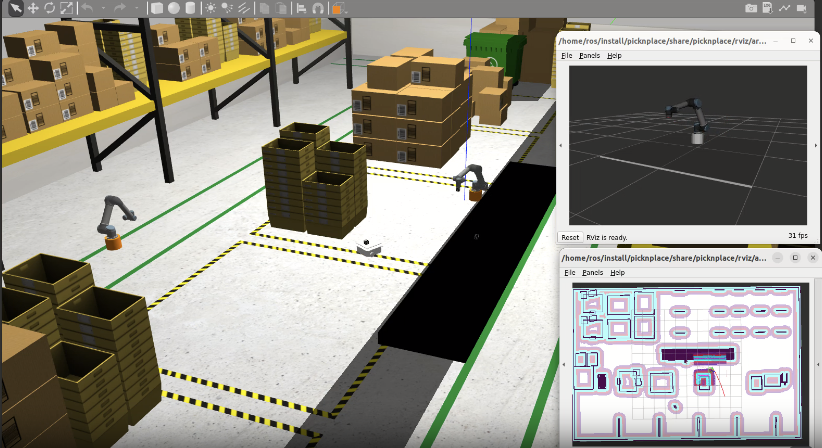
🇮🇳 An amazing pick-and-place demo
🇮🇳 Name the @GazeboSim I release
🇮🇳 NYT on construction robots
🇮🇳 Atlantic on ♻️ robots
🇮🇳 More!
https://t.co/SLTObgcEG0
@Fmrico I do.
Currently, we are using Nav2 on our Robocup@Home robot in an indoor environment.
However, for my research, I want to deploy it in more complex outdoor scenarios.
Cool, that you are working on this. I'd be keen to hear more about your plans.
@Fmrico Hi Francisco and thanks.
Great pipeline, I'll try using it with a digital elevation model from Lausanne.
How are you currently assigning cost to elevation and slope?
Is there a possibility to assign asymmetric cost, e.g., going down a slope is simpler than up.
Documentation with instructions to replicate the setup to enable "Long-range #ROS2 data transmission using SiK Telemetry Radios" is on #ROS Discourse, https://t.co/OMMiIBSOyl
@PX4Autopilot@OpenRoboticsOrg@rosorg
How do you communicate with your #ROS 2 powered field #Robots in extreme outdoor environments with no cellular coverage?
Checkout our latest video on "Long-range ROS 2 data transmission via SiK Telemetry Radios" https://t.co/S81FLAH2Eq
@rosorg@OpenRoboticsOrg