Leeds is probably the most unlucky city in Western Europe
🎭 European City of Culture funding? Sorry we're leaving the EU.
🚄HS2? Sorry we spent too much in the chilterns.
🛫New Airport terminal? Sorry that's not climate friendly, but London Airport expansions are fine.
(1/X)
@thomasforth It's an increasingly popular sentiment on US-centric podcasts I listen too as well. I don't have the data, but more and more conversations about university not being worth it. Bigger debt issues there too, but also different cultural dynamics. Possibly a global phenomenon.
Blair, Burnham, Streeting and Starmer all wrote essays this week. Here’s a summary of what they said for those who can’t be bothered to spend an hour reading about Labour’s favourite pastime: fighting about what it means to be Labour.
Blair's thesis is that Labour lost its nerve after 2007 and needs to rediscover the radical centre. Markets work, the private sector is your friend, competent technocratic government is still the answer, and the biggest transformative force on the horizon is AI, which he sees as a positive revolution that a serious centre-left government should embrace. Miss that wave and you miss everything. TLDR; the model isn't broken. Labour just needs to run it properly and stop indulging the perennial delusion that losing votes to the right means the country secretly wants you to go left.
Burnham, Streeting and Starmer think this misses the point. And they broadly agree on the diagnosis but disagree on the cure.
All three locate the origin of Britain's political unravelling in 2008, not 2007. The financial crisis broke the implicit bargain of modern capitalism: work hard, things get better. When that bargain collapsed and the banks got bailed out while wages stagnated for a decade, people got poorer – but also angry in a deeper, harder-to-satisfy way. And then austerity poured petrol on everything.
The more philosophically interesting disagreement is about what the crisis was actually a crisis of. Blair frames it as a delivery failure: the wrong policies and the wrong positioning. Starmer and Burnham both reach for ‘dignity’. The idea that whole communities (post-industrial, working class, people who didn't go to university) were made to feel invisible. That implies a fundamentally different kind of politics.
Burnham argues that New Labour never actually took Britain off the Thatcherite track. He blames deregulation, privatisation, leaving things to the market for the cost of living crisis. The centre failed people. You can't win them back by reasserting it more confidently. On AI, Burnham calls for tougher regulation of big tech and signals that an active, interventionist state would govern how AI develops rather than leaving it to the market. For Burnham, ungoverned AI is just the latest mechanism by which powerful interests extract value from everyone else.
Streeting is more moderate but lands in similar territory. Inequality is the organising fact of contemporary politics, and treating it as secondary is what produced the crisis in the first place. When the rules stop rewarding effort fairly, resentment grows.
Starmer agrees Britain should be an AI superpower, but where Blair frames AI as an opportunity to be seized, Starmer frames it as a force to be governed. The question isn't just whether AI grows the economy but whether Britain is a rule-maker or a rule-taker, and whether the gains flow to Blyth and Castleford or just to London.
The deepest difference, underneath all of this, is a question about whether the post-war and post-Thatcher economic settlement is fixable or finished. Blair thinks it needs better management and AI is the tool that makes better management possible. The others think the settlement itself was the problem, and are open to the possibility that AI (if ungoverned) compounds it by concentrating power further.
🇬🇧 There are 79 vape shops on the Home Office’s public register of licensed visa sponsors.
‘Guardian Vapes Ltd’ in South Shields is licensed to sponsor overseas workers via the ‘Skilled Worker Visa’ route. 🧵1/3
Illan Meslier having a moment on his own on the Elland Road pitch before departing on a free transfer this summer.
A sad way for his time at the club to come to an end.
#LUFC | #BBCFootball | @BBCWYS
What is the point of putting a “security guard” (and 3 inspectors) on the gates at Tottenham Hale station if they still don’t even confront the gate jumpers?
Chelsfield is surrounded by 'designated open space' per the GLA, basically a park which can't be built on. Not much more land within a reasonable distance of the station.
Knockholt also the same, but more high contributing greenbelt and ancient woodland. There is an app for 660 homes on an old golf course, but the one for 800 on the same land was rejected.
https://t.co/XAivywG3Lf
@PattyGr29702276@StatisticUrban This one is covered in highly contributing green belt, but it is getting reviewed as most sites around this station have now been allocated for housing. Thousands of new dwellings. So shouldn't be like this too much longer.
https://t.co/0tSzW0ci2N
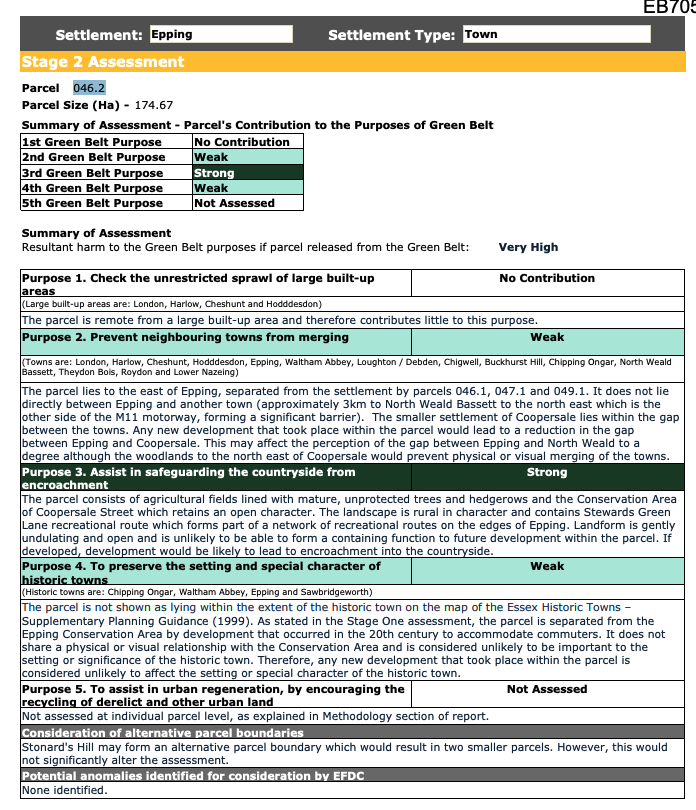
@StatisticUrban According to the councils greenbelt review those fields are highly important in protecting the countryside and rural character from encroachment. Basically impossible to build on them until it gets reclassified or the rules change.
https://t.co/nmY53NqMit
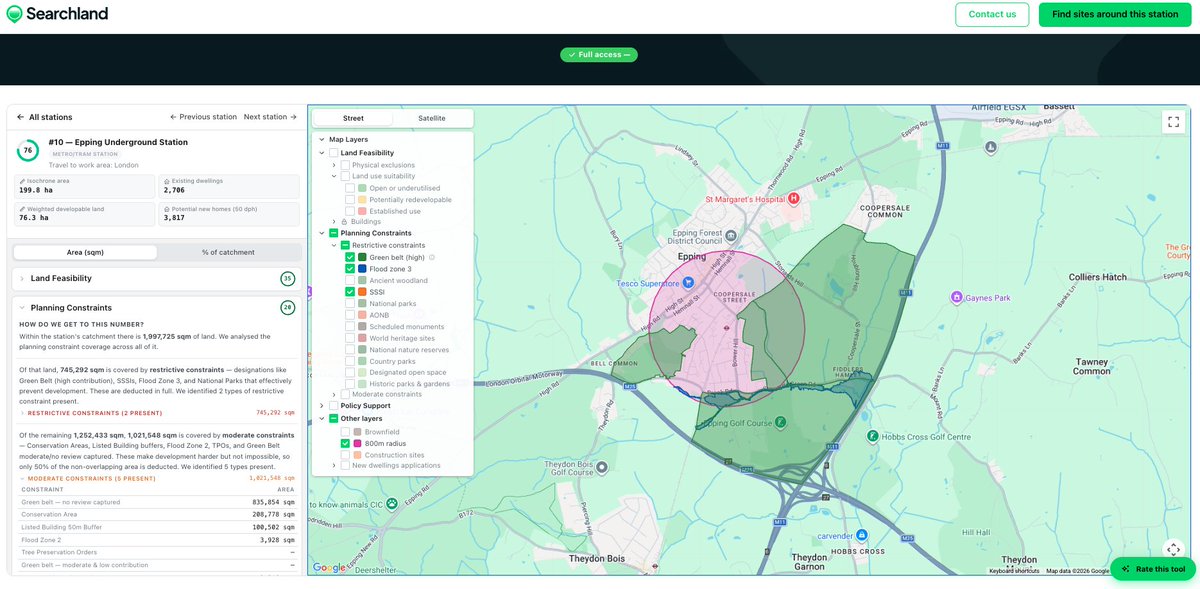
@GjMcGowan@jbarro It's all strongly protected green belt so no application would survive as the current laws stand. We rank it 13th nationally in stations with potential for residential development.
Leaderboard of all stations here: https://t.co/0tSzW0ci2N
@GjMcGowan@jbarro It's all strongly protected green belt so no application would survive as the current laws stand. We rank it 13th nationally in stations with potential for residential development.
Leaderboard of all stations here: https://t.co/0tSzW0ci2N
@jbarro It's classified as highly contributing greenbelt which is why it isn't getting built on at the moment, no planning application would survive.
You can explore more train stations in a leaderboard format here
https://t.co/0tSzW0ci2N