The per minute price keeps dropping, which is great for sales and service calls. What still takes real work is handling interruptions, knowing when to hand the call to a person, and getting the outcome written back into the CRM. Someone also still has to review the calls every week so thats worth counting when comparing it to minimum wage
10x ARR in the first year is a big number for this category. My guess is the teams getting real value from tools like this already had a clear ICP and clean CRM data, because the agent cant fix data you dont have. Would be interesting to see what retention looks like a year from now
This is a bigger deal for contractors than it looks. If the booking happens inside Google and lands in Jobber, the shop never sees a website visit, so some owners are going to think their marketing dropped off when the leads just came in a different door. Tagging those bookings with a source in the CRM seems like the first thing to set up and most shops dont do that today
@gb3speaks@TimFlynnLeary That makes sense to me. Every number you track costs someone time to collect and explain, and if nobody changes a decision based on it its just overhead. I'm curious which ones you dropped, since roofing companies usually track a lot around leads and close rates
I agree with this. One big sales agent that does everything tends to do each piece poorly, and nobody can tell which part broke. Splitting it into small jobs with a clear input and output, like research one account or draft one follow up, makes it much easier to check the work and fix what isnt working
The part I like is that hes still hiring salespeople. Using the agent to work trial users quickly while people take the conversations that need judgment seems like the right split for most teams. I'd want to know how they measured the jump though, since four weeks is short and trial conversion moves around with pricing and seasonality
For home service companies this is getting more important now that AI Mode can book jobs through Jobber and Housecall Pro directly. The basics probably still matter most, like consistent business info everywhere, real reviews that mention the actual service and the town, and pages that clearly say what you do. Curious how many of those searches turned into actual calls since thats what owners care about
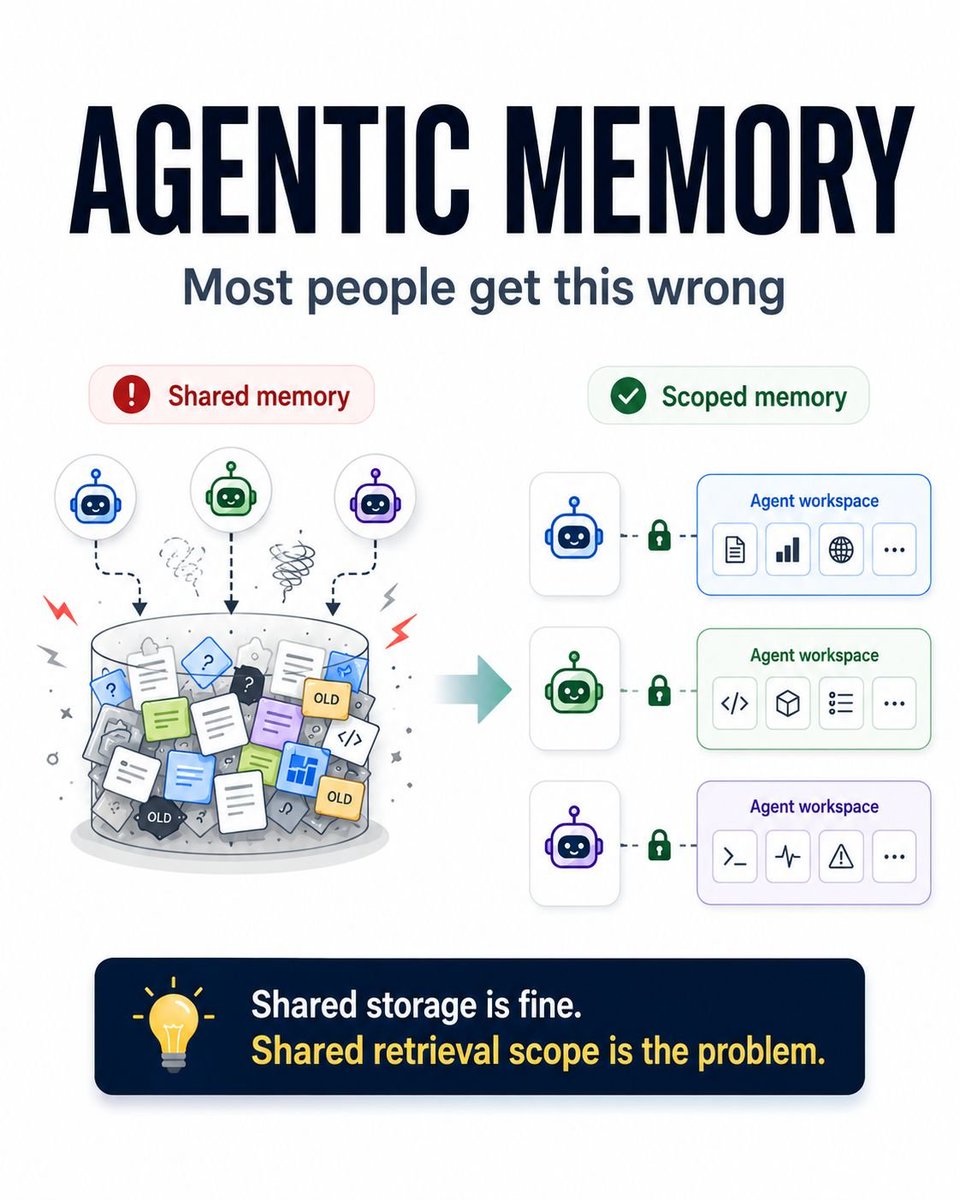
Most people get this wrong about agentic memory.
One shared memory pool that every agent reads from sounds efficient.
In practice, unscoped shared memory can quickly degrade a multi-agent system.
You get bloat, stale context, and agents retrieving information that has little to do with the task in front of them.
Once every agent searches the same undifferentiated history, retrieval precision drops, and the symptom can look like the model itself is getting worse.
A better approach is to scope memory by role.
Each agent can have its own:
→ Workspace
→ System prompt
→ Tools
→ Memory scope
A research agent should primarily retrieve research context.
A deployment agent should primarily retrieve deployment context.
Some information may still be shared across agents, like project goals, user preferences, or common state.
The important distinction is this:
Shared storage is fine.
Shared retrieval scope is the problem.
You can keep everything in the same underlying database while separating it by agent, customer, project, task, namespace, or metadata.
On the storage side, there are several approaches, and they aren't mutually exclusive.
1. Files and structured folders
Simple, transparent, provider-agnostic, and easy to inspect manually.
2. Semantic search
Useful when the agent needs to retrieve information based on meaning rather than exact wording.
3. Vector-backed conversational memory
Useful for automatically recalling relevant pieces of previous conversations or unstructured knowledge.
4. Relational storage like SQL
Underrated for information with a clear schema.
Vector search is great for fuzzy retrieval.
It's the wrong primary tool when you need deterministic structured queries.
That's naturally a database query.
If you're repeatedly asking questions based on fields, filters, relationships, or exact conditions, the information probably belongs in structured storage rather than a pile of markdown files.
The best systems often use two or three of these approaches together.
Each handles a different type of information.
And one rule I think matters even more:
A well-designed sub-agent shouldn't need memory to understand what its job is.
Its role, instructions, constraints, and available tools should already define that.
Memory is for context that changes.
Not for figuring out what the agent is supposed to do.
Google just released the Gemini Decisions API, and it works differently from every other Gemini model. It doesn't write any text. It only answers questions.
Here is what it does:
1.) You send it an input (text, images, audio, video, or a PDF) along with a list of questions about it.
2.) Each question is one of three types: yes/no, pick one option from a list, or score the input against a rubric.
3.) Every answer comes back with a probability and a confidence score, so your code can act on it automatically or send it to a person.
4.) You can ask up to 1,000 questions in a single request, and they all run at once, so asking more barely slows it down.
5.) It costs $0.10 per million input tokens, and output is free because it never generates text.
It runs on a new model called Gemini Decision 1, and you can try it for free in Google AI Studio.
@omarsar0@pluraiAI Testing in a copy of the agents world is a big deal for business use. For an agent that books appointments you want to see how it handles a customer who changes their mind three times before a real customer finds out it double books
@emollick The hard part for a lot of businesses is that the craft knowledge lives in one or two peoples heads. You cant industrialize a task until someone writes down how it actually gets done, and that documentation step is easy to underestimate
Traceability is what makes this usable for invoices and contracts in a real business. If the answer comes back with the exact passage, the person approving a payment can check it in a few seconds instead of rereading the whole document and thats the step that usually slows these workflows down
The confidence score is the part business teams should pay attention to. Being able to say anything under a set threshold goes to a person and everything above it runs on its own is a much easier thing to get an owner comfortable with than a model that writes a paragraph and hopes its right
A third moving into real conversations is a strong number for outbound if it holds up. I'd be curious how many of those 4,000 were existing customers versus cold accounts, since that changes the story a lot. Shipping seems like a good fit though because the questions are repetitive and the follow up matters more than the pitch
When the SDR team goes away a lot of the account context and judgment about who is actually worth a meeting goes with it, and the AEs end up spending their week on calls that never should have been booked. I'd want win rate and pipeline quality tracked from day one of any AI SDR rollout, not just meetings booked
Agree on the product feeds. For most small businesses the bigger risk isn't thin analytics, its ChatGPT confidently quoting an old price or a service you stopped offering. I'd treat the profile the same way as a Google Business Profile and put one person in charge of keeping it current every month
This is going to matter for local service businesses too, not just ecommerce. If someone asks ChatGPT for a roofer and your hours, service area and reviews are wrong or missing you probably never even find out about that lost call. If its free to claim theres no real reason to wait
Tenfold recurring revenue growth is a big claim and I'd be curious what its measured against. The more interesting part to me is that Rox pitches itself as a layer that sits on top of the CRM instead of another outbound tool, which says a lot about where buyers think the value actually is right now
Lead intake and scheduling are the easy part to get working. The harder part in roofing is when someone calls about an active leak during a storm and the agent has to decide whether to book an inspection or get a human on the phone right away. I'd map out those handoff rules before picking a voice tool, thats usually where these setups fall apart