Excited to share our paper just published in
@NatureComms on distinct local and global functions of mouse Aβ low-threshold mechanoreceptors in mechanical nociception. Thanks to all the co-authors!
https://t.co/AOnxjva7lw
https://t.co/vKnT2ZFokN
David Kleinfeld’s Sprague Lecture at @PennMINS deeply thought-provoking. Volitional control of behavior highlights that touch isn’t passive—the brain actively samples the world. Essential thinking for somatosensory neuroscience. #ActiveSensing#Neuroscience#Touch
Congratulations to David and Patrick - two pioneering scientists in the touch and pain field whose work has opened up and facilitated the work of so many others.
Cool new study from @VAbraira lab on tactile hypersensitivity associated with chronic pain. Glad we could collaborate. One cool thing Abraira lab did was use high-speed videography plus the PAWS pain detection system for uncovering pain behaviors.
https://t.co/6lruz3fXsi
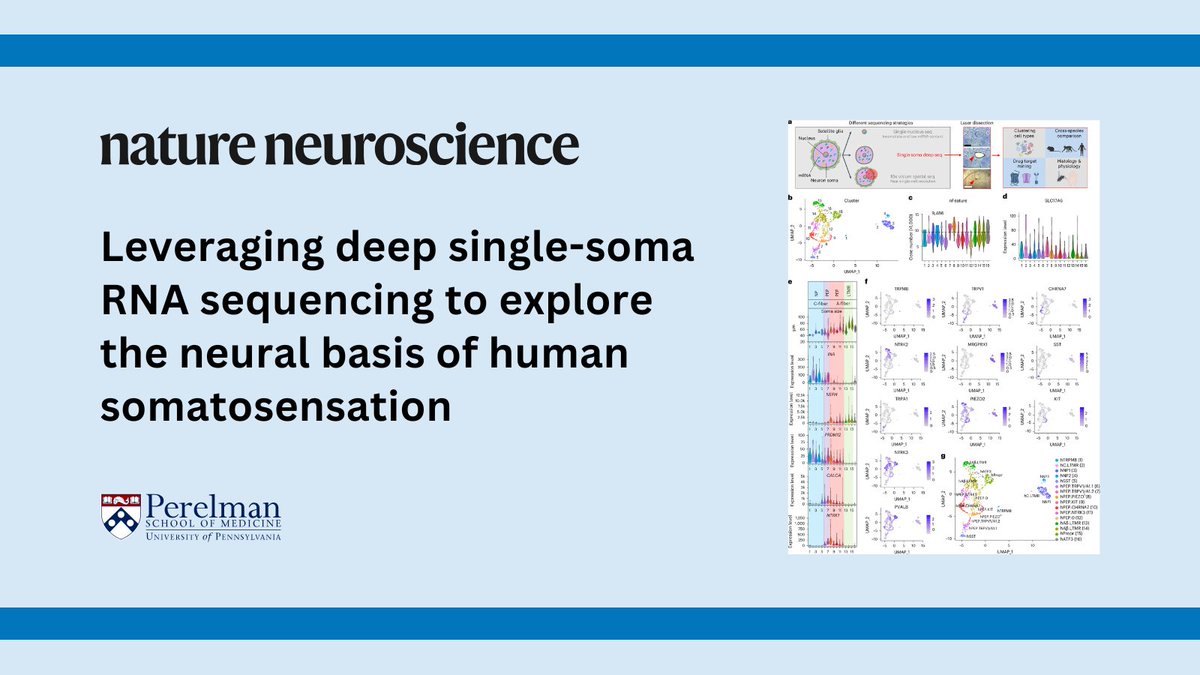
Deep RNA-seq of isolated somata from individual human dorsal root ganglia (DRG) neurons identifies 16 neuronal types; molecular-profile-informed microneurography recordings revealed temperature-sensing properties across human sensory afferent types
https://t.co/9F5hfTAUPM
16 Nerve Cell Types Identified in Human Touch
In a detailed study, scientists identified 16 unique types of nerve cells involved in the human sense of touch, revealing unexpected complexities in how these cells respond to various stimuli.
Some touch-sensitive cells were found to also react to temperature and pain, challenging traditional beliefs that each nerve cell type has a specific function.
This study mapped gene expression in human sensory cells and compared them to those in mice and macaques, highlighting both similarities and unique human traits.
For instance, humans have more and faster-responding pain-signaling cells, which may be due to our larger body size and the need for quicker responses.
The findings provide new insights into sensory nerve function, showing that nerve cells may serve multiple roles.
This research could lead to better understanding and treatment of sensory processing and pain.
Cool paper from the lab of my postdoc mentor Wenqin Luo and many other outstanding collaborators of hers including @saadsnagi. Lots to impact here, but one discovery that strikes me is that human C-LTMRs (the gentle touch detectors) also respond to noxious heat. So interesting.
1/12 Excited to share our new paper, “Leveraging Deep Single-Soma RNA Sequencing to Explore the Neural Basis of Human Somatosensation,” now out in @NatureNeuro! 🎉 https://t.co/ifqZ2joGFE
Mechanical hyperalgesia is pain from things that should feel like a gentle touch, such as clothes against the skin, but @PennMedicine researchers uncovered clues about what causes this condition to happen https://t.co/4AAhWQBxyD @NatureComms
1. Excited to share our improvement of pain testing in rodents. No more back-breaking inconsistent poking of mouse paws. We present the ARM (Automated Reproducible Mechano-stimulator). 1/7
https://t.co/fVUqn19V83
Excited to share our paper just published in
@NatureComms on distinct local and global functions of mouse Aβ low-threshold mechanoreceptors in mechanical nociception. Thanks to all the co-authors!
https://t.co/AOnxjva7lw
https://t.co/vKnT2ZFokN