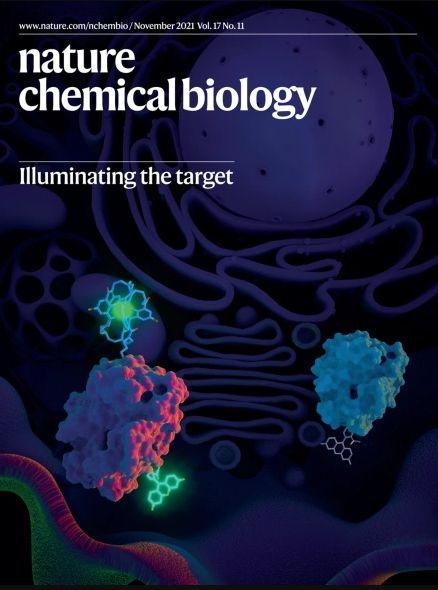
In the recent issue of @nchembio we report the development of #CoraFluors, a #novel class of bright and stable TR-FRET donors optimized for biological #application, including measuring the binding of drug molecules to their targets, directly in #livecells and in real time 🧪(1/n)
The cover of our November issue (https://t.co/d1d755lpIS) features a class of luminescent terbium-based probes called CoraFluors (https://t.co/gPKTURHuuk) used for detecting ligand-bound protein targets by TR-FRET.
Excited to share 2 preprints, together showing how mechanisms of a molecular glue & E3 ligase cancer mutations serendipitously converge to cause neomorphic protein degradation in distinct contexts. Highlights below: 1/17
#1: https://t.co/8UA8tJ2iti
#2: https://t.co/QOgfdXaxW7
Rockstar work championed by @Chemist_Payne and Saki Ichikawa synergistically combines #CoraFluors and #Cyclimids into a powerful platform approach to accelerate degrader development and comprehensive characterization.
Our newest work in collaboration with Saki Ichikawa and @drcmwoo @mazit is now online @CellChemBiol! Here is a free-to-read link:
https://t.co/7b92WWuPGD
Awesome collaboration with #BullockLab and @Chemist_Payne! Combining our complementary expertise, we shed new light on the CUL-3-KEAP1 complex, establish a straightforward assay to measure CUL3 binding to its adaptor proteins, and reveal CDDO’s activity as a “partial antagonist”.
The Bullock lab @CMDOxford has a new paper on KEAP1-CUL3 structure, TR-FRET and inhibition by CDDO. Great collaboration with Ralph Mazitschek @mazit DOI: https://t.co/yvcZv96X0j
@BagPhos From Wikipedia: The official SI unit is the megagram (symbol: Mg), a less common way to express the same mass. - Now, of course, “Mg” is messing with our heads. How many mol are 1 Mg Mg?
Preprint out!
KEAP1-CUL3 structure, an awesome new assay platform for BTB domain-containing proteins, and elucidating the mode of inhibition of CDDO...what a fantastic collaboration @mazit@MGHCSB@CmdOxford
https://t.co/V63uQ0l2Aq




![Rainmaker1973's tweet photo. What if great scientists had logos
[✏️ Kapil Bhagat & Prateek Lala] https://t.co/6K6o1c3NMU](https://pbs.twimg.com/media/GFpyLDeWYAAa0GS.jpg)