Regional anesthesia, pain medicine and critical care. (Un)professional account… Associate Professor @ University of Parma—opinions just my own (thankfully).
Una giornata di formazione teorica e pratica in anestesia regionale e protocolli ottimizzati per il recupero postoperatorio—grazie per l'invito @Milena11006189 & coll. @ CdC Città di Parma; w/ @ElenaG_Bignami, @ValeBelliniMD, Andrea Tognù, Giorgio Danelli and many others!
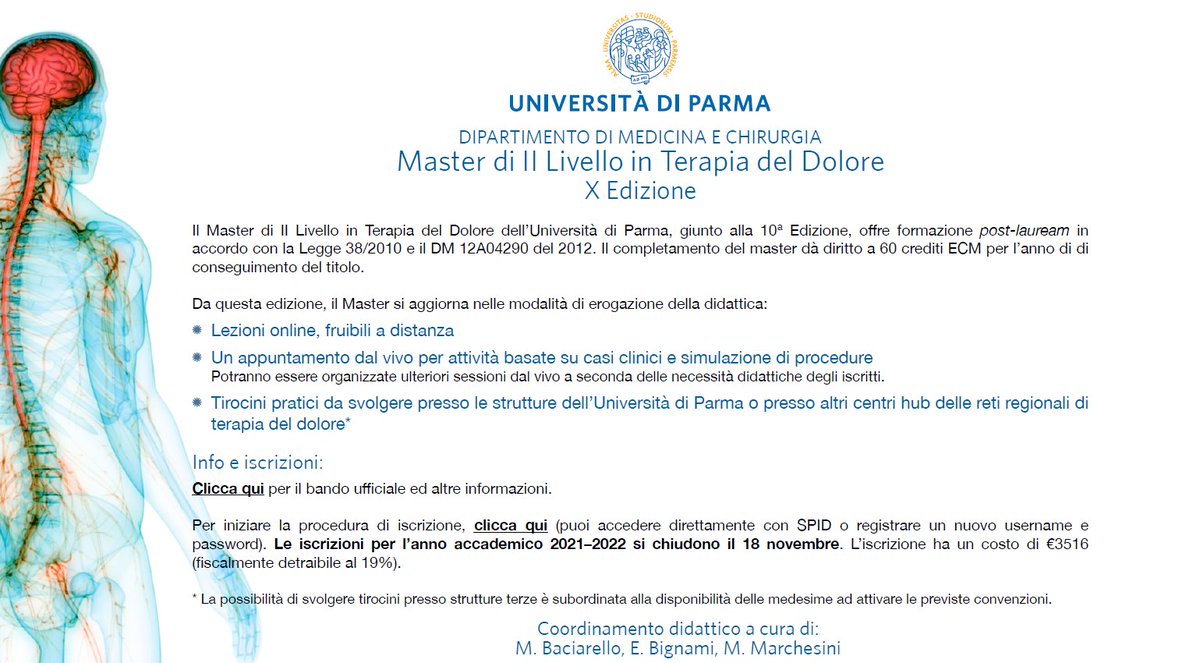
Il master è aperto a specialisti in anestesia e rianimazione, geriatria (medicina di comunità e delle cure primarie), neurologia, oncologia, radioterapia, e a medici con comprovata esperienza di almeno 3 anni nella terapia del dolore.
Nuovo master di II livello in Terapia del Dolore @unipr.
Quest’anno le lezioni frontali si terranno online, con 1–2 appuntamenti dal vivo per casi clinici e simulazione di procedure. In coll con @ElenaG_Bignami e Maurizio Marchesini.
Brochure: https://t.co/TspYPxeXU8
Iscrizioni aperte fino al 18 novembre.
Tirocinio in presenza @unipr o presso centri hub regionali di terapia del dolore che propongano la convenzione.
Importo fiscalmente deducibile al 19% nel 2021.
Info/bando: https://t.co/qQJOOKnKW2
Registrazione: https://t.co/IL8y32Q0mB
Here’s the monitor of a patient who presented to the ER with an acute thalamic stroke.
Notice the irregular breathing pattern with periods of apnea, followed by increasingly deep breaths and hyperventilation. These are known as Cheyne-Stokes respirations.
#FOAMed
@NidaQadirMD@ChrisCarrollMD Agree 99%! The 1% against is because I got there first! Though I didn’t actually coined it, either… 😏
https://t.co/XB4wohCbRK
@drmarcogarrone @HMonster19 Maybe if AVDO2 is very high, then it takes either a long time, or a higher alveolar to capillary gradient to close the gap? If mixed venous blood is very low in oxygen, then paO2 won’t reach high values even in the absence of lung pathology, due to low diffusing capacity
@EthanLSanford@emcrit blog on this coming out in a few days... but yes, keeping patients off ventilation (if possible) is probably the single most important intervention. multiple studies from NY showing that intubated patients fared extremely poorly. early-intubation strategy likely misguided
These numbers are frightening. 88.1% mortality for intubated pts...21% overall in hospitalized patients..how can we keep patients off the vent and/or better manage when on? @emcrit@PulmCrit#medtwitter#COVID19 https://t.co/eiqjInxil6
@CriticalCareNow The citation mentions evidence of harm with increased respiratory effort in children under APRV, as compared to “tranquil” pressure-controlled A/C or SIMV. BTW, there were almost 2x severe cases in treatment group v controls. I think physiological effort is protective (3/3)
@CriticalCareNow I think a lot depends on your ventilator’s capability to trigger rapidly and/or to ramp up insp flows adequately. In this regard, open-valve modes like APRV can be useful. Tracheal tubes are small and cause a lot of resistance, so compensation by the vent (1/3)