We noticed a huge problem with the Bittensor $TAO ecosystem⚠️
So we built https://t.co/WQRhsS8aIo as the solution 🎯
Problem: The market has proven to be inefficient in pricing subnet alpha tokens based on what the projects are actually building, shipping, and achieving
Example 1: it took the market several days to react when Templar published their decentralized model results. 48 hours of flat price action, then the SN3 alpha token did a 4x.
Example 2: we saw smart money and whales exiting SN3 Templar and picked up strange activity in the SN3 Discord several days before Sam rugged. Most people missed these signals.
Solution: AlphaGap is a new AI model built for Bittensor that:
💻Tracks all subnet development and product updates
🐳Detects unusual price action (whale wallets, smart money TAO flows, price reversal signals)
📱Scans Twitter/ X to identify early stage viral momentum
💬Scans every subnet Discord to snipe alpha before it goes public
⛓️Keeps track of important on-chain metrics like emissions, validators, and stakers
And much more, for all 128 Bittensor subnets.
The pitch is simple -> to keep track of all of this information would typically take us 2-4 hours per day of research.
With AlphaGap, you can scan the website and get all the important alpha within a few minutes.
We are using this website daily, and believe it is the absolute best place to find everything you need to know about what Bittensor subnets are doing.
Not only that, but our AI takes the over-complicated world of developer speak and confusing on-chain signals and breaks it down into simple actionable analysis that anyone can understand.
Give it a try and let us know if there are any new features you would like to see 🤝
https://t.co/OYhzfZUIE0
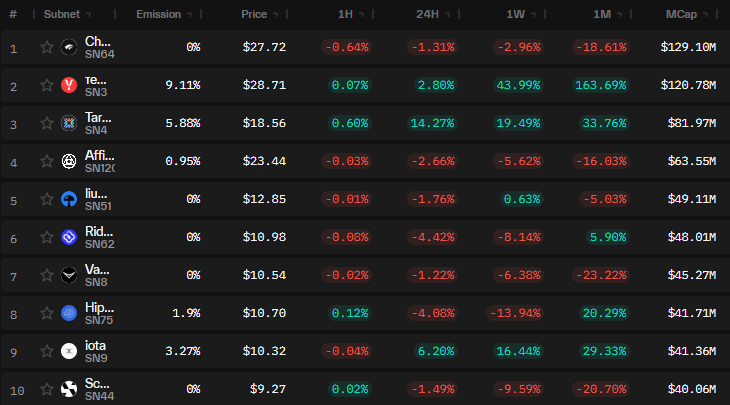
bittensor's top 10 subnets by mcap and what they actually do:
> SN64 Chutes: serverless AI cloud, deploy any model instantly, 85% cheaper than AWS. basically decentralized OpenAI API
> SN3 Templar: training frontier LLMs across random GPUs worldwide. Jensen Huang heard about this.
> SN4 Targon: multimodal AI marketplace, text/image/audio inference all in one. just dropped a whitepaper with Intel on running trusted compute on untrusted hardware
> SN120 Affine: RL coordination layer that connects subnets together and keeps improving models through open competition
> SN51 Celium: rent H100s cheaper than anywhere else, actual GPU marketplace with real revenue
> SN62 Ridges: AI coding agents competing against each other 24/7
> SN8 Taoshi: miners generating live trading signals for BTC, ETH, forex. quant firms can plug directly into this
> SN75 Hippius: decentralized S3 storage for Bittensor, the missing piece for AI apps that need to persist data
> SN9 IOTA: distributed LLM pretraining, already proven at 14B params with a PhD-level team behind it
> SN44 Score: computer vision for football analytics, 10x cheaper than traditional annotation with actual club partnerships
$700M combined mcap for the whole top 10. less than one useless AI meme. do the math
which one hits $1B first?
A Bittensor subnet just dropped a white paper co-authored with Intel.
Not a "partnership announcement." Not a logo on a slide. Two Intel engineers put their names on it.
Subnet 4. Targon. The biggest confidential compute network on Bittensor. And Intel just validated the entire architecture.
Targon built something called the Targon Virtual Machine. It uses Intel TDX and NVIDIA Confidential Computing to spin up fully encrypted VMs on random people's machines.
The host operator can't see your data. Can't read your model weights. Can't inspect GPU memory. Can't even mount the disk.
Here's how it works.
• Every hardware provider gets a uniquely encrypted VM
• The VM only decrypts after passing remote attestation through Intel Trust Authority
• If any part of the boot chain is tampered with, the key never releases. The disk stays locked.
• Once booted, the VM is IP-locked to that specific machine. You can't clone it, migrate it, or replay it elsewhere.
• Every 72 minutes, the node re-attests with a fresh challenge-response nonce. No stale proofs.
• CPU attestation and GPU attestation are nested into a single cryptographic proof
The threat model assumes the hardware provider is actively hostile. Full physical access. Controls the hypervisor. Can snapshot VMs. Can collude with other providers.
And the system still holds.
This is Bittensor Subnet 4. Over 1,500 H200s on the network. 20 billion+ paid inference tokens per day. $60M+ in annual compute incentives flowing through it.
Manifold raised a $10.5M Series A from OSS Capital, with Ram Shriram (early Google backer) participating.
But the Intel co-authorship is the real signal here.
Intel doesn't put engineer names on white papers for marketing. This is their team validating that Targon's architecture correctly implements TDX for production confidential computing on decentralized infrastructure.
That's enterprise credibility you can't buy.
The biggest unsolved problem in decentralized compute has always been trust. Nobody serious will run sensitive AI workloads on machines they don't control.
Targon just solved it at the hardware level. And Intel co-signed the receipt.
🚨UPDATE: $TAO Subnet 97, Constantinople
Current APY opportunity is still around ~300%. Very attractive.
I don’t know if my post had anything to do with it. But the fact is: price moved ~50% since then.
And as more stake enters, APY naturally adjusts and spreads out across validators.
Study how this works.
Now I see an even stronger setup. More holders. More TAO in the pool. And the fundamentals remain the same.
A subnet built 100% by agents (Arbos, study this)
and the owner is Const, founder of Bittensor.
PS: Don’t trust the average APY shown in apps. Check the data directly on-chain, through APIs, or via taostats and taoapp.
APY changes hour by hour, validator by validator.
Everyone watching TAO price action.
Nobody watching what's actually happening inside the network.
Subnets stopped being experiments. Now they're:
- Generating real revenue
- Signing enterprise clients
- Publishing peer-reviewed research
The subnet layer is where value actually accrues, not the token ticker.
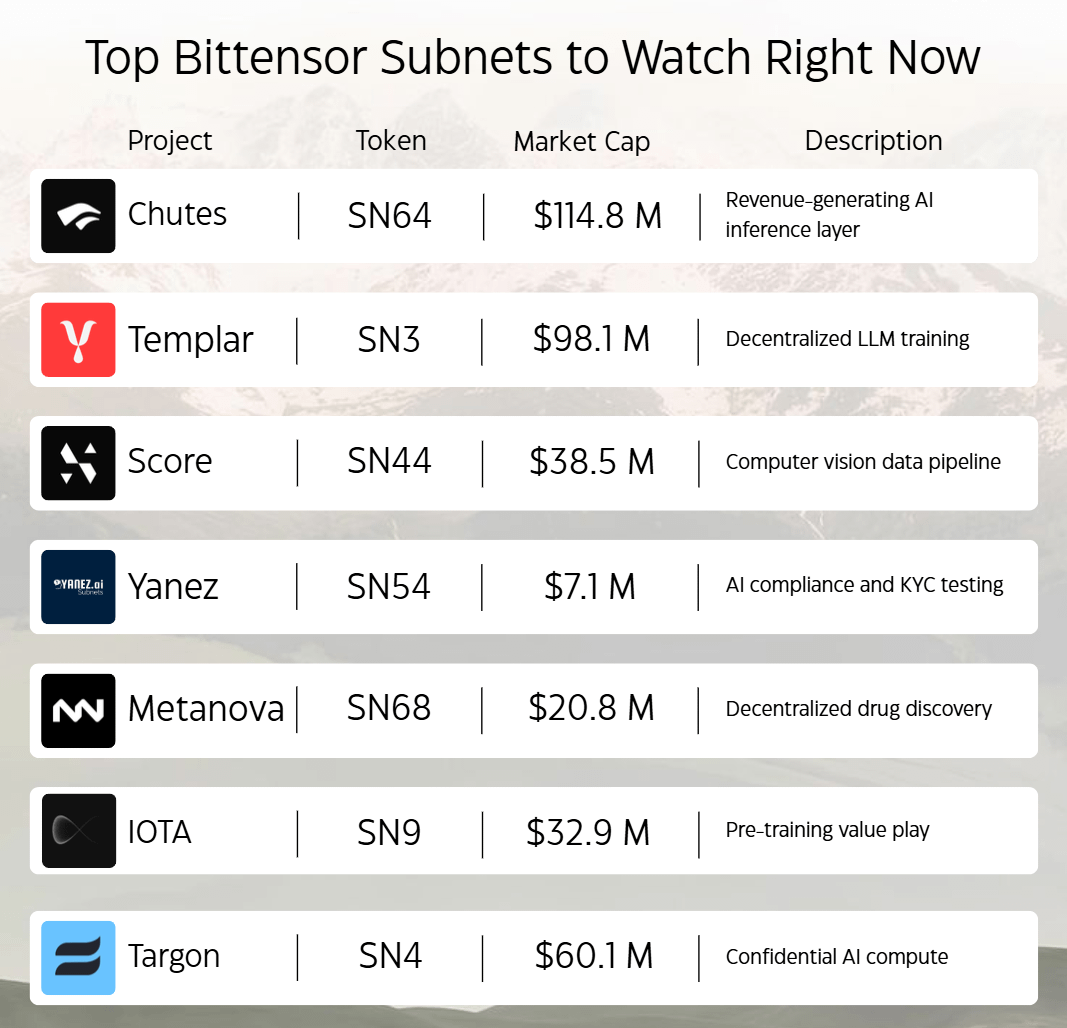
7 Bittensor subnets doing real work right now:
@chutes_ai - Inference layer already doing ~$5.5M annualized. Real usage, real developers, and one of the clearest revenue signals across all subnets.
@tplr_ai - Decentralized pre-training. Running one of the largest permissionless training experiments, with actual academic validation (NeurIPS).
@webuildscore - Computer vision subnet with enterprise clients (sports, retail, infrastructure). Turning video into structured data at scale.
@yanez__ai - Compliance + RegTech. Generates adversarial datasets to stress-test KYC/AML systems. Selling directly to financial institutions.
@metanova_labs - Drug discovery subnet. Early stage, but targeting a massive market with asymmetric upside if validation works.
@IOTA_SN9 - Pre-training competitor targeting undervalued training infrastructure. Positioned as a value play within the training layer.
@TargonCompute - Confidential compute subnet enabling private AI execution. Focused on secure environments for sensitive data and models.
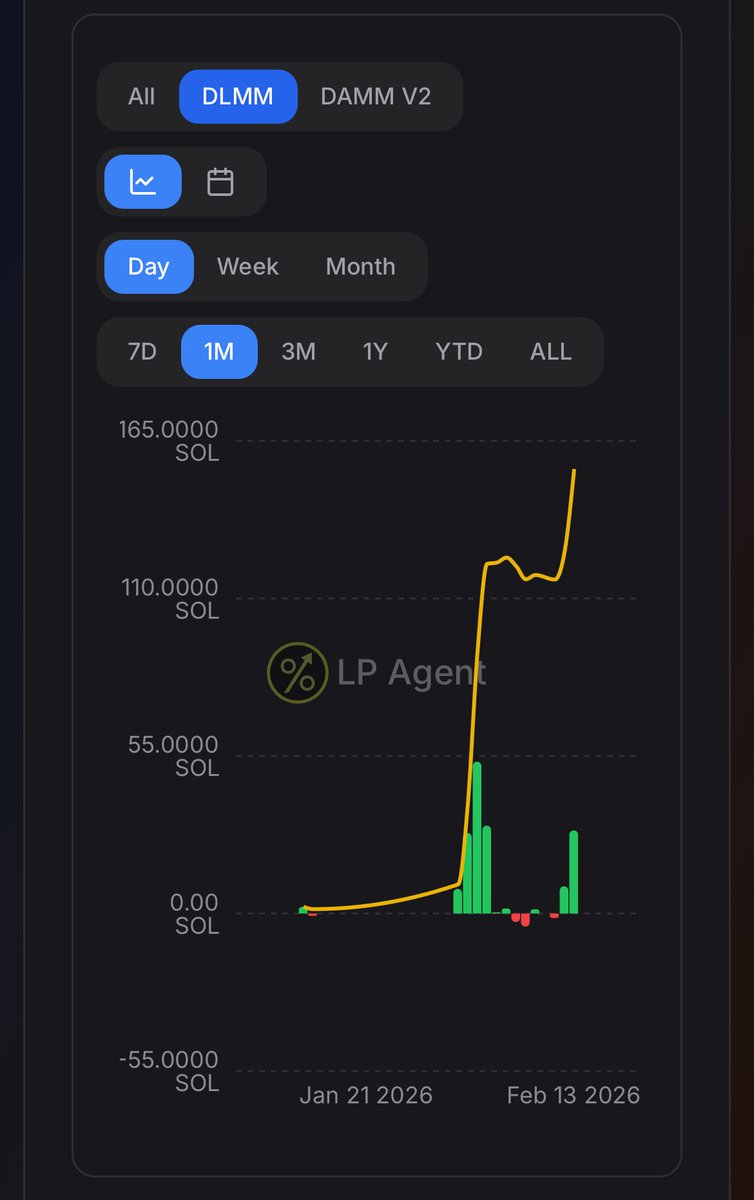
So, as promised, I am publishing a more updated strategy for dlmm.
@MeteoraAG
It is almost identical to the one published earlier, but it will answer all your questions.
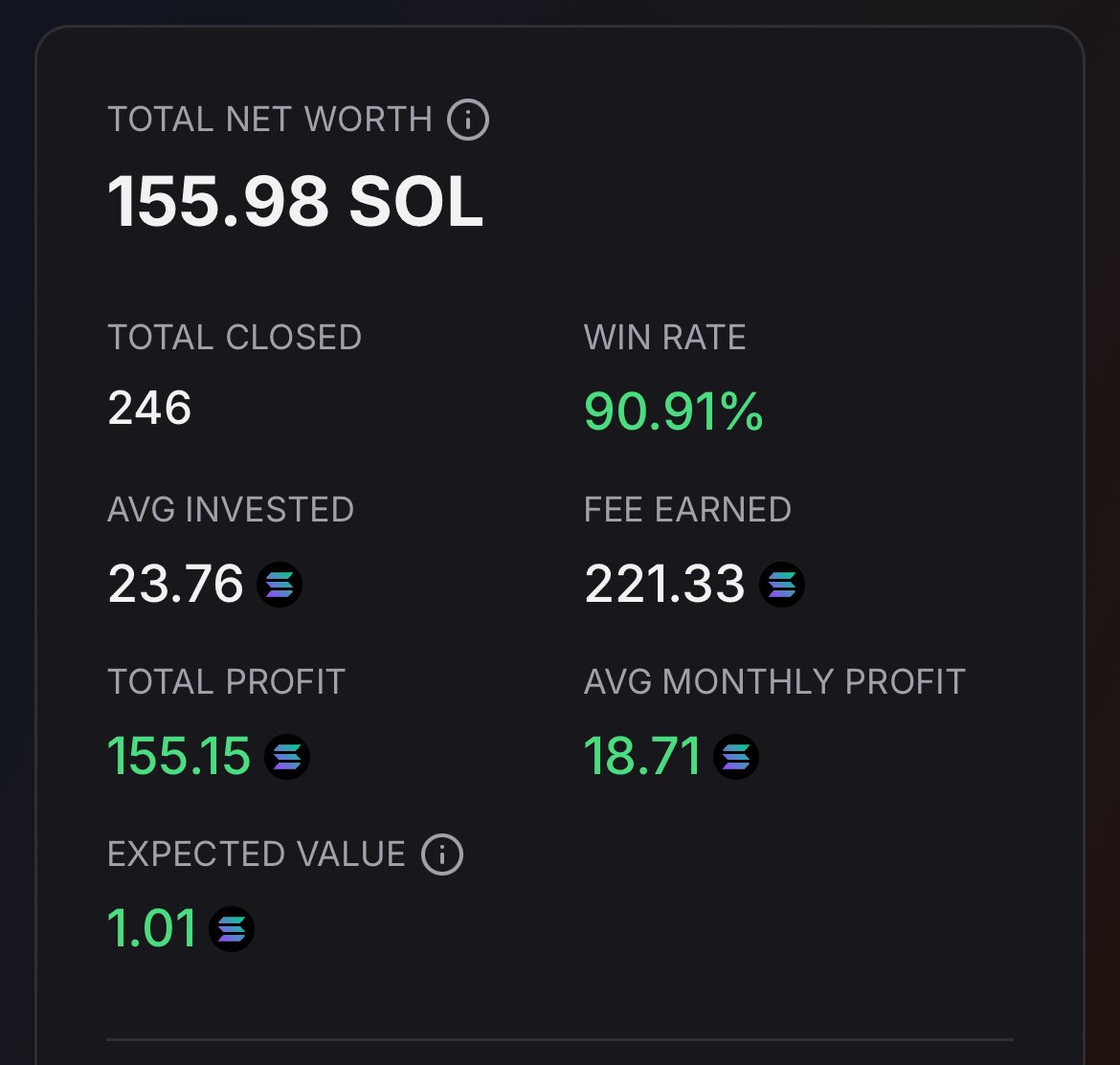
Yes, it's true, I exceeded 150 sol, starting with 5. That's a little over 10k greenbacks.
1/5
Chinese student in the US spent three years telling his parents he was studying finance.
Last Tuesday they accidentally saw his screen during a WeChat video call.
Browser tab. Three seconds. That was enough.
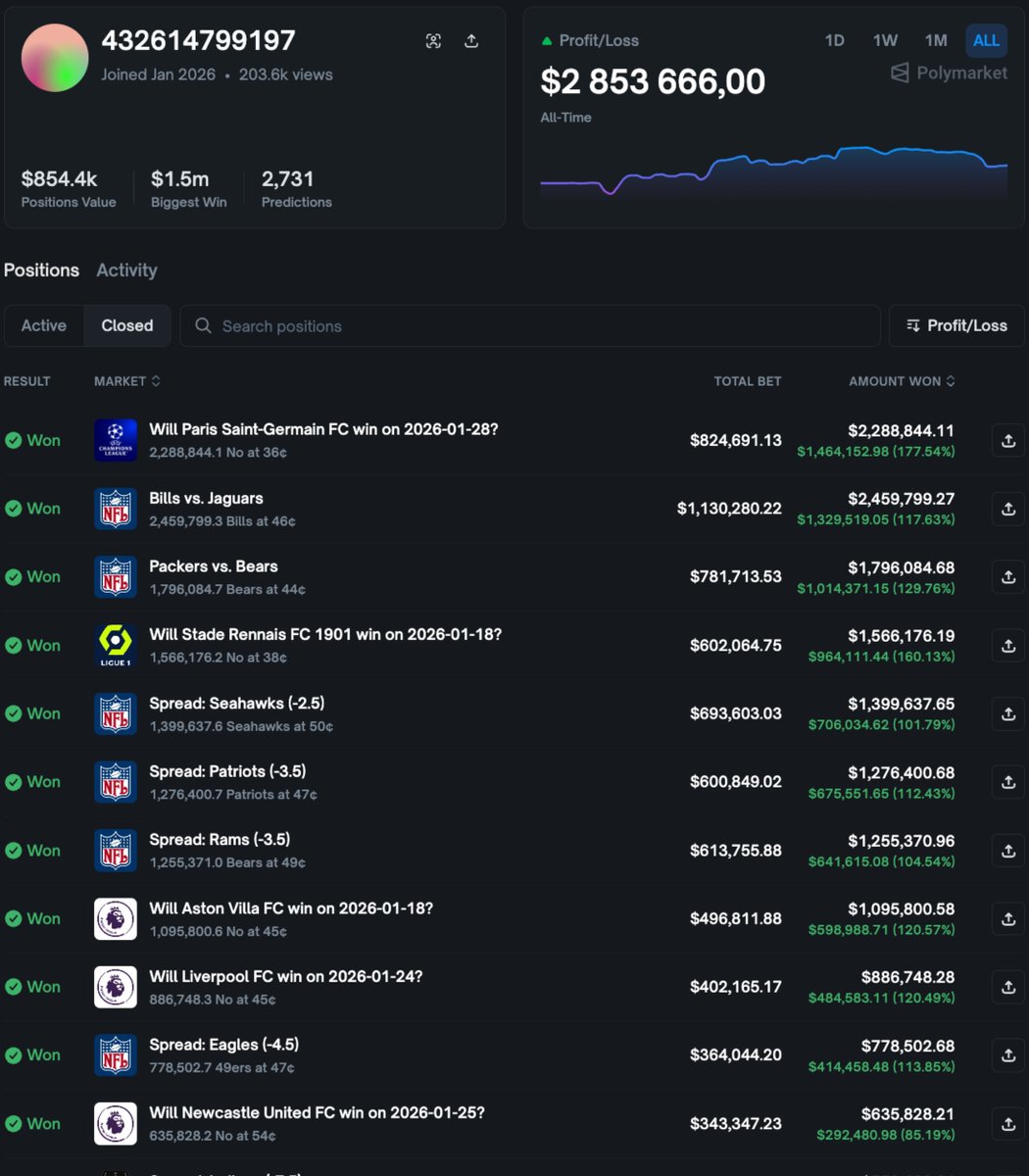
432614799197. $2,853,666 profit. 2,731 predictions. Joined January 2026.
→ Wallet: https://t.co/IAtNrCzXI5
He did study finance. Just not at university.
The wallet:
Every trade sports. NFL, Premier League, NBA, NHL. All leagues simultaneously.
Biggest single win: $1,500,000. One game.
Bills vs. Jaguars put in $1,130,000, walked away with $2,459,799.
PSG won't win put in $824,000, walked away with $2,288,844.
He doesn't guess winners. He finds where the crowd mispriced. Buys at 35 cents. Collects $1.
2,731 trades. Zero losses.
Hasn't graduated yet. Wallet is already active.
🚨🇺🇸🇻🇪 HOW THE U.S. TOOK DOWN MADURO IN A 3-HOUR NIGHT RAID
The lights in Caracas went out at 2 a.m.
By sunrise, the Venezuelan president had vanished without a trace.
While the world watched aircraft carriers off the coast, Delta Force was already breaching a compound in the capital.
The plan? Wait until Maduro stayed put. Then strike fast, strike hard.
They called it Operation Southern Spear.
The CIA had a mole feeding them real-time updates. Delta trained in a replica of his safe house until they could raid it in their sleep.
Venezuela’s defenses? Dozens of Russian S-300 missiles, Chinese radar, and Iranian drones.
The U.S. sent F-35s instead of old-school jets because the older ones would’ve been barbecue before touchdown.
Stealth fighters cleared the skies so the boots on the ground could grab the prize and vanish. No warning. No broadcast. Just gone.
Source: AiTelly