Educator, teacher, learner, passionate about education & learning outcomes for students. Interested in innovative ideas in higher education and libraries.
Applications are open to study in 2026. Explore our range of courses and build a future that offers so much more.
Learn more and apply now - https://t.co/9McPdmDTGA
Two big steps towards our vision for @NotebookLM as the ultimate research platform:
• Integrating Deep Research, with a set of only-at-Notebook features that let you explore the retrieved sources
• Launching a series of Featured Notebooks curated by @GoogleResearch
These developments are designed to enhance the full life cycle of research and scholarship: using the power of AI to assemble the knowledge base you need to advance your understanding, and then making your work accessible and intelligible to a wider audience using all the explanatory tools that Notebook offers.
If you've used DeepResearch in the Gemini app, you already know that it's a pioneering advance in assembling complex, grounded information on any topic imaginable—collecting an entire trove of material for you and writing a nuanced research report that summarizes the findings.
But because NotebookLM is designed to manage and explore potentially hundreds of sources, the Deep Research report is only the beginning of your journey. In our integration, Deep Research gives you an overview all of the sources it found during its research phase, with annotated commentary explaining how each source related to your original query. You can then choose to import some or all of the sources to the notebook, along with the report itself, which you can then explore or transform using the full suite of tools that Notebook offers: grounded chat with citations, Mind Maps, Audio/Video overviews, and much more.
And it's that suite of tools that make the @GoogleResearch Featured Notebooks so compelling as well. Each notebook contains a curated collection of articles on a specific topic, published by the Google Research team. Think of them as a kind of knowledge base of Google's best thinking on a series of compelling research questions: How do scientists link genetics to health? How will quantum computing be useful?
If you're a specialist in these fields, you can read the original papers or ask nuanced questions in chat and advance your understanding of the latest developments. But these notebooks can also make the complex but important topics understandable to non-specialists or students. Each notebook comes with pre-generated audio and video overviews, flashcards, and other Studio artifacts designed to make the scientific and technological concepts accessible and interesting. And you can always explore the material with our new "Learning Guide" chat mode that effectively gives you a personal tutor to enhance your understanding.
There's much more to come on this front, but you can see in these two announcements how we see Notebook as both a workbench for conducting research and a publishing platform for sharing the results of that research once you're ready to make it public.
Deep Research is rolling out this week to all users. The first two Google Research notebooks are live now, both of them deep dives into our most recent discoveries involving genetics and health. (Links in the following tweets.) We'll be publishing new notebooks in the series every other week or so for the next few months.
This is going to revolutionize education 📚
Google just launched "Learn Your Way" that basically takes whatever boring chapter you're supposed to read and rebuilds it around stuff you actually give a damn about.
Like if you're into basketball and have to learn Newton's laws, suddenly all the examples are about dribbling and shooting. Art kid studying economics? Now it's all gallery auctions and art markets.
Here's what got me though. They didn't just find-and-replace examples like most "personalized" learning crap does. The AI actually generates different ways to consume the same information:
- Mind maps if you think visually
- Audio lessons with these weird simulated teacher conversations
- Timelines you can click around
- Quizzes that change based on what you're screwing up
They tested this on 60 high schoolers. Random assignment, proper study design. Kids using their system absolutely destroyed the regular textbook group on both immediate testing and when they came back three days later.
Every single one said it made them more confident.
The part that surprised me? They actually solved the accuracy problem. Most ed-tech either dumbs everything down to nothing or gets basic facts wrong.
These guys had real pedagogical experts evaluate every piece on like eight different measures.
Look, textbooks have sucked for centuries not because publishers are idiots, but because making personalized versions was basically impossible at scale. That just changed.
This isn't some K-12 thing either. Corporate training could work this way. Technical documentation. Professional development.
Imagine if every boring compliance course used examples from your actual job instead of generic office scenarios.
We might have just watched the industrial education model crack for the first time. About damn time.
"learners want their learning experience within a microcredential to facilitate career progression and help them apply their new skills in different contexts" https://t.co/appRZM2OOL #onlinelearning#onlineeducation#highereducation
The revolution has just begun. And most people don't see it.
History was made today. And 99% of people didn't even notice.
The fact that AI agents are here now and can already operate computers is a turning point.
Of course, Operator is not yet fully functional. You can't let a company work with it. It's basically the GPT-3.5 of agents. You can see the potential, but it still needs development.
However, as we now know, development is progressing rapidly. We are not talking about years, but months.
And when the really capable agents are there, there will be no turning back. These agents can simply be multiplied. This means that a person who normally performs one task can now serve a multitude of agents at the same time. Or to put it another way: we will see an explosion in productivity.
Many do not understand this simple fact. Once the agents are fully functional, you will simply multiply them and the human task will be to manage a swarm of agents. A human being will be able to perform the work of 10 workers by sending the agents and just monitoring them.
This is not a pipe dream that could exist in decades, but it is here now. And in a few months, they will be so efficient that every corporation will use agents. While operators today mainly browse the internet, the next generation of agents will operate the computer as a whole; create and evaluate Excel spreadsheets; work as software engineers and write codes independently. As “The Information” already wrote, OpenAI is working on an agent that can replace a senior SE.
Many people only realize what is happening after it is too late. In 2023, LLMs brought us the AI revolution. And after many thought that we had hit a wall, in 2024, with reasoners and inference-scale, we realized that scaling intelligence and reasoning knows no limit. And in 2025, we see that the two go together: LLMs that do reasoning and now work independently. 2025 is the year of agents. And this year, people will realize what a huge impact this will have on their entire lives.
But it won't stop there either. In 2026, the agents will probably start doing their own research (if not this year) and thus help to ensure that AI as a whole is used even better, more intelligently, more efficiently and more widely.
Without exaggeration, I say: we are at a turning point. The revolution has begun. When I write this, it sounds like something crazy, as if I belong to a cult. But everything I say is already reality. It is not religious fanatics who talk about a revolution of humanity, but credible and respected scientists.
We will be able to cure all diseases, longevity is within reach and worldly abundance is available to all.
Everything will change, nothing will remain the same. It is up to us to ensure that this revolution serves all people equally. That will be our task.
Because this revolution in technology is unstoppable. And it has only just begun.
P.s.: and I haven't even mentioned robotics yet, the upcoming humanoid robots.
Why respect is a massive issue at work. Research shows that for employees, “feeling respected” is 17.9 times more powerful a predictor of an organisation’s overall culture score than the average factor (& almost twice as strong as the 2nd most important factor, supportive leadership).
As leaders, we may show disrespect repeatedly in seemingly small ways that have a very negative impact on people & culture, eg, by showing disregard for others’ effort, expertise, time or failing to include them.
Three strategies:
1) Make "multitasking" an unacceptable behaviour
2) Treat other people’s time like gold
3) Teach & evaluate listening skills
https://t.co/DSiJUBi6Gy. By Jim Detert in @mitsmr. Graphic by @gapingvoid.
A WELL-DESIGNED SCHOOL LIBRARY DOESN’T JUST SUPPORT LEARNING - IT INSPIRES IT. It's much more than a place for books, it’s a hub for learning, creativity, and connection. It should be the beating heart of the school. #librarydesign#schoollibraries https://t.co/C6AIndZDfM
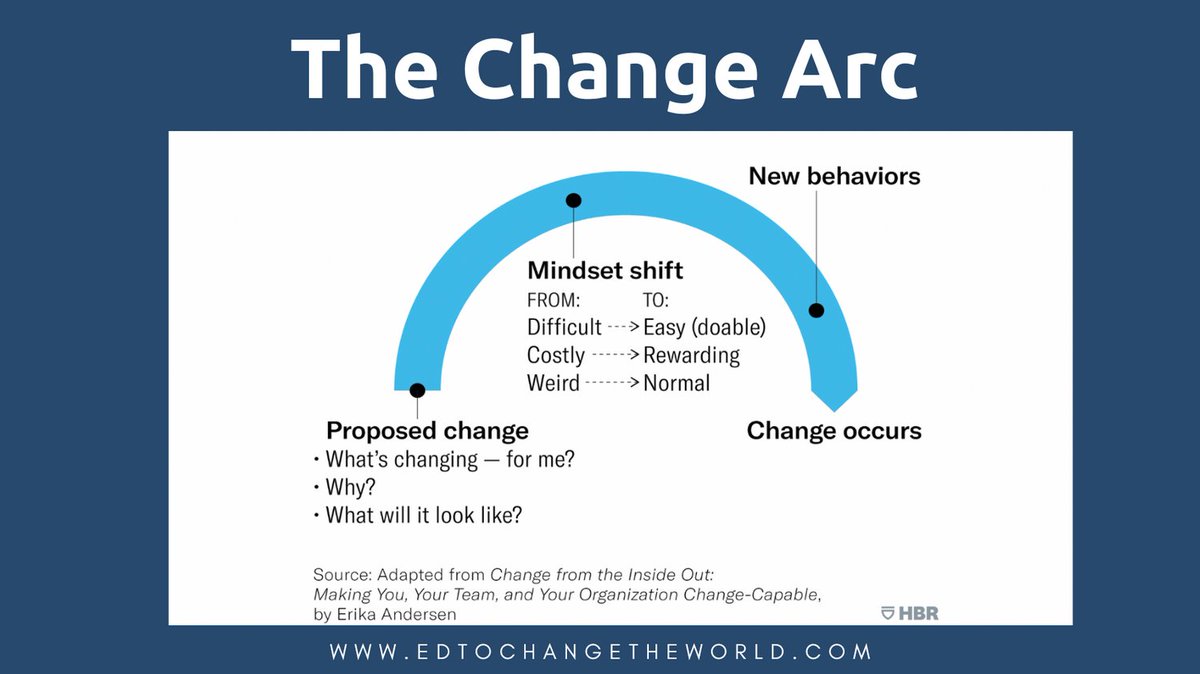
Why do 70% of change initiatives fail?
The missing piece: a mindset shift.
From: “This is hard, costly, & weird.”
To: “This could be easy, rewarding, & normal.”
Our new micro-course helps teachers make this shift & land in the winning 30%!
Learn more: https://t.co/an9rJ5mqbQ
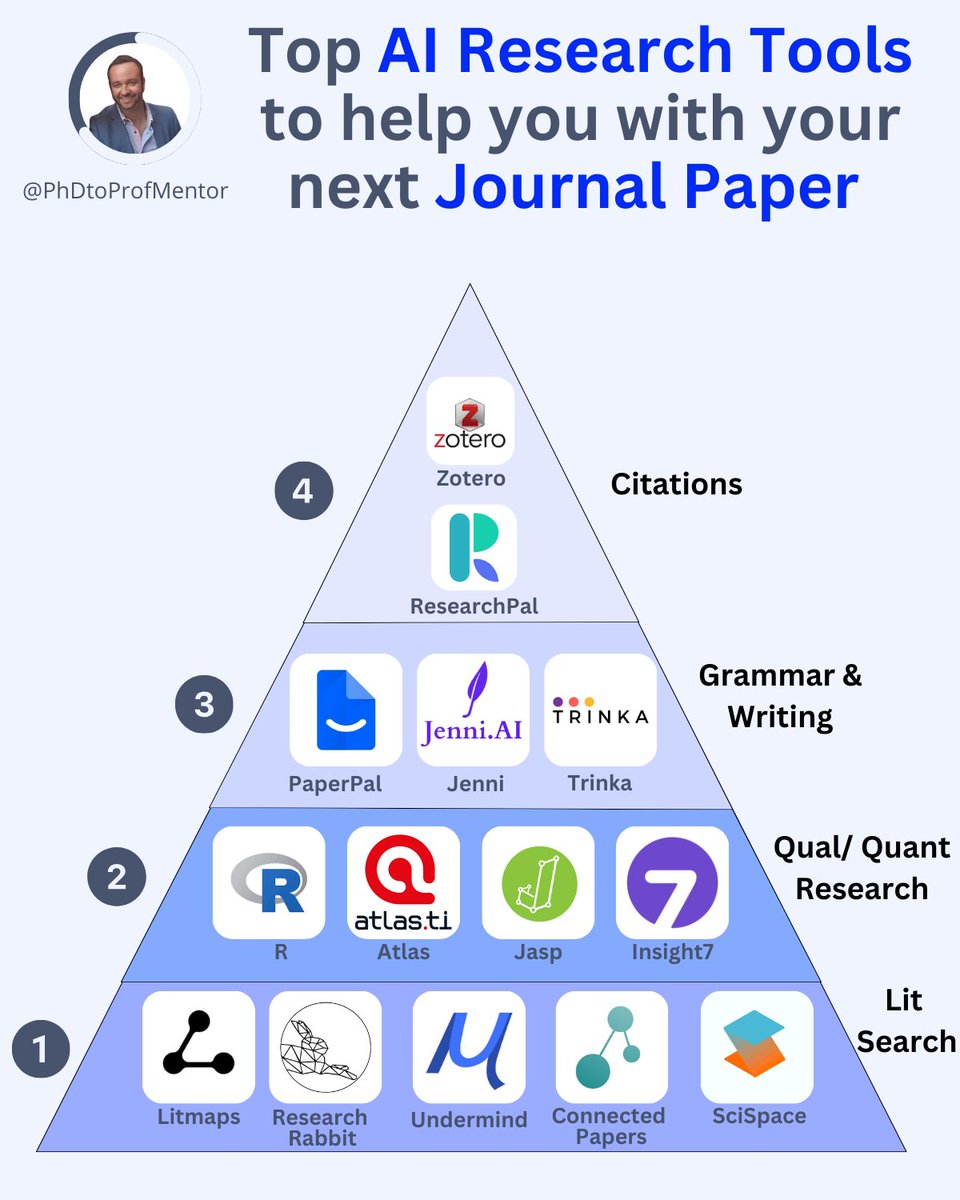
I don't understand why people don't use AI to turn hours of work into minutes.
97% of people don't know about this secret.
9 AI Tools to finish the work of 3 days in 3 mins:
(You won't believe what 6th one can do)
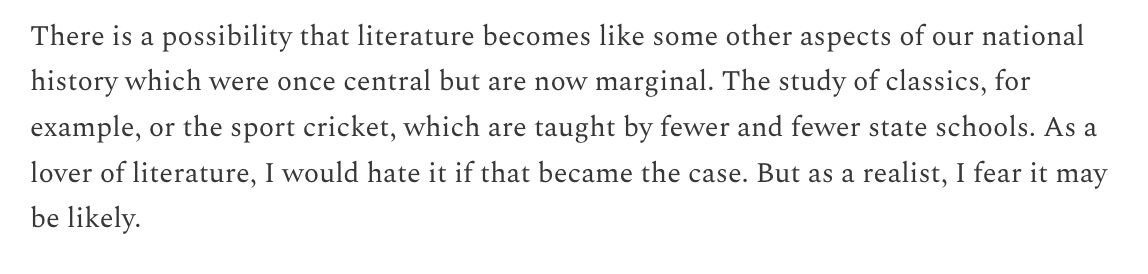
A pessimistic post from me this morning about the decline of English Lit.
Is it all the fault of Gove's exam reforms?
I'm not convinced, because the decline of Eng lit & humanities is a global trend - and I think reversing it could be much harder than people think.
To provide insight into the current state of gen AI tools, Sydney Uni's @dannydotliu and Benjamin Miller have produced a series of 3 videos on TEQSA's behalf.
The latest provides insight into #AI and reflective writing.
View the video: https://t.co/DiIE1sIpBz
#GenAI
An increasing willingness of undergraduates to consider studying interstate and a recovery in NSW applications has meant that the nation’s biggest admissions centre has seen a small uptick in applications this year.
https://t.co/9XSRrIuyuL
#HigherEducation#FutureCampus
Your first peer review request just landed in your inbox. Panic sets in.
Where do you even start?
Breathe. I've got you covered.
Here's your step-by-step guide to crushing that peer review:
Well worth reading. I hope this is what AI can achieve, but I remember my embrace of the Internet and my utopian ideals in the 2000’s…and look at the algorithmic profit driven mess we’ve been dealt.