This week I'm running a series of three episodes on Australian immigration policy.
Immigration is one of the most important yet poorly understood areas of Australian public policy.
I learned this first-hand last year, after I did an interview with Abul Rizvi, a former Deputy Secretary of the Department of Immigration. The quality of responses to that interview by otherwise smart people showed me there's a real absence of knowledge about how the system actually works. People are starved of good information here in a way they aren't for other policy areas.
Part of the reason for this is simply that most Australians don't have direct experience with the immigration system because they're not themselves immigrants. In contrast, people have more contact with, for example, the housing system, because they're either homeowners or renters, and so their opinions about housing are somewhat more informed than their opinions about immigration.
But the other reason is that there seems to be a dearth of good intellectual content on immigration policy. In comparison, take defence and foreign policy: it feels like every couple of years in Australia we produce and then debate a really good new book in that field.
Who is our Hugh White for immigration policy?
There's been some excellent work on immigration policy over the last few decades, some of which we discuss in this series. But it feels less frequent or less prominent than in other fields.
Recently I've been puzzling over why high-quality analysis on immigration seems relatively scarce. I don't have a complete answer, but I suspect at least part of it is that immigration policy feels intellectually low-status. Or to put it differently: it just doesn't excite people's intellectual curiosity (as distinct from their tribal passions) as much as topics like housing, AI, or foreign affairs. People who could write about it, and people who would read about it, don't fully realise how interesting it can be. (I was one of these people until a couple of years ago.)
Immigration policy appears boring possibly because it feels like something that we have both no control over and complete control over -- like some combination of "the weather" and "accounting". On the one hand, it's always there in the background, and feels like it just happens to us. On the other hand, it's this clockwork system of categories and lists, points and quotas. Both framings lead to the same outcome: intellectually checking out.
But checking out is a mistake because immigration is no longer (if it ever was) merely a task for technocrats. We've arrived at a moment, as we have at only a few other times in our history, where immigration policy requires momentous choices. Immigration literally built Australia. And whether we get it right or wrong over the next few years could shape our national fortune as powerfully as assisted passage did in the 19th century, or the postwar migration program in the 20th century.
To provide people with as much high-quality information as possible, I decided to do a series on Australian immigration policy. In constructing the series, I wanted to boil immigration down to three (more or less) mutually exclusive, collectively exhaustive interviews:
1. The economics of immigration policy.
2. The history of immigration to Australia.
3. The social cohesion, cultural, and security dimensions of immigration policy.
Then I went out to find the best guest to speak to each of those topics. As luck would have it, I was able to wrangle each guest.
For economics, it was Martin Parkinson. Martin ran Treasury, then PM&C, then chaired the Australian government's 2023 Migration Review -- the most substantial review of our migration system in more than three decades.
For history, it was Mark Cully. Mark was chief economist at the Department of Immigration from 2009 to 2012. He has just written what will really be the first general history of immigration to Australia, all the way from assisted passage in the 1830s to the present day. The book, Waves of Plenty, is out in September. (That Australia hasn't had a general history of its immigration until 2026 is further proof of the strange undersupply of immigration content.)
And third was Mike Pezzullo. Mike ran Australia's immigration and border protection apparatus for almost a decade. He oversaw Operation Sovereign Borders, the policy that stopped the boats. Then he was appointed Secretary of the Department of Immigration and Border Protection from 2014, leading it through its transition into the mega-department of Home Affairs, until his departure in 2023. Few officials with his depth of recent experience are out of the department and able to share what they know about how the system actually works.
Getting immigration policy right is more important now than at any point in my lifetime. And yet the quality of the debate seems to be as poor as it's ever been.
We're not asking good questions, by which I mean we're not asking specific enough questions. The debate so far has occurred at a very low level of resolution.
So I hope these interviews help people understand how the system actually works, the trade-offs involved, what we can reasonably expect of our immigration system in 2026 and beyond. And some questions we should be asking to improve it.
School of Economics at USYD @USydneyEcon is on the market for a new Head of School. The deadline to apply is February 4. Position: https://t.co/qHWJkURcmk
A map of Sydney showing top country of birth by suburb, excluding Australia.
The clustering is striking.
People like living near others of the same ethnic group.
https://t.co/ikIYrTy8mb
📢 The Micro 4 Macro Workshop 2025 is coming back to Sydney!
🗓 15–16 Dec | 📍 UNSW Kensington
Hosted by @e61_institute & @UNSW, the workshop unites top economists to explore how micro heterogeneity shapes macro outcomes.
⚠️ In-person only, spots limited → https://t.co/CT2wBBMEZR
Stay updated → https://t.co/IJi6VaBM9m
Just got back from this year’s @KansasCityFed Jackson Hole Symposium. What a special place!
Beautiful scenery, interesting papers, and great discussions.
I presented new work with @a_auclert, @HannesMalmberg1, Matt Rognlie… 🧵
Economists have gotten a lot better at doing econometrics. We now cluster our standard errors, and don’t falsely reject the null as often. At the same time, by raising the bar for significance, we actually exacerbate publication bias! So which prevails? 1/
Always wanted to go to a great Macroeconomics Workshop in Melbourne? WAMS has got your back!
Workshop of the Australasian Macroeconomics Society
Nov 19-21 in Melbourne, Australia.
Keynotes:
Marco del Negro @marcodelnegro
Rachel Ngai
https://t.co/x45WTMGQtl
Apply by August 31st
🚨 Call for Papers 🚨
The fourth annual OzMac Workshop! December 5-6 at the University of Queensland (Brisbane, Australia). We welcome papers in applied and quantitative macroeconomics.
Submission deadline: Friday 29th August. See website for more info: https://t.co/bCENJo0MHG
Try to imagine a US President telling Ford that they shouldn't sell cars to foreigners, and that they should cut their R&D. It wouldn't happen. But that's what we're doing to one of America's most important exports: Education. 🧵
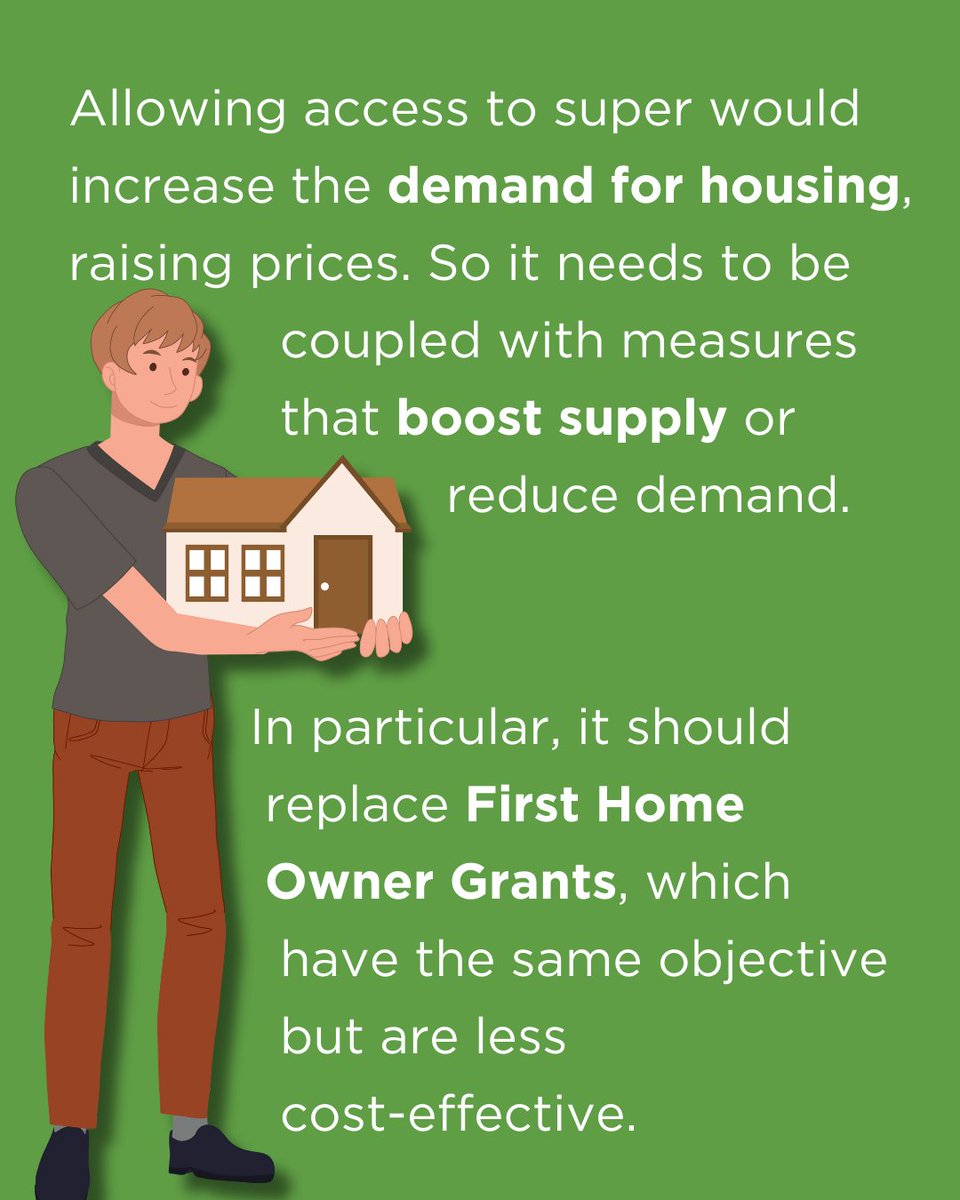
When it comes to the increase in demand, this is a drum we have been beating for a long time: BUILD MORE HOMES.
If we remove barriers and allow the market to operate, then the increased demand won't be a problem.
We also recommend replacing this First Home Owner Grants with a Super for Housing option. It would cost taxpayers less and benefit homebuyers more. 10/
@JosephNWalker@DrCameronMurray Some of the impacts of the recent rapid decline in fertility over the past decades. For some time, it will - absent migration - strongly increase the dependence ratio. to avoid that temporary (yet long-lasting) problem, a policy with temporary impact is perfectly adequate!
@StuartBDonovan But paying cash for the house is not a very conservative assumption, no? If you could pay 20% of it, your capital gains would be boosted, which may flip the conclusions (?)