@mattpocockuk With Copilot CLI you can define custom Agent instructions and limit their available tools in their Frontmatter. That overrides part of the default system prompt. At least it was like that a few months ago
Mistral CEO Arthur Mensch walked into the French parliament this week and told lawmakers Europe has exactly two years to build independent AI infrastructure or hand over one trillion dollars in spending to American tech companies.
The math he laid out should be front-page news.
This is not a technology story. It is a macroeconomic one.
Global wages are fifty trillion dollars. AI will cost around ten percent of that. Europe's share is nine trillion. Which means over one trillion dollars in AI spending over the next five years flowing somewhere.
Europe already sends 250 billion dollars a year to the US in digital services. Every dollar that leaves funds American R&D. None of it comes back.
Mario Draghi's competitiveness report last year made the same point from a different angle. Europe needs eight hundred billion euros in annual investment just to close its existing productivity gap with the US.
AI dependency makes that gap structural. You cannot close a productivity gap when the tool driving productivity is owned by your competitor.
Mensch compared it to gas. The same way Europe discovered too late what energy dependence costs in a crisis, it is standing at the same crossroads with AI right now.
The compute is being allocated today. The chips are being spoken for today.
Europe is watching it happen and calling it a technology debate.
It is not. It is a sovereignty one.
Watch the full podcast on YouTube at @CNBCi
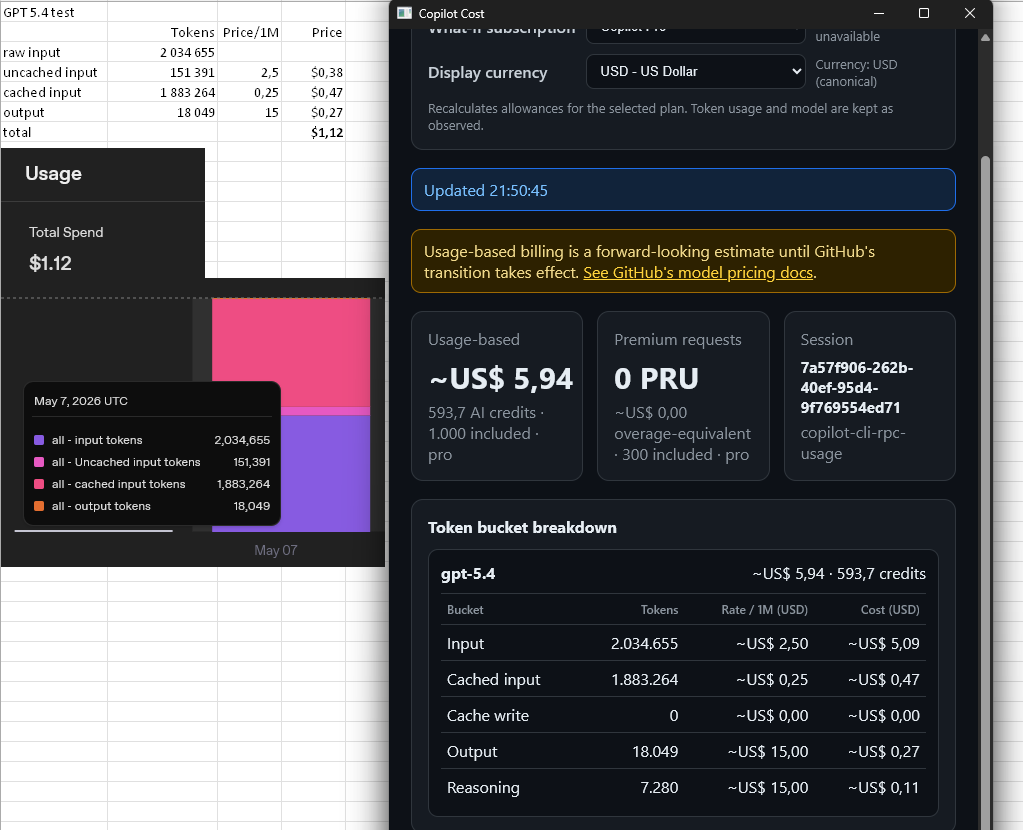
@DamianEdwards Sorry, what i meant to say was that this takes the total input tokens as base when it should actually use the uncached (input - cache).
I reproduced this using the OpenAI API directly via Copilot with your tool active:
I'm a dad and I don't want to give US Tech Bros photos of my child. Used to have a NAS, which works, but is kind of clunky. Friends of mine built https://t.co/7IFZeomMh5 and it's a wonderful solution. European data privacy and residency, beautiful smol team. Check it out.
@mitsuhiko@_ohhmaar@marlene_zw Just to make sure... I tried Pi for the first time today and logged in using my Copilot subscription via /login. Isn't that officially supported? Am I violating any Copilot Terms of Service by using it this way?
Judging by my tl there is a growing gap in understanding of AI capability.
The first issue I think is around recency and tier of use. I think a lot of people tried the free tier of ChatGPT somewhere last year and allowed it to inform their views on AI a little too much. This is a group of reactions laughing at various quirks of the models, hallucinations, etc. Yes I also saw the viral videos of OpenAI's Advanced Voice mode fumbling simple queries like "should I drive or walk to the carwash". The thing is that these free and old/deprecated models don't reflect the capability in the latest round of state of the art agentic models of this year, especially OpenAI Codex and Claude Code.
But that brings me to the second issue. Even if people paid $200/month to use the state of the art models, a lot of the capabilities are relatively "peaky" in highly technical areas. Typical queries around search, writing, advice, etc. are *not* the domain that has made the most noticeable and dramatic strides in capability. Partly, this is due to the technical details of reinforcement learning and its use of verifiable rewards. But partly, it's also because these use cases are not sufficiently prioritized by the companies in their hillclimbing because they don't lead to as much $$$ value. The goldmines are elsewhere, and the focus comes along.
So that brings me to the second group of people, who *both* 1) pay for and use the state of the art frontier agentic models (OpenAI Codex / Claude Code) and 2) do so professionally in technical domains like programming, math and research. This group of people is subject to the highest amount of "AI Psychosis" because the recent improvements in these domains as of this year have been nothing short of staggering. When you hand a computer terminal to one of these models, you can now watch them melt programming problems that you'd normally expect to take days/weeks of work. It's this second group of people that assigns a much greater gravity to the capabilities, their slope, and various cyber-related repercussions.
TLDR the people in these two groups are speaking past each other. It really is simultaneously the case that OpenAI's free and I think slightly orphaned (?) "Advanced Voice Mode" will fumble the dumbest questions in your Instagram's reels and *at the same time*, OpenAI's highest-tier and paid Codex model will go off for 1 hour to coherently restructure an entire code base, or find and exploit vulnerabilities in computer systems. This part really works and has made dramatic strides because 2 properties: 1) these domains offer explicit reward functions that are verifiable meaning they are easily amenable to reinforcement learning training (e.g. unit tests passed yes or no, in contrast to writing, which is much harder to explicitly judge), but also 2) they are a lot more valuable in b2b settings, meaning that the biggest fraction of the team is focused on improving them. So here we are.
"Using coding agents well is taking every inch of my 25 years of experience as a software engineer, and it is mentally exhausting.
I can fire up four agents in parallel and have them work on four different problems, and by 11am I am wiped out for the day.
There is a limit on human cognition. Even if you're not reviewing everything they're doing, how much you can hold in your head at one time. There's a sort of personal skill that we have to learn, which is finding our new limits. What is a responsible way for us to not burn out, and for us to use the time that we have?" @simonw
@burkeholland I’m skeptical, though, about whether the premium request model will stick around. I don’t think it’s sustainable in the long run to make a request that runs for two hours, uses 20 million tokens, and costs only $0.12. I’m enjoying it while I still can :-)
@burkeholland For now it's Opus for everything in our rather small software company with adversarial reviews baked in from other models. It's undoubtedly worth the 3 premium requests.
If the AI revolution doesn’t result in 10x higher quality software when being driven by experienced engineers, I’m gonna be so disappointed in us. We should be “over cooking” the things we undercooked before because of the cost.
Introducing dotnet/skills, a repository that hosts a set of agent skills for .NET developers from the team who is building the platform itself.
https://t.co/POeJiPkFPD