3 out of 4 #allireland 1/4 finals were lost by the team who scored the most per phase of possession and won by the team who won the most kick outs
County football has become less about football and all about who wins kick outs
It's a seismic shift
"Piggery", some might say
As scores per ten phases has rocketed in 12 months, the pattern is unlikely to change
Full thread below
@m_brosnan@shanemcgrath1
@offtheball@michellehealy21 Absolutely brilliant performance. What really stands out about this Galway group is their humility, and willingness to work hard for each other. Well done to Michéal, Franny, Noel and all the mgt and players.
Surely now the @amgenirishopen and @DPWorldTour will reconsider its location for the 2026 Irish Open. Since its owner is now also a war criminal after illegally invaded Iran.. this along with the numerous other offences committed. What sort of message is this to send out?!
I proposed
The "tap'n'go in 2007
To ban the backpass in 2017
The 12v11 unworkable in 2024
And I remain convinced the 3-2-1 scoring system needs changing
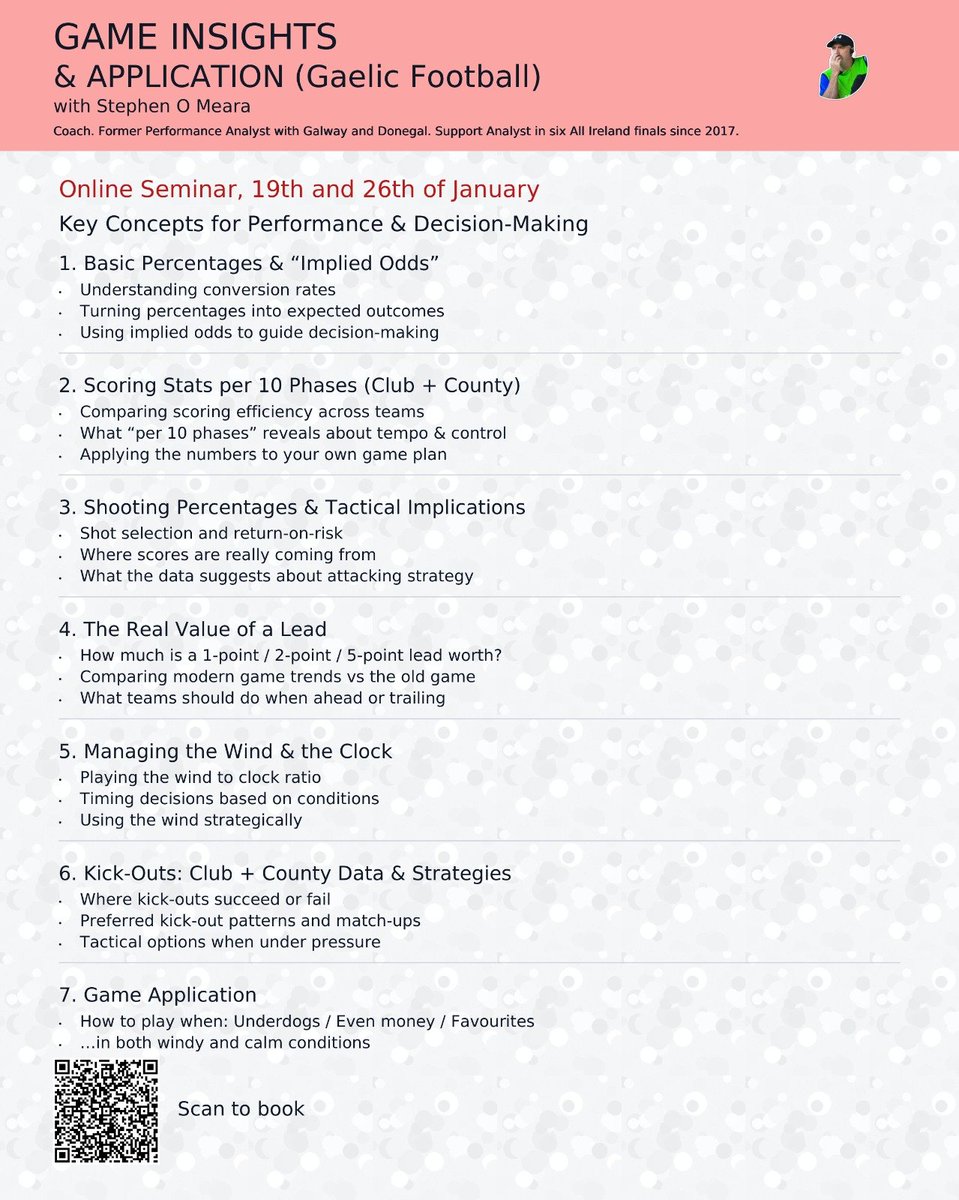
Understand why, and how it all affects tactics at my Zoom webinar
https://t.co/WvqzDcHnvb
Jan 19th 7.30 PM
Jan 26th 7.30 PM
Recordings e-mailed post Webinar
€49 for the lot
No Way that Free should have been brought forward 50m. The Dingle fella barged in to him. The St Finbarrs lad couldn't got out of the way. A cruel way to lose a Munster Final. Absolute Skulldugery.
A full break down on the new rules - what I see has improved the game, what is already not working and what issues I see arising as it evolves
☑️"Tap and Go" + 50 metre penalty. This combination is one of two changes which has wholly improved the speed of the game. Cynical fouling had the game ruined. A rule change crying out and is a game changer.
☑️Back-pass to the keeper. The second rule that was crying out. Plus-1 possession out of the back had become a key tactic and had turned Gaelic football into a slow, easy possession game, hard on the eye and reducing the need for skill. This simple rule change was crying out and now can reward high pressing.
There are still loopholes, which will probably become problematic, but nobody has spotted/used them yet
☑️Offensive mark - the old mark wasn't fit for purpose and I think the new "offensive mark" is far better. I see merit in the advantage element to incentivise a "shot to nothing" for a goal, albeit there haven't been many.
It's my belief that these three should have been trialled for a full year before any other major changes were made. But so many have been made, it's now hard to put a finger on what is making elements that aren't working as intended, go that way
❓11v11 - The jury is out, for me. Scores into set defences are up, proportionately, as a result of less numbers, on average, being behind the ball. That sounds good.
However, it's also made it more difficult, especially for the less athletic teams, to press out on the man when set in defence. This is allowing nouveau-Kerry style play where, once in the lead or playing into the wind, they hold the ball between the 45 and 56, luring teams out. It makes for dreadfully slow play, where teams are frequently standing soloing the ball on the spot outside a defence. Paddy Small found time for Ballymun against Castleknock a few weeks back to do a soccer dribble and then a few "keepy-uppies". It's already a major problem which I see this getting much worse as the game evolves.
The 11v11 certainly incentivises a lower defence for the athletically inferior teams. It doesn't auger well for what has clearly become a major issue with the rules
Of course, away from championship matches with four officials, it's completely unpoliceable and causing carnage. That's over 90% of games. I simply can't fathom that this can be seen as the future of club league and Intermediate and Junior championships in most counties
It's possible (we just don't know because it's never been tested) that having more than eleven behind the ball might have made for a better spectacle, now that the ball can't be passed back to a keeper/extra player. It would have allowed for teams to press out more aggressively and possibly prevent this style of play. We can't and won't know now as we skipped a natural testing stage in the potential evolution of the rules.
3v4 - this is obviously ties in with the 11v11. The one piece of personal philosophy, as opposed to tactical/statistical analysis is this - defenders having to turn around and count how many teammates are in the half, in my opinion, is anti-sport. It runs against against every natural dynamic, I personally believe in, in sport. As far as I'm aware, such a dynamic doesn't exist in any other sport in the world.
A lot of cheap scores are coming off this. I think celebrating higher scoring games off the back of this is a totally flawed argument.
A practical point - it frequently makes defences drop back to a defensive arc as they have to look around to make sure they aren't committing a breach, compromising their capacity to high press and make a more open game.
Had we not put the cart before the horse on this and trialled the other rules without an 11v11, had the 11v11 proven necessary after a year, a more natural approach would have been a 13 v13 game with a designated 1v1 in each half . That would mean the other 11 could run where they want, and referees wouldn't be trying to police the impossible - both far more natural sporting concepts, in my view.
❌3v4 penalties - I initially saw a value, within the context of the new rules, to give a 2-point free for breaking this rule when the other team has the ball. If this penalty didn't exist, there could be an incentive to break it to prevent a 2-pointer or goal threat.
However, I haven't seen a single example in over fifty games I've seen this year where a deliberate breaching of this rule would have represented value if the penalty was only a 1-point free. Hence, I think a 1-pointer would be enough of a penalty - representing enough disincentive to deliberately breaking the 4v3 rule. Two thirds of a goal for what is frequently a misdemeanour is just unnaturally high and sways games unnaturally.
One exception would be in the last 30 seconds where a team two points up could flood the defence . A simple rule where this offence in the final play of the game would result in one extra play until the ball would go dead after the kick-out, would solve this
As far as the penalty of a 2-pointer for breaking the 4v3 rule when your team has the ball goes - this has to be the most ludicrous rule in any sport in the world. It's like giving penalty against a team for being caught offside in soccer. It's absolutely irrational and illogical. A half way line free would surely be enough of a penalty. Surely losing the ball is enough of a penalty.
On that note, the wording of the rule makes no sense. It has to be a "deliberate" breach. Who in their sane mind would "deliberately" break that rule when their team has the ball? It makes no sense. And hence, by the letter of the law, none of these should actually be fouls as you'd imagine nobody would do it "deliberately" when their team has the ball. At the very least, that needs rewording.
Referees also need reminding of the "interfering with play" element of these rules. On breaches where the other team have the ball, fouls are frequently being called where a player is still well out from the play, realises he's breached, is nowhere near interfering with play, and gets blown up as he's nearly back at the half way line. A rule along the following lines would clear up the ambiguity - " where the breaching player is more then ten metres from the ball, behind the ball and not within ten metres of any opponent, he is allowed ten seconds to correct his breach". It would be more specific than "interfering".
❌40 metre kick-out - Designed to create more high fielding, it had achieved this to a point. However, the dribble kick-out and other elements is likely to reduce this.
As it stands, "the butterfly effect" off this rule has destroyed much of what the FRC were aiming to do.
A) it has packed the middle third, depriving space to play quick and/or kick passes forward
B) it's made zonal presses king. This also means that unless the kick is won straight down the centre, if the kicking team wins it, they generally have no choice but to play short diagonal hand-passes to get safe possession. This allows teams to set up a set defence where we're back to lads soloing the ball outside a set defence, and if they feel like it, doing "keepy-uppies".
It has literally deprived all possibility for the type of game the FRC were looking to create. Traditional Kerry, Corofin, Killarney Crokes type football is virtually impossible to play now.
With the backpass to the keeper banned, it is wholly unnecessary and counter-productive. Short kicks to the original "D" would represent far higher risk with the backpass rule and hence, a lot more kicks would have gone long anyway, but with more space to play when they'd have been won.
C) this has lead to a rule where you were getting an undefendable free run at the opposition once you caught a high kick-out. It's a terribly cheap score with no such rule in any filed sport I know of. It appears as though the FRC have recommended re-introducing it.
I personally believe it to be anti-sport, equivalent to giving a penalty to a team in soccer for heading the ball first off a kick-out
❌2-pointer - The idea is to incentivise long kicking and to disincentivise deep lying defences.
However, a deeper data analytics delve illustrates that it hugely reduces the incentive for quick transition football. The point and goal have been devalued. So, the funnel effect of the value being to get closer to goal is eroded. Many circumstances where it previously would have been value to quick transition or kick forward are now better value to slow the game down to set up outside a defensive arc where you can shoot for 2s.
It has actively disincentivised quick transitions and kicking football which the FRC wanted to achieve.
It is also highly likely, once teams have got to grips with a season of new rules, to lead to a scenario where teams actively set up to score 2s. It's likely to become basketball without a shot clock.
More significantly, the proportion of the 1-2-3 scoring system is all wrong. The data people in basketball are saying that the 3-pointer needs to be reduced to 2.5 (25 % higher than the 2-pointer). We've got a 100% subsidy. It's far too high.
If there's merit in it, 1.5 points would be sufficient to make defences push out but not create a dynamic where teams are actively setting up for 2s. I see this dynamic being the major flaw in the game over the next 12 to 24 months.
More significantly, it has begun to lead to teams actively trying to hold possession for as long as possible into the wind, defeating the object of what the rules were designed for. I can only see this getting worse.
Worse again, from what I've seen so far, in all five club championship games with significant winds where the bookies' odds were no greater than 55/44 the team who've played into the wind in the first half have won. If this plays out over a larger sample size, and I suspect it will, it's completely unsporting - stacking the chances of winning a game based on the toss of a coin.
Worse, where winds reduce between a first and second half, it makes an even matched contest almost unwinnable. It's completely unsporting in my view.
❌ 1v1 throw in. It's not the 1v1 is the problem. It's the 6v7 when you lose it. Why not line the two spare men up beside each other.
IT's a completely unnatural an ant-sport dynamic. The only sport or game in the world I know where a team can't defend from the first point of play.
It probably sums up the whole thing for me. It appears to be a cheap marketing trick to get games exciting from the off, but completely lacks in sporting integrity.
Conclusion - whether you like to believe it or not, proportionately to all phases
- forward kick passes are down (not including frees)
- the value off forward kick passes is down
- plays into set defences are up
- turnovers in the other half are down
To my mind, a game gone bad is now a different version of bad...and it's going to get much worse
@m_brosnan@CahairOKane1@lanno10@malmcmullan@MickFoley76@lonesharkoy@SmallerFishGAA@MalachyClerkin@DeclanBogue
At what point do the FRC realise that the 40 metre arc has murdered end to end kicking football?
They've traded high fielding for any capacity for consistent kicking football
You'll never see a game like Kerry vs Dublin 2013 again. Jim Gavin vs Éamonn Fitzmaurice!
The space opened up by the act or threat of a short kick out is what allowed for end to end kicking football. And there were still plenty of long kick-outs too
The 40 metre kick out clogs the centre and kills any prospects of an open field
While assuring we've escaped from the increasingly common, humdrum keeper in possession games (which only required banning passing to the keeper), they've also insured we'll never get end to end kicking games either
It's a depressing choice they've made. It's even more depressing that they've got there without any open debate
The Square D is back for the All Ireland 1/4s
If you want some insight into the maths behind the new game, here it is
The FRC kick-pass dream not a reality as "through the hands" football is king - Kerry and Donegal the primary exponents
Kick-outs are key, but the data is not straight forward. Armagh and Dublin paid the price
Tyrone's 2-pointer and long kick-out success but failure to beat set defences, again
Meath's high turnover success and kicking transitions
Donegal's efficient attacking but porous defending, until 2nd half
Galway losing value on short kick-outs and the kicking game not working
The Dubs a shadow of the past, but an Expected Score draw