The macro repricing of energy is now underway. Check out today's move in long dated oil - that's calendar 2027 WTI. When long dated oil moves this strongly in tandem with energy equities making new ATHs, financial markets need to listen. This is not a transient spike in prompt oil. It's far more structural. Get long, buckle your seat belt, and hang on for the ride.
If I'm not mistaken, Anthropic's 85% gross margin and >40% compute margin from this Bloomberg story implies that 70-75% of their compute is now going to R&D.
https://t.co/c812lWQdmz
The amount of CPUs we're going to need over the next five years is actually ridiculous.
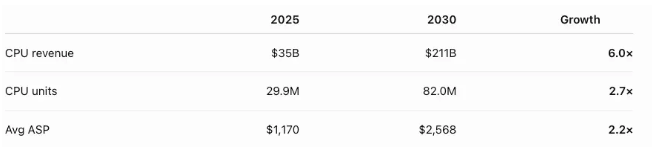
According to AMD's projections, the data center CPU market is expected to grow from $26 BILLION in 2025 to roughly $220 BILLION by 2030. That's nearly an 8.5x increase in just five years. Now let's put that into perspective. If we assume an average selling price of $3,000 per data center CPU, that would translate to roughly 73 MILLION CPUs being sold annually by 2030 or nearly 200,000 CPUs every single day. Obviously, this is just an estimate since CPU prices and configurations will change but it gives you an idea of just how much computing capacity we're going to need.
And look at $AMD, its server CPU shipments are projected to grow at 25% annually, reaching roughly 23 MILLION units by 2030. At the same time, average selling prices are expected to increase by 9% annually to roughly $2,500. That's potentially $57.5 BILLION in annual server CPU revenue alone for AMD by 2030, assuming these projections play out. And that's BEFORE accounting for its AI accelerator business.
Speaking of which, the AI accelerator market is projected to grow from roughly $200 BILLION today to nearly $1.4 TRILLION by 2030. I think one of the biggest reasons behind all this growth will be agentic AI. We're moving toward a world where AI agents are constantly executing code, interacting with software, searching databases, and completing tasks in the background. A lot of that work still requires CPUs, even if GPUs are doing the heavy lifting for the AI models themselves. And remember, more CPUs means more DRAM demand, while more AI accelerators means more HBM demand. Then you have all the networking, storage, and power infrastructure needed to support these systems. This is why I'm so bullish on the broader AI infrastructure buildout. We're not just going to need more GPUs. We're going to need significantly more computing capacity across pretty much every part of the data center.
🔊 𝗦𝗢𝗨𝗡𝗗 𝗢𝗡: Listen to the incredible reception Scott McTominay received on his return for Napoli after his recent heart surgery. https://t.co/LzehHxJZIL
I got a lot of thoughtful feedback after publishing the original post - thank you to everyone who took the time to read it, challenge the assumptions, and share data points. A few of the pushbacks changed how I think about the framework, so I wanted to write a short follow-up and lay out the main areas of disagreement.
Where the feedback roughly landed
Most clustered around ~0.2–0.3GW for standalone/agent CPU at 100M DAU, versus ~0.1GW in my original estimate.
Inference demand is all over the place.
---
1/ My CPU scope was too narrow.
My original CPU estimate focused mainly on the agent sandbox/VM. Separately, my inference estimate modeled GPUs, but did not include the head-node CPUs that support the GPU fleet.
One clarification: tool execution is not necessarily a separate CPU bucket. Browsers, code, and tools often run inside the sandbox itself; orchestration may run in a separate backend or share other CPU infrastructure.
So I now think about CPU demand as two main pieces:
Standalone / agent-execution CPU
Sandbox + the actual work happening inside it + some orchestration
Head-node CPU
CPU required alongside the GPU/XPU fleet ≈ GPU/XPU fleet × CPU attach rate
2/ The sandbox itself may need more CPU than I assumed.
The original estimate used the 2 vCPU environment exposed by Muse as a starting point. But provisioning a lightweight VM is different from the physical CPU consumed once agents are actively running browsers, code, tools, and multiple tasks.
The bigger long-term question is also whether one human request continues to map to one agent. A request could increasingly spawn 4–8 sub-agents, or eventually become agent → agent → agent. Usage will likely be highly skewed toward power users, and infrastructure also needs to be provisioned for peaks rather than averages.
A more complete framework is:
Standalone CPU demand
users
× tasks/user/day
× agents/task
× active time/agent
× physical CPU per active agent
× peak factor
There are a lot of moving pieces here, but I suspect agents per task is one of the biggest long-term swing factors.
3/ Inference may also be understated, but for a different reason.
The relevant unit probably isn’t simply “human messages per day.”
A consumer might only initiate 5–10 meaningful tasks per day, but one agent task could require dozens of model calls as the agent reasons, uses a tool, observes the result, reasons again, etc. So a better framework is:
GPU inference demand
users
× tasks/user/day
× agents/task
× model steps/agent
× tokens/step
This is also where the feedback was most dispersed. Some people think 50+ model steps for a meaningful agent task is completely reasonable; others think an assumption of 50 consumer-initiated events per day is far too high. Those aren’t necessarily contradictory - tasks/day and model steps/task are different assumptions.
---
How this compares with sell-side CPU math
The sell-side approach is generally much more top-down.
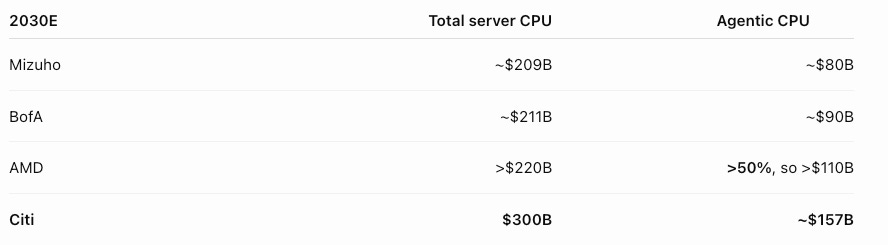
Using BofA as one example - they estimate total data-center systems TAM growing from roughly $506B in 2025 to $2.56T in 2030, while assuming CPUs remain around 7–8% of total system value. That gets them to roughly $211B of server CPU TAM in 2030.
Their CPU bull case is essentially:
AI infrastructure spending gets much larger
× AI becomes more CPU-intensive relative to GPUs
× agents create a new standalone CPU compute layer
× AI CPUs get more expensive / higher-spec
BofA splits the 2030 number into roughly $90B of GPU-attached/head-node CPUs, $90B of standalone agentic CPUs, and ~$30B of traditional server CPUs.
++
Better formatted version: https://t.co/qVwYKNr1ZA
++
Thank you again to everyone who challenged the assumptions and shared thoughtful feedback - I learned a lot from it!
Messi scoring into the top corner on his farewell appearance while Ronaldo is busy releasing 2,000-word statements comparing himself to Pele and Maradona having scored in 2 of his last 9 internationals perfectly sums up how one-sided this rivalry became.
Tried this after sitting at my desk for 10 hours and my neck/shoulders were screaming.
Literally 8 seconds later the pain just… vanished.
No fancy equipment. No expensive massage. Just a towel.
If you carry tension in your upper traps or wake up with a stiff neck, stop scrolling and try this right now.
Your future self will thank you.
(And yes, I felt stupid for not knowing this earlier.)
15–20 reps of each every day is realistic and smart.
These moves target the real reasons most people look “soft” even if they’re not overweight:
– anterior pelvic tilt
– tight hip flexors
– rounded shoulders
– weak glutes
Consistency > intensity here. Save this one.
IF YOU’RE A FINANCIAL ANALYST, THIS IS WORTH PAYING ATTENTION TO
These guys just launched Filot Autopilot, a finance tool that can basically keep your financial models updated for you as companies report earnings.
So your laptop could be closed, earnings could drop, and the system can still pull the new filings, transcripts and numbers, update the model in the background, and have it ready for you to review.
And I think that’s really the interesting part here.
A lot of an analyst’s time during earnings season is still spent doing pretty repetitive work, updating numbers, checking models, making sure everything ties out.
If tools like this can handle more of that reliably, it probably means analysts can spend more time on the higher-value part of the job: actually understanding what changed, what matters, and what the market might be missing.
Here is Elon Musk's and Jensen Huang's full interview alongside Gavin Baker today during the White House livestream.
They take about power needs in the coming years, Super-intelligence, Starship, how AI is helping the average American, and more.
Yup. The latest models from Anthropic, OpenAI and Google no longer expose their full chain of thought as plaintext. As distillation becomes less effective, open-weight developers will need to invest more in their own reinforcement learning, synthetic data generation and training environments. All require compute.