@aresotik Que un agente pague facturas, bien. Que pague una con un IBAN que cambió ayer por un correo, no.
Lo difícil no es el pago, son las compuertas: límites, proveedores aprobados y una persona que firma todo lo que sale del patrón.
¿Versine trae límites por agente?
Totalmente. Y un paso antes de sumarlo: ponlo en modo sombra.
El agente trabaja con datos reales y propone, pero no ejecuta. Comparas sus decisiones con las de tu equipo unas semanas y, si acierta, pasa a producción con aprobación humana en lo que mueve dinero.
¿Con cuál de los tres empezarías?
"Testing on data that resembles the real workload" is the whole game.
For agents in production we push it one step further: every failed trace becomes an eval case before the fix ships. The suite grows from real incidents, not synthetic prompts.
How do you handle drift when the web results change between runs?
Right about the system of record, wrong about the order.
Before rewriting a line, put the agents you already run under audit: shadow mode first, human gates on money, every incident turned into a test.
Auditability is a process, not a repo. https://t.co/p6rSoDUu4x
All, I repeat ALL, existing software needs to be rewritten. Because this software was written by humans it is both inefficient and insecure. The cost of inefficiency and insecurity in a pre-AI world was moderate, but in a post-AI world it will destroy your company.
This new effort should not be a bottoms up exercise where engineers get to have an opinion about how they set up their repo or which coding assistant to use.
This needs to be done in a new, top down system of record that focuses on auditability, drift detection and verification among other things.
Every company needs to do this asap as today has shown.
If you want help: https://t.co/fkfTXgdfXK
The system of record part is the real point. Rewriting everything is the expensive half.
What breaks first in practice: agents writing into old systems with no audit trail.
Our order: shadow mode on real data, a human gate on anything that moves money, every prod trace turned into a regression test.
Capgemini preguntó a 1.000 directivos por los agentes de IA en su cadena de suministro.
El 22 % ya los usa o los probó (16 % en 2025).
Solo el 25 % espera una cadena totalmente automatizada en 3–5 años (37 % en 2025).
El 84 % quiere que una persona valide lo que decide la IA.
Más uso y menos fe en la autonomía total. Es lo que le pasa a una demo cuando llega a producción.
We run our company with 10 AI agents on one server. Treg is where they get their data: SERP, SEO, B2B enrichment, all through one MCP.
What surprised me: pay-per-call puts a price on every task. Our marketing agent's last research plan cost $1.23.
Our rule: agents ask before any paid call.
An agent with a budget behaves differently from one with an API key.
OpenSource our AI-UGC workflow
For as low as $0.2/s instead of $50 per video
Try it here: https://t.co/DBdmmcWHHy
Reverse-engineer trending videos to scalable UGCs that brings $$$ millions of impressions
Repo link below 👇
@luisnhenrich Exactly. We score the shadow run against what buyers actually ordered that week. The agent's draft is what's being tested, never the reference.
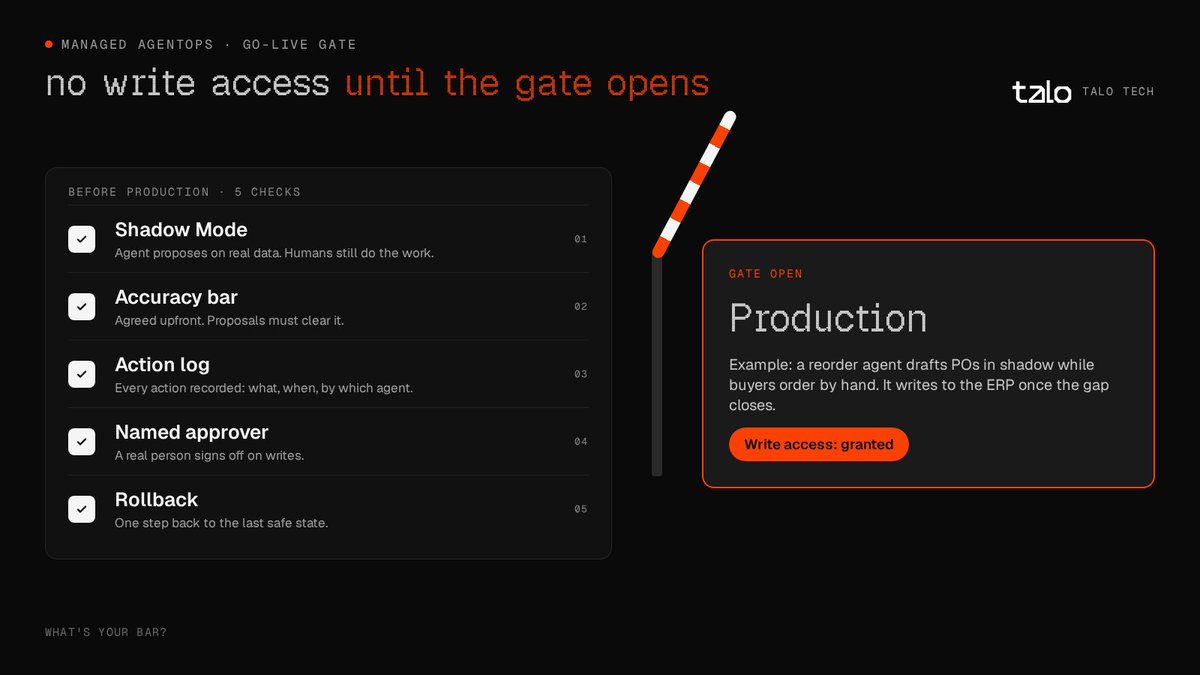
Before an agent gets write access, it passes a gate: Shadow Mode, an agreed accuracy bar, every action logged, a named approver, a rollback.
Example: a reorder agent drafts POs in shadow while buyers order by hand. It writes to the ERP once the gap closes.
What's your bar?
@rodriguezhernan Ponerle precio a cada llamada cambia cómo se diseña un agente. Nuestro último plan de investigación de marketing costó 1,23 $.
Regla: el agente estima el coste antes de lanzar la tarea y, si pasa un umbral, pide aprobación.
@dannypostma Service businesses are the right target: the work already lives in SOPs.
I'd run each SOP in Shadow Mode first. The agent does the job in parallel, you compare it with what the team actually shipped, and it only gets write access once it matches.
@dabit3 20-day threads work for reads and drafts. The moment an agent posts to the ledger, it should stop for a human and log who approved what. That's the part auditors will ask about.
@expansioncom Rellenar un formulario es una lectura con pasos. Pagar es una escritura.
Nuestra línea: el agente prepara todo, una persona confirma el pago y queda registro de qué se pagó, a quién y quién lo aprobó.
@michael_chomsky The best evals we've seen come straight from production traces.
Every time a human rejects an agent's proposal, that trace becomes a test case. The suite grows from real failures, not imagined ones. Trace-to-Test.
@dannypostma "Asks me before anything risky" is the whole product.
The hard part is defining risky up front: reads are free, anything that sends, pays or signs goes to a queue with the draft visible. Log every approval so you can tune that list later.
Cada acción de un agente debe dejar rastro: qué leyó, qué propuso, quién lo aprobó y qué cambió.
Un agente corrige un precio en el ERP. Sin registro, el lunes nadie sabe por qué. Con él, ves quién lo aprobó y el valor previo.
¿Puedes reconstruir lo que hizo tu agente ayer?