Thrilled to lead the Standard Bots Series C
Industrial robots can be thought of as the GPU of industrial work. Powered by AI, they’ll be able to power much of the work required in industrial settings - welding, machine tending, assembly, dispensing, sorting, the list goes on. Industrial robots have existed for decades, but it’s important that they’re built and designed for an AI native future.
The work they’ve done over the past decade was not easy - vertical integration, engineering their own parts and a plan to manufacture all of it in America. We talked to many industrial customers and asked them to compare them to the other companies and products on the market and Standard Bots overwhelmingly received the highest marks.
AI-native robot adoption is not a 5-10 year in the future event. It’s happening now and Standard Bots is at the forefront of that. If we want to reindustrialize America and massively scale American manufacturing then we need millions, eventually billions of robots produced in America.
Standard Bots stands to be one of the pillars of American reindustrialization.
Highly recommend following @standardbots & @evanbeard
The first RoboStrategy Investor Day is Wednesday, June 10 at 10:00am ET
The team will walk through the robotics thesis, fund, portfolio, and how we invest in robotics and physical AI
Will be streamed from the @RoboStrategy account on X - follow and turn on notifications 🔔
First Podcast Appearance in 5 years
Building a Robotics focused investment firm has been one of the most fascinating experiences of my life
Robots will be as ubiquitous as smart phones within a decade. Everyone should be paying attention and the @RoboStrategy team will be sharing much more about the most exciting developments in the industry
Not enough people are talking about physical AI and robotics.
I sat down with @rewkang, one of the best investors of the last decade, to discuss his massive bet on humanoids and robotics.
He breaks down the industry, the addressable market, multiple leading companies, and why he launched a publicly-traded fund ($BOT) focused on investing in the top private robotics companies.
YouTube: https://t.co/aBFxTzP2Kg
Apple: https://t.co/9KnbfWL6Wv
Spotify: https://t.co/ZVRprV7bdT
TIMESTAMPS:
0:00 - Intro
1:28 - Why Andrew shifted from crypto to humanoid robots
3:58 - How big is the total addressable market?
8:08 - Building conviction — the $19M bet on Figure AI
16:06 - US vs. China — who wins the robot race?
28:08 - General purpose vs. specialized robots
31:05 - Where does training data come from?
40:24 - Humanoid robots in your everyday life
43:27 - Can Tesla & Elon win the humanoid race?
46:19 - Job displacement & UBI
51:15 - RoboStrategy — the publicly traded venture fund
1:11:17 - What is exciting about Apptronik?
1:13:24 - Addressing the critics
Jack brings a unique mix of technical and commercial expertise after spending a decade in the robotics industry as a former operator/founder
We’ve effectively been building @Robostrategy in stealth for a year, assembling a team of robotics vets across investment and research (also still hiring exceptional talent)
Excited to share a lot more with the world very soon
Proud to announce my position as CEO of @RoboStrategy.
When I initially started looking into investing in robotics 2 years ago most VCs I consulted with recommended not to invest in the space. Robotics companies at this time did not have an easy time raising capital. The industry didn’t have a track record of big venture winners, was perceived to be challenging for a variety of reasons, and was not well understood. But it was clear to me that the rate of acceleration of physical AI development would dramatically change the industry. I invested $19m into FigureAI as my first investment.
I believed it was a question of when, not if we could imbue machines around the world with physical intelligence. To accomplish this, the industry would need a tremendous amount of capital to grow, and also an investment firm that deeply understood the needs of robotics/physical AI companies so that it could build a platform to better support them. It will take hundreds of billions to capitalize the mechanized future meaning there is a big gap in the market. We decided we wanted to fill it.
Previously, Mechanism Capital had never taken outside capital, but to do this at the scale I envision, I would need to do so. However, the private markets don’t have that scale. The public markets do, and it was clear that there is and likely will be tremendous appetite for public market investors to participate in the immense value creation happening in AI & robotics that only private market investors currently have the privilege of accessing. The explosive growth of AI companies is a precursor of what will happen in physical AI. So in 2025, we founded RoboStrategy and a year later, we took it public on Nasdaq. Throughout this year, we’ve assembled a great portfolio, started leading rounds of some amazing companies, and have built the foundation to be ready to scale to the next level after going public.
We look different from a traditional VC firm in ways that founders appreciate. Our structure as a closed end fund means our capital is permanent - no fund life meaning we can invest with extremely long time horizons. Our investment firm also of course needs to have deep industry and research experience so that it can make the best risk reward optimized investment decisions. In the last year, we’ve brought on some truly exceptional robotics industry veterans who have previously served for decades as founders/operators. Many founders we talk to consider us as the most sophisticated venture capital firm they’ve talked to and we only intend to grow our expertise in the industry. RoboStrategy’s success depends on our ability to distribute the fund and capture maximal mindshare. This plays to our team’s strength in digital marketing and social media. We’re building a special marketing engine that serves as an attention amplifier for both us and our founders so that our products and stories can reach more people.
A source of inspiration for our fund structure, Strategy (MSTR) raised tens of billions from public capital markets to invest in Bitcoin. I believe robotics will be a much larger industry than Bitcoin and the asset class is orders of magnitude less accessible. We are aiming to raise more and not only become the largest robotics investor globally, but also one of the largest venture capital funds in the world. Venture capital has traditionally been restricted to a limited group of investors. We are changing the paradigm and bringing it to the rest of the world.
Be sure to follow @RoboStrategy.
Job’s not finished.
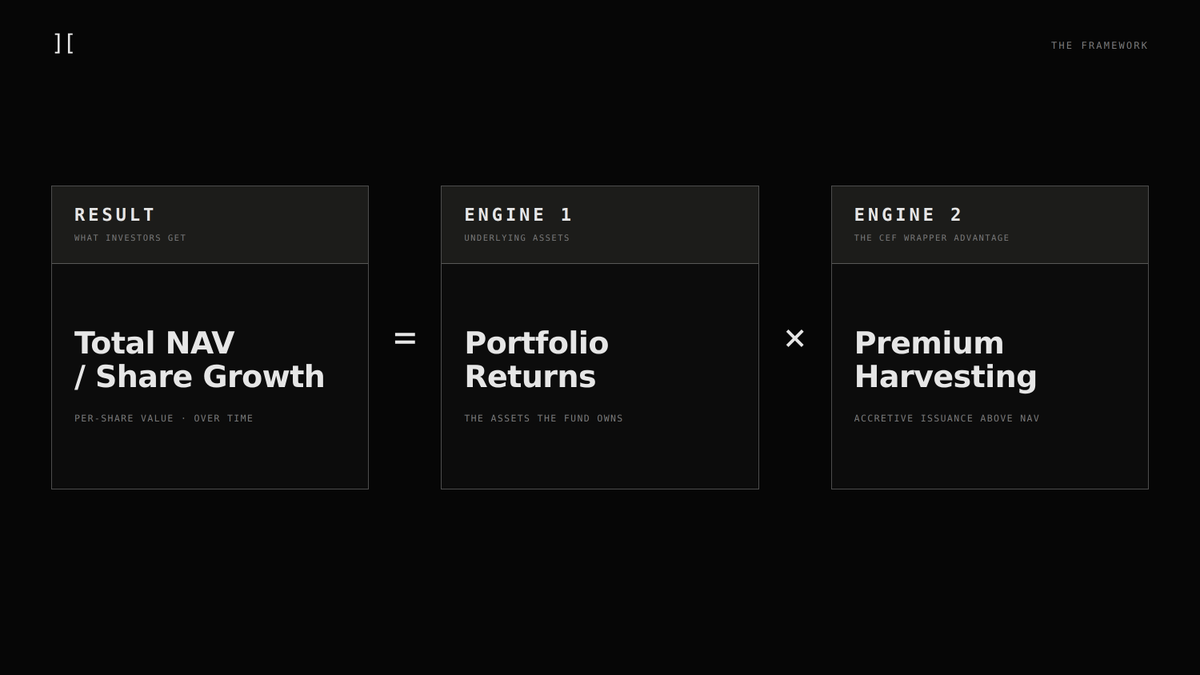
MicroStrategy for Robotics - How does RoboStrategy's capital markets model work?
Public capital raised at scale, redeployed into leading private companies in robotics.
A primer on how a publicly-listed vehicle can compound NAV per share over time via accretive share issuance:¹
RoboStrategy, Inc. (Nasdaq: BOT) Enters Into Committed Equity Facility of up to $2,000,000,000 from Roth Principal Investments, LLC to Support Strategic Growth Initiatives
https://t.co/Rc0EjzRFIv
2025 was an insane year for robotics research
Long time model architecture/training challenges were solved and major progress was made on data collection techniques, understanding data quality, and data recipe. This gives Physical AI companies the confidence to finally start investing in large scale data collection.
You saw companies like Figure, Dyna, and PI reach >99% success rates in real life deployments in diverse settings by leveraging RL innovations. Many frameworks were developed for self improving and self-recovering robot models. Researchers figured out how to prevent overfitting in VLA fine-tuning while retaining generalist capabilities. Which means we can build toward generalist models by merging specialist models.
Robots can also move much more agilely from methods like action chunking and FAST tokenization. We see robots able to exhibit smooth full body control at human speeds and not slow or choppy movement.
Roboticists showed how to effectively fuse multi-modal sensor data for huge policy improvements. Integrating vision, language and tactile data was challenging, but doing so opens the door for many contact rich tasks that require a granular sense of force. Force awareness also solves for common issues like visual occlusions.
System 1/2 architectures were hardened to handle long-horizon planning/ task orchestration which enable robots to perform jobs that require series of tasks. Gemini Robotics-ER 1.5 introduced Chain-of-Thought reasoning to physical agents, allowing them to parse constraints and evaluate Semantic Safety.
Memory advancements allowed robots to maintain long-term spatio-temporal reasoning, breaking the "memory wall" with brain-inspired algorithms. NVIDIA's ReMEmber used memory-based navigation, while Titans + MIRAS enabled test-time memorization for sustained performance.
Advancements in the foundation model space also continue to compound progress in Robotics. Better VLMs means VLAs with better spatial understanding and data labeling and processing pipelines that can massively increase in throughput. World models are starting to show promise in data augmentation and policy evaluations.
2025 gave us a small taste of what data scale could do. A glimpse into the future with robots exhibiting emergent intelligence such as zero-shot affordance mapping, visual force sensitivity, and all sorts of general physical reasoning
2026 we get to experience physical AI with 100x the data scale
We’re excited to colead Dyna’s Series A with a $68M investment
Dyna is one of the ONLY companies that have performant physical intelligence models that are ready to be deployed in the real world
Physical AGI is coming!
Make sure to follow @Lindon_Gao@JasonMa2020@YorkYang5050
Earlier this year, we led an investment consortium that invested $120M into @Apptronik
This is our thesis on Humanoids and Apptronik
https://t.co/s1erpMir9v
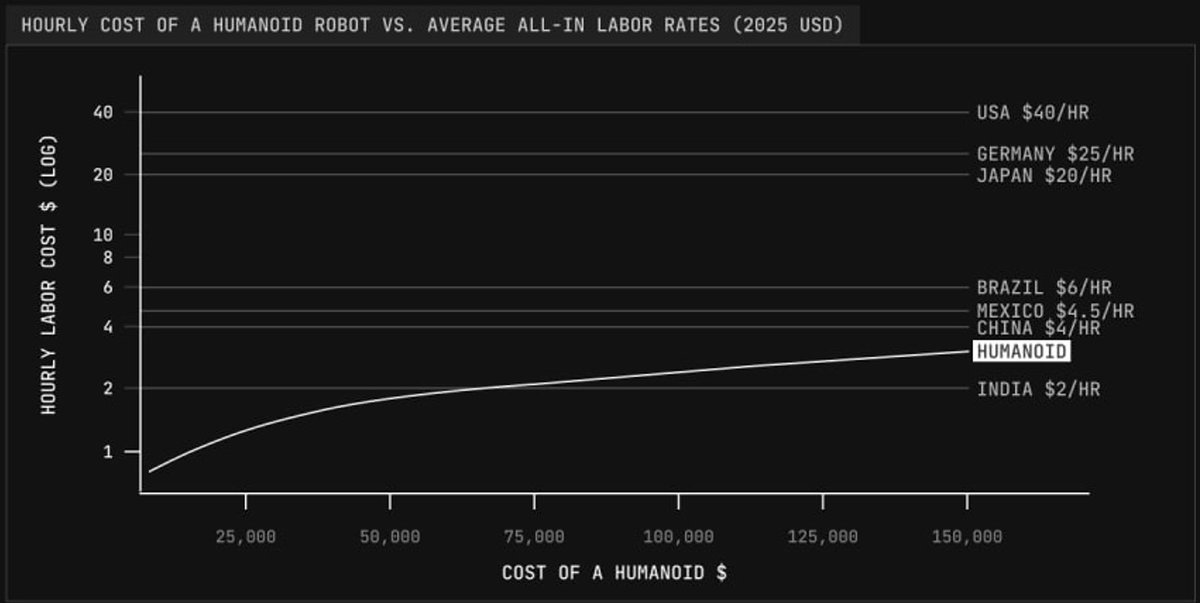
We took a look at the hourly cost equivalence of a humanoid at different price points vs human labor
A humanoid at $50,000 is more economical than even a worker in India at $2/hour
Human labor will be mostly unnecessary in the next decade
Rewriting Crypto Trading Capital Structures - @breakoutprop
Access to capital is a huge barrier for retail crypto traders. This forces them to choose between trenches or irresponsibly high leverage. There’s a better way.
Crypto trading is evolving from a monolithic, collateral-heavy world to a modular, capital-efficient future. Just as DeFi unbundled exchanges into primitives—AMMs, oracles, lending markets—we’re now seeing the capital stack itself rearchitected.
The old way? On traditional venues you front the capital and take all the risk. Leverage amplifies both gains and catastrophic losses. It's a system designed to bleed most traders dry.
@Breakoutprop has a different model. They’re pioneering this shift by rewriting the trading capital structure stack by allowing users to trade with capital—not against it.
Instead of your capital at risk, it's theirs. Traders bring the skill, they bring the capital. Both share the trading profits. Pass the evaluation, and traders get access to house money and no liquidation anxiety.
It’s a structure that flips the script: risk is externalized, alpha is rewarded. The structure prioritizes upside for performance. Better traders can fast track their portfolio growth without resorting to high leverage.
What Breakout is building isn’t just a funding model; it’s a new financial primitive that slots cleanly into the emerging modular trading stack. Think: execution layer, perp infra, and now → capital-as-a-service.
Breakout accounts scale up to $100K in size (with max combined capital of $200K), and traders can access 5x leverage on BTC/ETH and 2x on altcoins. In practice, that means <$1K in evaluation fees can unlock up to $500K in buying power—without debt or collateral. Both traders and Breakout win, when traders win, but traders keep 80–90% of profits, benefiting from instant, unconditional withdrawals. The model rewards precision over risk, and talent over bankroll.
In a world moving toward unbundled infrastructure and composable finance, Breakoutprop is a bet on crypto-native trading capital structures. We believe this is how trading should look: permissionless access to capital, aligned incentives, and modular design.
Traders can use code 'APE' for a discount at checkout
@MechanismCap invested in Breakout in 2024 and since then they've attracted over 30,000 unique users with May volume exceeding $4B
This past year has been one of the most interesting of @MechanismCap's history
We continued to back some stellar crypto teams across synthetic dollars (@ethena), memecoins (@pumpdotfun), distributed AI systems (@NousResearch + @PrimeIntellect) and consumer (@defiapp)
But we also expanded heavily into Deeptech backing companies in Robotics (@Figure_robot + @Apptronik), Brain Emulation, and Nuclear
The pace of change in the world is the highest it's ever been and its a great time to be part of it









![RoboStrategy's tweet photo. ][ https://t.co/bdJ30QTEhz](https://pbs.twimg.com/media/HINNyWKWwAAlwyc.jpg)