We let the Internet down today. Here’s our technical post mortem on what happened. On behalf of the entire @Cloudflare team, I’m sorry. https://t.co/uTi23Vcx0g
When I started competing, I had a small dream - to one day compete alongside the able-bodied and win medals ♥️ I didn’t make it at first, but I kept going, learning from every setback.
Now, that dream is one step closer. 🌟
In the Asia Cup trials, I secured Rank 3 and will now represent India in the Asia Cup - in the able-bodied category. 🇮🇳
Dreams take time. Work. Believe. Repeat. 💫
Habits that have a high rate of return in life:
- sleeping 8+ hours each day
- lifting weights 3x week
- going for a walk each day
- saving at least 10 percent of your income
- reading every day
- drinking more water and less of everything else
- leaving your phone in another room while you work
An exciting milestone for AI in science: Our C2S-Scale 27B foundation model, built with @Yale and based on Gemma, generated a novel hypothesis about cancer cellular behavior, which scientists experimentally validated in living cells.
With more preclinical and clinical tests, this discovery may reveal a promising new pathway for developing therapies to fight cancer.
Growing up in Silicon Valley, I believed tech was meant to democratize opportunity and accelerate human progress. The early ethos of the Valley wasn’t just about building profitable products, but about shifting the trajectory of lives and societies. There was idealism, for sure, but also a serious belief that technical breakthroughs should serve human success.
But somewhere along the way, parts of the industry traded vision for vanity. As capital flooded into tech, incentives shifted. Virality began to outpace value. The goalposts moved from solving hard, important problems to maximizing engagement, retention, and monetization.
Today some of the brightest minds are pulled towards optimizing ad clicks and frictionless dopamine loops. Why? (Insert disclaimer: The issue isn’t the people).
Innovation isn’t dead. (Insert disclaimer again: Many technologists are building remarkable human-centered tools.) It’s worth asking again and again: What is worth building? And who is it truly for?
The hallmark of expertise is no longer how much you know. It's how well you synthesize.
Information scarcity rewarded knowledge acquisition. Information abundance requires pattern recognition.
It's not enough to collect facts. The future belongs to those who connect dots.
Men become more caring when they become girldads.
Data on >12k CEOs: After having a firstborn daughter, men spend 10% more on social responsibility initiatives—especially culture, inclusion, and the environment. They also pay female employees better.
Daughters activate empathy.
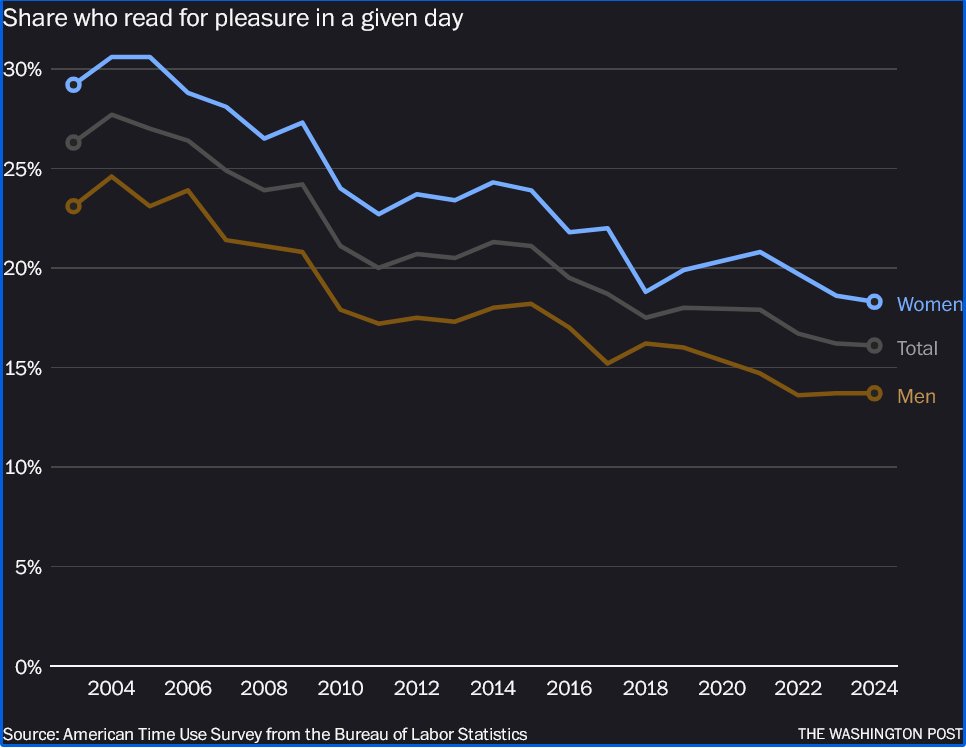
The love of reading is an endangered species.
Just 16% of Americans do regular leisure reading—down from 28% in 2003. 41% of UK parents read daily to their toddlers—down from 64% in 2012.
Books aren't only a source of flow. They're a gateway to empathy and lifelong learning.
Cheat code for life: Surround yourself with people who root for your growth, not your comfort. The ones who refuse to let you coast. Who celebrate risks. Who hold you to a higher standard. Who force you to think bigger. Give your energy to those who give it back 10 times over.
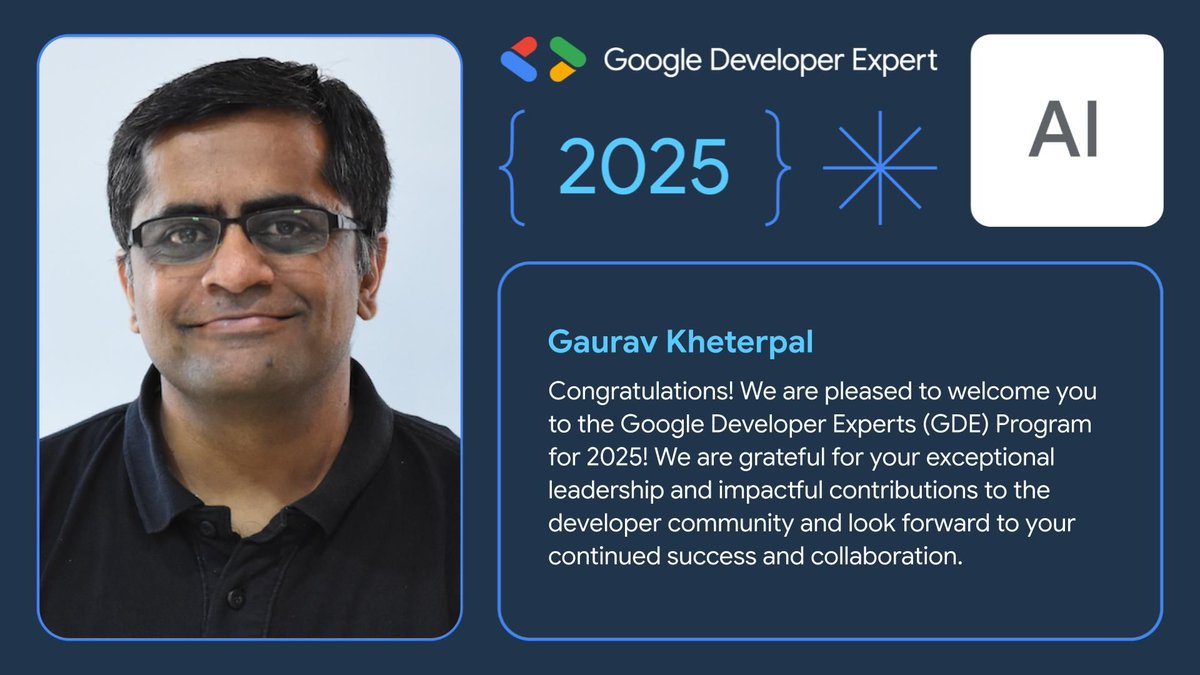
A few weeks ago, I became a Google Developer Expert for AI at the age of 47! Someone said I’m TOO OLD for this so I thought I'll post here to share my perspective on it.
@GoogleDevExpert is a recognition given to people across categories such as AI, Cloud, Flutter & more based on their knowledge & community contributions. Less than 1500 GDEs globally!
I've not been very active on @X and I probably wouldn't have posted it all - if it was not for an interaction which left me questioning how people judge on age - in addition to ethnicity, skin colour, religion, gender & more!
At a recent event, I got introduced to this 20-something CEO who claimed he knew it all, a self proclaimed expert building the next BIG THING on AI.
Then he asked me what model I thought was best for few-shot learning in multilingual NLP.
I said:
“Depends — are you optimising for inference latency or token accuracy on code-mixed datasets?”
He blinked. Paused. Then changed the topic to the fact that he's about to hit 100K subscribers on YouTube teaching AI.
He didn’t know what few-shot meant.
Didn’t understand what code-mixed datasets were.
But had plenty of opinions — including that I was too old to be in AI. And add to that, his YouTube fan following - probably all AI generated content.
So here’s to the late bloomers.
To the second careers.
To everyone who’s been told they missed the bus.
🚫 You’re not too old.
⏳ You’re right on time.
🔥 Keep learning. Keep building. Keep showing up.
At 47, I became a Google Developer Expert in AI - my knowledge matters, not my receding hairline.
And I’m just getting started.
@googledevs@GoogleAI
#GoogleDeveloperExpert #GDE #AI #GenAI #GoogleDevelopers
Our scarcest, most precious resource is not time or energy. It’s attention.
Our circumstances are often beyond our control. Our concentration is within it. Where we focus shapes our happiness, success, and relationships.
Undivided attention is the most basic currency of care.
I got this image forwarded - on India vs China startup ecosystems.
China does all the things India does (Fintech, edtech ..) but China also invests in deep tech. We have to deepen our tech.
That awareness is spreading so I am optimistic it will happen.