We asked an unreleased research version of Claude to take a stab at the Riemann hypothesis.
It didn’t solve it, but it did make strides on a related problem: it increased the lower bound for the fraction of zeros of the Riemann zeta function that satisfy the hypothesis from 41.6% to 67.2%.
https://t.co/aZDvqqhHRi
Eric Schmidt says intelligence is about to decouple from us.
“The computers are now doing self-improvement.. They don’t have to listen to us anymore.”
Within six years: a mind smarter than the sum of humans -- scaled, recursive, free. We have no language for what’s coming.
Everything you love about generative models — now powered by real physics!
Announcing the Genesis project — after a 24-month large-scale research collaboration involving over 20 research labs — a generative physics engine able to generate 4D dynamical worlds powered by a physics simulation platform designed for general-purpose robotics and physical AI applications.
Genesis's physics engine is developed in pure Python, while being 10-80x faster than existing GPU-accelerated stacks like Isaac Gym and MJX. It delivers a simulation speed ~430,000 faster than in real-time, and takes only 26 seconds to train a robotic locomotion policy transferrable to the real world on a single RTX4090 (see tutorial: https://t.co/bEkIlCKqdf).
The Genesis physics engine and simulation platform is fully open source at https://t.co/DhBv7NdyqH. We'll gradually roll out access to our generative framework in the near future.
Genesis implements a unified simulation framework all from scratch, integrating a wide spectrum of state-of-the-art physics solvers, allowing simulation of the whole physical world in a virtual realm with the highest realism.
We aim to build a universal data engine that leverages an upper-level generative framework to autonomously create physical worlds, together with various modes of data, including environments, camera motions, robotic task proposals, reward functions, robot policies, character motions, fully interactive 3D scenes, open-world articulated assets, and more, aiming towards fully automated data generation for robotics, physical AI and other applications.
Open Source Code: https://t.co/DhBv7NdyqH
Project webpage: https://t.co/SBNyhFB0yn
Documentation: https://t.co/3yuBoaealV
1/n
also: the model we used for all of our o3 evals is fully general; a subset of the arc-agi public training set was a tiny fraction of the broader o3 train distribution, and we didn’t do any additional domain-specific fine-tuning on the final checkpoint
Here’s a way to think about the market size of AI. US labor costs are $11T. If a company pays 2% of headcount expenses to get a 10-50% productivity gain with AI, that’s $200B+. The US enterprise software market today is around $150-200B. So AI doubles that just in the base case.
🚨🇦🇷MILEI'S ECONOMIC MIRACLE: INFLATION CRASHES 90% IN MONTHS
Argentina's Milei is delivering on his bold promises, slashing monthly inflation from a devastating 25% to just 2.7% through his "chainsaw economics."
The reforms are working: $20 billion in hidden cash is back in the formal economy, the notorious black market dollar gap is shrinking, and over 30,000 government jobs have been cut.
The former TV star economist turned president — who campaigned with an actual chainsaw — isn't just talking tough.
He's kept every wild promise, from closing ministries to privatizing state companies.
Despite the radical changes, @JMilei 's popularity keeps climbing, with polls showing over 50% support for his turbo-charged free market revolution.
Source: UnHerd
DeepMind just dropped Lyria, a state-of-the-art music generative model. Last year, I said 2022 was the year of pixels and 2023 would be the year of soundwaves. We are making great progress here!
The most impressive demo is converting humming to a full instrument suite. I think Lyria will unlock all the operators we are used to in image models: text-based editing, style transfer, in-painting (fill out tracks), out-painting (continue a track), super-resolution, etc.
Lyria is deployed as an intuitive software tool to musicians, in partnership with YouTube. This is the right move: ship the model! With enough artists on board, Lyria could spin a data flywheel that learns from the artists' feedback and editing signals.
Congrats to DeepMind for shipping!
Launch blog: https://t.co/n0EPhJU2io
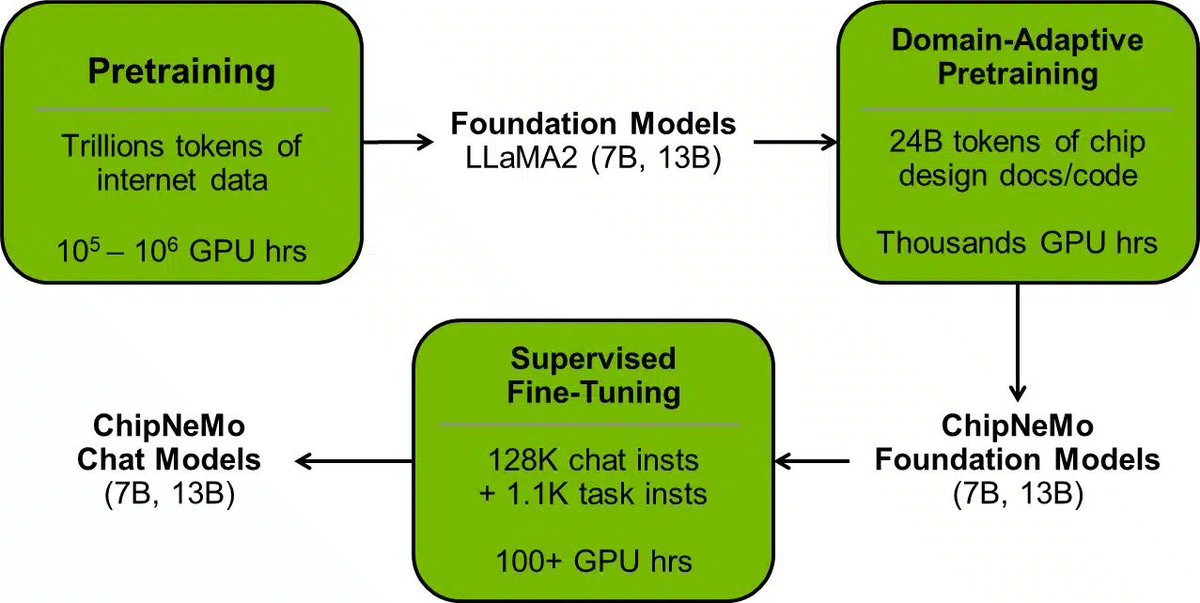
NVIDIA basically compressed 30 years of its corporate memory into 13B parameters. Our greatest creations add up to 24B tokens, including chip designs, internal codebases, and engineering logs like bug reports. Let that sink in.
The model "ChipNeMo" is deployed internally, like a shared genie:
- EDA scripts generation. EDA stands for "Electronic Design Automation", a core software suite for designing the next-gen GPUs. These scripts are the keys to a $1T market cap 🦾;
- Engineering assistant chatbot for GPU ASIC and Architecture engineers that understands internal hardware design specs and is capable of explaining complex design topics;
- Bug summarization and analysis as part of an internal bug and issue tracking system;
- Domain-finetuned retriever that achieves much better accuracy over internal knowledge.
And we publish a whitepaper to share ChipNeMo's creation process: https://t.co/dMG5AFMXTH
Official blog: https://t.co/MMjLbKxE34
Congrats to Haoxing "Mark" Ren's team for the outstanding work!