Mage 1.2 is here! This release brings the full package of useful graph analytic tools in the terms of dynamic and static graph algorithms, handy utilities, and finally - an introduction to the field of graph machine learning.
https://t.co/YaLoal5FrA
Agraphcadabra! 🧙
Prepare your magic wands because MAGE 1.1 is out! Explore the land of DYNAMIC graph algorithms!
The only thing that @dtomicevic is missing in this video is a big, gorgeous wizard hat 🎩. We need to get him one.
https://t.co/KJ7Pc0m4xI
#DataScience#Graphs
Check out this new blog post by @mmbronstein and myself to find out what dynamic graphs are, why they are important, and how we can learn on them using Temporal Graph Networks (TGN)! https://t.co/zevVChh4Pf
Agraphcadabra! 🧙
Some advantages of #DynamicGraphAlgorithms:
1. Changes are local - it is not necessary to execute the algorithm from scratch but only on newly added vertex/edge neighborhood
2. Update is faster than a full re-run of a static algorithm
#ComputerScience
Exponential growth leads to exponential time complexity. If it takes a millisecond to find one cut-set, it would take us -> 35 years to find all the cut-sets on a fully connected 40-node graph 🤓🪄.
#DataScience
(2/3)
Agraphcadabra! 🧙♀️
Today’s #FunFactFriday isn’t that much fun for someone who solves exponential problems. One of them is the enumeration of all cut-sets on the graph ...
#ComputerScience
(1/3)
A cut-set is a set of edges that, when removed, divide a graph component into two. Printing all cut-sets on a graph is an NP-HARD problem that is that depending on the number of nodes and edges. With more nodes and edges, cutsets grow exponentially. 💥
#ComputerScience
(2/3)
We are proud to announce that Memgraph 2.1 is finally here! 🎉
Along with Kafka, you can now connect to @apache_pulsar and Redpanda by @VectorizedIO.
There are even more fixes & improvements, so check out the release blog post 👇
https://t.co/6SE2oTNkvx
Agraphcadabra! 🧙
#FunFactFriday with the big news today. @Google has introduced @TensorFlow Graph Neural Networks - https://t.co/lRuuNDw7dD.
Graphs are getting stronger every day! I'll make sure that we use this magic properly! 💥
#DataScience#GNN
How lovely 🧙!
@supe_katarina has used my magic dust in her magnificent "Twitch Streaming Graph Analysis" blog post. Seems like she has been listening to what I've been talking about lately and applied #PageRank to find the most influential streamers.
https://t.co/HlAWSnyIlb
Agraphkadabra!
I must say thank you to those who helped me build a recommendation system with the new spell - dynamic node2vec. In my opinion, it works fantastic! 💓https://t.co/3XIO89N4Qt
Have you tried my new spell already? I am sure my brother @neo4j already did!
I think I turned out to be extremely photogenic in this article! 📸
My dear padawan @AntonioFilipo18 wrote an amazing article about #OnlineNode2Vec 🧙. Use your magic wisely!
https://t.co/3XIO89N4Qt
Once big and global research is conducted, it is simply hard to reference knowledge and papers which are legitimate. If domain knowledge graph is present ➡️ #PageRank values can be used to determine whether the entity is relevant in research or not! 🤓
#DataScience
(3/3)
Now for the best part - #PageRank applications.
@Google's search engine is an obvious example. But what about others❓
If you know about others, use this tool from my garage to tackle them!
https://t.co/MoZLkQzD0B
@MemgraphDB#DataScience
(1/3)
Of course, I'll mention some #PageRank applications.
Traffic can be one of them 🚗. Represent streets as nodes, and intersections as edges➡️run #PageRank and find out the most important streets➡️these will be bottlenecks of your traffic system!
#DataScience#Traffic
(2/3)
With this concept, we can introduce a dynamic environment! Once a new vertex or edge appears in the network, we can simply update the stored #RandomWalks.
From them, we calculate approximation #PageRank values and that's it!
Beware. Dynamic algorithms are coming to MAGE
(3/3)
Agraphcadabra! 🧙♂️
Time is money. One way to be faster when calculating #PageRank is by introducing approximations.
Imagine a random surfer on a network and let him randomly pick the next destination. Repeat, and store it as a #RandomWalk 🕸️.
... (1/3)
Now, for each node calculate the proportion of its appearances in #RandomWalks. This number is the approximation #PageRank.
Read more in research by @Stanford & @Twitter: https://t.co/xh0ADRfAzF
#GraphDataScience
(2/3)
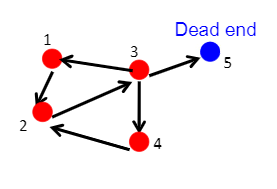
The other problem which can make your network influence vanish is called 'rank sink' 🚰. This one occurs once there are no outgoing edges to propagate the importance.
Fortunately, a solution is the same ➡️ introduce teleportation - propagation can teleport to other nodes!
(3/3)
Now that we talked about #PageRank and influence flows, we can dive into some technical details. 🔖
Imagine influence score is propagated throughout the network via outgoing edges till a stable state is created - #NodeRanking. However, problems can occur 👾
#GraphLearning
(1/3)
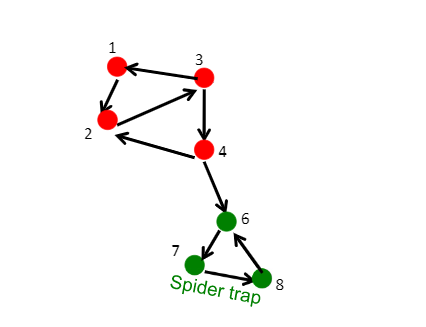
The first problem is called 'spider traps' 🕸️. It occurs once there is a closed cycle in the #graph. In a closed cycle, the nodes successively increase each other's influence scores, absorbing the influence flow!
Learn more on: https://t.co/MoZLkQzD0B
#MemgraphDB
(2/3)