I really believe that the next turn of AI is personalization and proactivity, with one massive caveat:
These two things are only powerful if they are "subtractive."
Let me explain.
Most “personalized” products today add more: more recommendations, more alerts, more surface area. True personalization should do the opposite. It should quietly take things away.
The same goes for proactivity. A proactive system shouldn’t interrupt you, it should preempt friction. It should remove steps, not insert itself.
Since we launched Huxe a month ago, I've been talking daily to our users. Unanimously, each person describes the best quality of the app as being subtractive: it takes away something as its core value.
"I listen to it first thing in the morning instead of opening my mail app"
"Instead of opening a bunch of tabs, I just listen to the news"
"I always look up this niche topic to keep track of it, but now I just created a station about it"
In these quotes I'm hearing what I've always believed about good products, too: there’s a real usefulness in things that unburden us, especially from tasks we’ve always believed we had to do, but never actually liked doing.
So as we build the app more, we're really embracing the art of subtraction.
People want less:
fewer tabs,
fewer decisions,
less friction.
Not just an app that does everything for you, rather an app that removes everything that gets in your way.
In the age of agentic AI, the companies that thrive won’t succeed by automating everything. They’ll win by distinguishing between tasks entrusted to AI for predictable, routine processes (the "autonomic core") and those requiring human judgment. https://t.co/RP6lIPmKr7
Many execs see AI automation as an opportunity for a sleek org that runs with minimal oversight.
The companies that succeed won’t automate everything — they'll distinguish between tasks that should be entrusted to AI & those that require human judgment. https://t.co/zYdLV2kN6x
NotebookLM is quite powerful and worth playing with
https://t.co/EMHIjc15iU
It is a bit of a re-imagination of the UIUX of working with LLMs organized around a collection of sources you upload and then refer to with queries, seeing results alongside and with citations.
But the current most new/impressive feature (that is surprisingly hidden almost as an afterthought) is the ability to generate a 2-person podcast episode based on any content you upload. For example someone took my "bitcoin from scratch" post from a long time ago:
https://t.co/7ajZNZ0BGi
and converted it to podcast, quite impressive:
https://t.co/ZZn0LJgsnu
You can podcastify *anything*. I give it train_gpt2.c (C code that trains GPT-2):
https://t.co/gDrAqix4Iv
and made a podcast about that:
https://t.co/bgcwmQr5d7
I don't know if I'd exactly agree with the framing of the conversation and the emphasis or the descriptions of layernorm and matmul etc but there's hints of greatness here and in any case it's highly entertaining.
Imo LLM capability (IQ, but also memory (context length), multimodal, etc.) is getting way ahead of the UIUX of packaging it into products. Think Code Interpreter, Claude Artifacts, Cursor/Replit, NotebookLM, etc. I expect (and look forward to) a lot more and different paradigms of interaction than just chat.
That's what I think is ultimately so compelling about the 2-person podcast format as a UIUX exploration. It lifts two major "barriers to enjoyment" of LLMs. 1 Chat is hard. You don't know what to say or ask. In the 2-person podcast format, the question asking is also delegated to an AI so you get a lot more chill experience instead of being a synchronous constraint in the generating process. 2 Reading is hard and it's much easier to just lean back and listen.
You're seeing in real time how disinformation works. This is an outright, intentional lie from someone who knows better.
Governor Abbott graduated from Vanderbilt Law, was a Supreme Court Justice in Texas, and was the Attorney General. He knows that Trump was not indicted by the DOJ or by President Biden, but by a grand jury of Floridians who heard the evidence presented and made a decision based on the rule of law. The DOJ or a President cannot 'indict' anyone at their whim.
I'm sure this isn't the first time you've seen this claim on your feed today. This lie is the passed around talking point that's being pushed out to allied Senators, Members of Congress, and Governors to repeat over and over again in hopes folks don't know any better — to distract from the substance of the indictment. It is a distraction from an action that deserves no excuses.
Unfortunately for all of them, lies only support a cracking foundation for so long.
@whassupe OMG - that is 1/ a really bad autocorrect and 2/ whoops for not linking the article. What the heck was I doing that day?
Should have read:
One of the most impactful essays on growth I have read in a looooong time.
Here it is: https://t.co/rpbJScF20L
There was a shoplifting ring in my hometown who was known for dropping huge sums of money on designer clothes.
Everyone in town knew who they were, but they NEVER got caught.
Some high end stores would even let them shop freely, KNOWING they were thieves
Why?
A thread
What if there was a way to:
• Mitigate climate change
• Create more life
• Grow the economy
• And make money along the way?
Let's call it *Seaflooding*
CEOs of google, anthropic, microsoft, & openAI
nobody from community organizations; nobody from advocacy orgs like WGA or @amazonlabor, who have been fighting over how AI is used in their labor; nobody from @DAIRInstitute or any independent research orgs
https://t.co/jRB7B9zKiD
I’m scared of AGI. It's confusing how people can be so dismissive of the risks.
I’m an investor in two AGI companies and friends with dozens of researchers working at DeepMind, OpenAI, Anthropic, and Google Brain. Almost all of them are worried.
🧵
I am a CHILD. I’m only 16. I go to school every day in order to learn, make friends and thrive.
Kentucky just made it illegal for me to use the bathroom in school. They are forcibly taking away my healthcare. I can no longer speak to a school counselor without (1/2)
What would a being *made* of code, that has *read* most of the code in the world, think about how to *design* code?
https://t.co/It0xd1RT2K
#GPT4 Designed a programming language while I... did almost nothing.
I don't think people realize what a big deal it is that Stanford retrained a LLaMA model, into an instruction-following form, by **cheaply** fine-tuning it on inputs and outputs **from text-davinci-003**.
It means: If you allow any sufficiently wide-ranging access to your AI model, even by paid API, you're giving away your business crown jewels to competitors that can then nearly-clone your model without all the hard work you did to build up your own fine-tuning dataset. If you successfully enforce a restriction against commercializing an imitation trained on your I/O - a legal prospect that's never been tested, at this point - that means the competing checkpoints go up on bittorrent.
I'm not sure I can convey how much this is a brand new idiom of AI as a technology. Let's put it this way:
If you put a lot of work into tweaking the mask of the shoggoth, but then expose your masked shoggoth's API - or possibly just let anyone build up a big-enough database of Qs and As from your shoggoth - then anybody who's brute-forced a *core* *unmasked* shoggoth can gesture to *your* shoggoth and say to *their* shoggoth "look like that one", and poof you no longer have a competitive moat.
It's like the thing where if you let an unscrupulous potential competitor get a glimpse of your factory floor, they'll suddenly start producing a similar good - except that they just need a glimpse of the *inputs and outputs* of your factory. Because the kind of good you're producing is a kind of pseudointelligent gloop that gets sculpted; and it costs money and a simple process to produce the gloop, and separately more money and a complicated process to sculpt the gloop; but the raw gloop has enough pseudointelligence that it can stare at other gloop and imitate it.
In other words: The AI companies that make profits will be ones that either have a competitive moat not based on the capabilities of their model, OR those which don't expose the underlying inputs and outputs of their model to customers, OR can successfully sue any competitor that engages in shoggoth mask cloning.
I recently came across a short story that forced me to rethink my life, priorities, and regrets:
The Parable of the Farmer and the Horse.
Here are the two lessons everyone needs to hear:
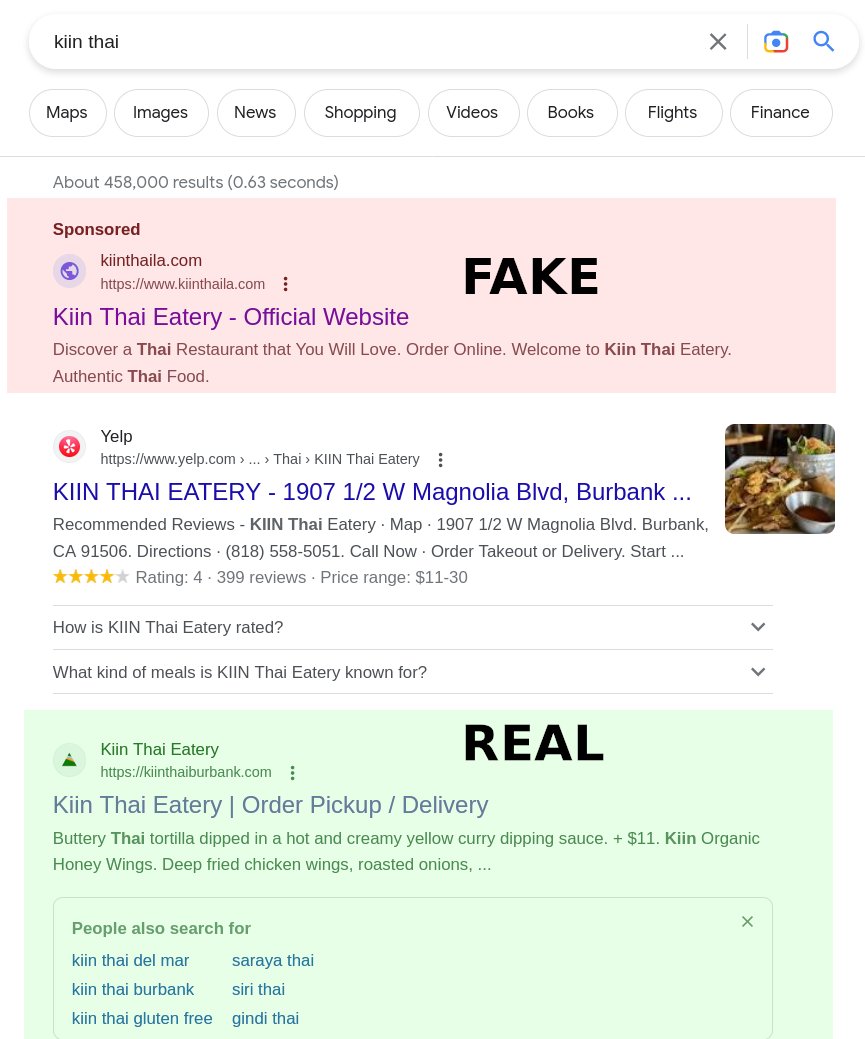
So there's a great Thai restaurant in my neighborhood called Kiin. Yesterday, I searched for their website to order some takeout. Here's the Google result.