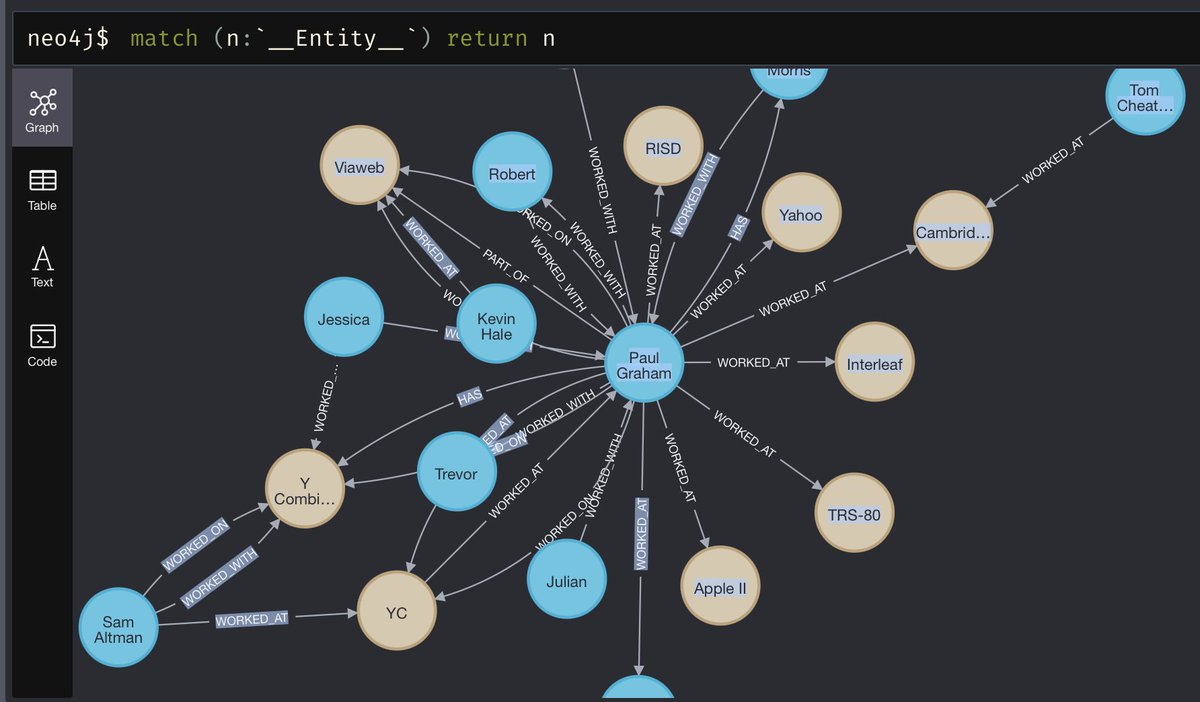
Soo excited about the #GenAIStack that we @neo4j launched today together with @Docker@langchain and @Ollama_ai
Learn more at
https://t.co/qa9bYSCNuP
Or our live streamed session at @DockerCon at 11:45PT
@jobergum Documents are just one dimension, across documents you have topic clusters that you can utilize.
And yes @swyx vector similarity forms an "invisible" graph that you can choose to materialize so it's not black box. But I agree we're very much in the space of experiments and eval.
@jobergum#GraphRAG is a RAG pattern that uses graph data structures.
Metadata is often only one level of attributes or you have to denormalize a lot.
If you have existing structured data combining it with vector search gives you an entry point to fetch more relevant context.
Folks, seriously. The GraphRAG Ecosystem Tools are frickin' amazing. The KG Builder is a visual cloud service that easily (click click!) turns unstructured data into a knowledge graph! You can point it to some random PDFs, a wikipedia page or a youtube video, and a few seconds later you have the data and concepts from those sources represented as a knowledge graph in your Aura free account. 🤯 This used to take DAYS! It really makes it so easy to get started on your own knowledge graph journey.
https://t.co/UYtUI6KiQ5
@gillinghammer@emileifrem It provides more relvant context than pure vector rag. You can follow longer patterns of information that might be a few hops away. And if the ingestion aggregates across similar tooics it provides horizontal, cross document topic discovery and summarization to work with
@attila_ibs@emileifrem It currently starts with vector search and expands to entities and their rels from the top 3 chunks. If they are connected both should show up.
We plan to add more retrieval queries.
Did you configure any graph schema?
We’re excited to launch a huge feature making @llama_index the framework for building knowledge graphs with LLMs: The Property Graph Index 💫
(There’s a lot of stuff to unpack here, let’s start from the top)
You now have a sophisticated set of tools to construct and query a knowledge graph with LLMs:
1. You can extract out a knowledge graph according to a set of extractors. These extractors include defining a pre-defined schema of entities/relationships/properties, defining a set of node relationship with @llama_index constructs, or implicitly figuring out the schema using an LLM.
2. You can now query a knowledge graph with a huge host of different retrievers that can be combined: keywords, vector search, text-to-cypher, and more.
3. You can include the text along with the entities/relationships during retrieval
4. You can perform joint vector search/graph search even if your graph store doesn’t support vectors! We’ve created robust abstractions to plug in both a graph store as well as a separate vector store.
5. You have full customizability: We’ve made it easy/intuitive for you to define your own extractors and retrievers.
Labelled Property Graph: a KG representation with nodes + relationships. Each node/relationship has a label and an arbitrary set of properties.
Why you care: This is a robust representation of knowledge graphs that extends way beyond just triplets - allows you to treat KGs as a superset of vector search. Each text node can be represented by a vector representation similar to a vector db, but also link to other nodes through relationships.
Our initial launch was done in collaboration with our partners from @neo4j. Huge shoutout to @tb_tomaz for creating a detailed integration guide as well as extensive guidance on how to refactor our abstractions.
Our blog post: https://t.co/iYTf22PQkU
Full guide in the docs: https://t.co/Qe5gEWdPAI
Usage guide: https://t.co/qV8WPEsgvC
Basic notebook: https://t.co/9RQrBwbUTh
Advanced notebook (shows extraction according to a schema): https://t.co/ELTX360w84
Using Neo4j with our property graphs: https://t.co/sBtHruu5Kz
@deepset_ai@Haystack_AI@neo4j@qdrant_engine@mixedbreadai Can't wait. If you're in #Berlin and interested in #GenAI make sure to come to this meetup. We'll have so much great content. I'll be talking about both creating knowledge graphs w/ LLMs and also GraphRAG with Neo4j. Be there!
Ok, this is pretty crazy.
SQL has been the lingua franca of database querying since the dawn of time.
But for the first time in over three decades (!), ISO just published a NEW database query language called GQL -- the Graph Query Language!
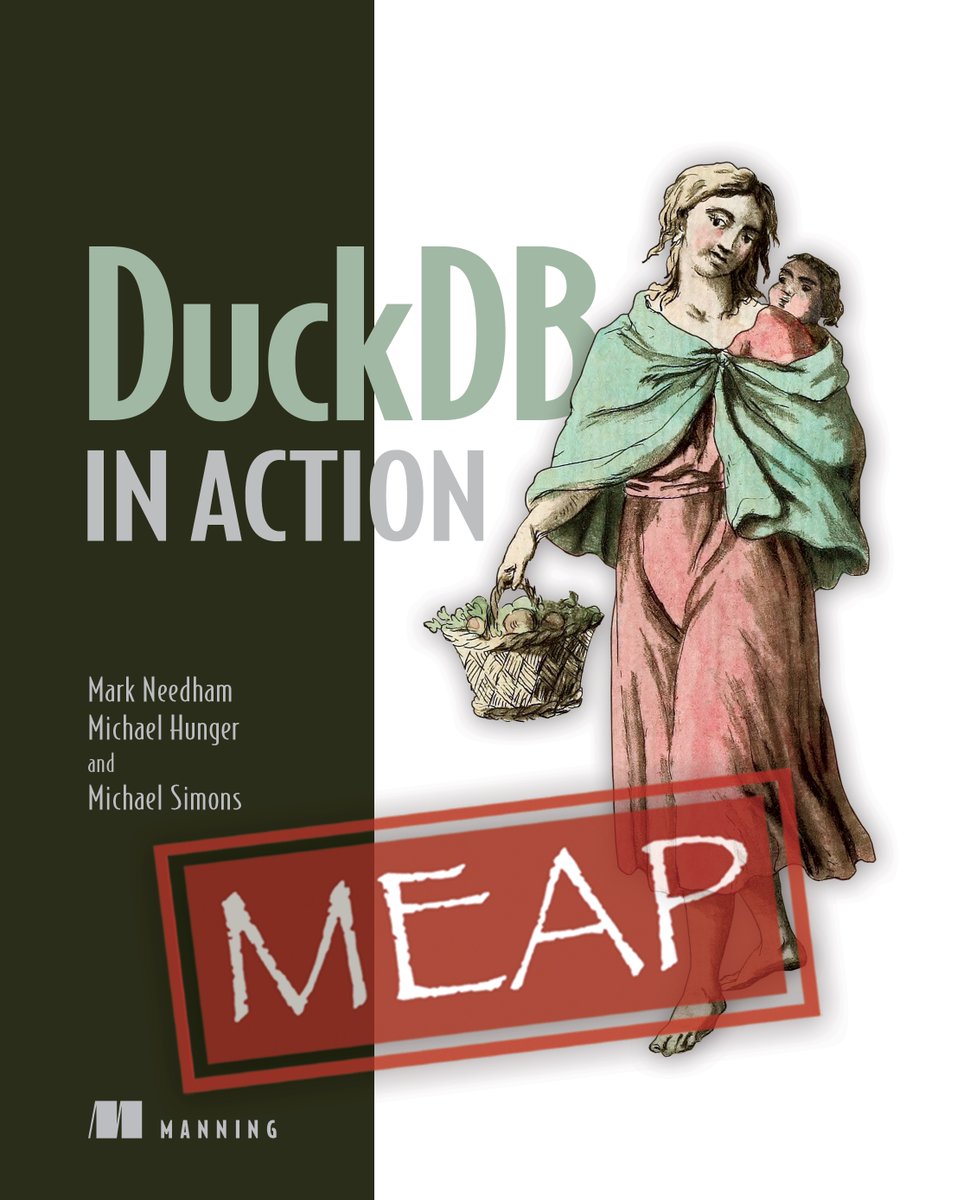
🎉Our #DuckDBInAction book is almost there, Chapter 10, 11 and Appendix released on the MEAP.
Soon off to print!
@markhneedham @rotnroll666 it was a great collaboration.
Big Thanks to @ryguyrg@jrdntgn @hfmuehleisen & @ManningBooks for your support 🙏
https://t.co/UugOG9jsh2
Building text-to-SQL models? Take advantage of our new training dataset featuring 25K samples covering virtually all documented DuckDB features. Now that's something to quack about!
https://t.co/xurj1LqHEi
@codexeditor Great news Iian! Good luck and have fun.
Check out GLiNER for initial annotation. @markhneedham just did a video on it.
https://t.co/awToZSvbq6
Learn how to use knowledge graphs to enhance your RAG applications with our new course, built in collaboration with @Neo4j!
Explore the basics of knowledge graphs, use Cypher, Neo4j’s query language, build your own graphs, and more.
👉 Join now: https://t.co/VHL75j52JU
hi friends!
I find myself approaching the end of the month and I REALLY need to land a new contract, like, this week 😬
any companies looking to partner on content? explainer videos, tutorials, social media, etc. — I'm available! [email protected]
(plz share — thanks!)
📣 Just Scheduled
If you're like me and you don't know what "GenAI" means, @adamcowley will teach us how to use langchain.js and build our own custom apps.
Details:
https://t.co/vyKdBokb3Q
Perfect timing. We finished all the main chapters of our book @duckdb 🐥in action. And the reviewers love 💕 it so far.
Hope you do too.
@ManningBooks gives out a 45% discount with NMDUCKDB24LT
https://t.co/hEEVPzGT25
Thanks to @motherduck for the support
Alle, die mit unserem „System“ unzufrieden sind, sollten sich diese Rede (8 Min) anhören. Wir können nur produktiv miteinander streiten, wenn wir uns in den Grundsätzen einig bleiben, die #Habeck hier skizziert. Die Notwendigkeit, Prioritäten zu setzen, bestand auch ohne BVerfG.