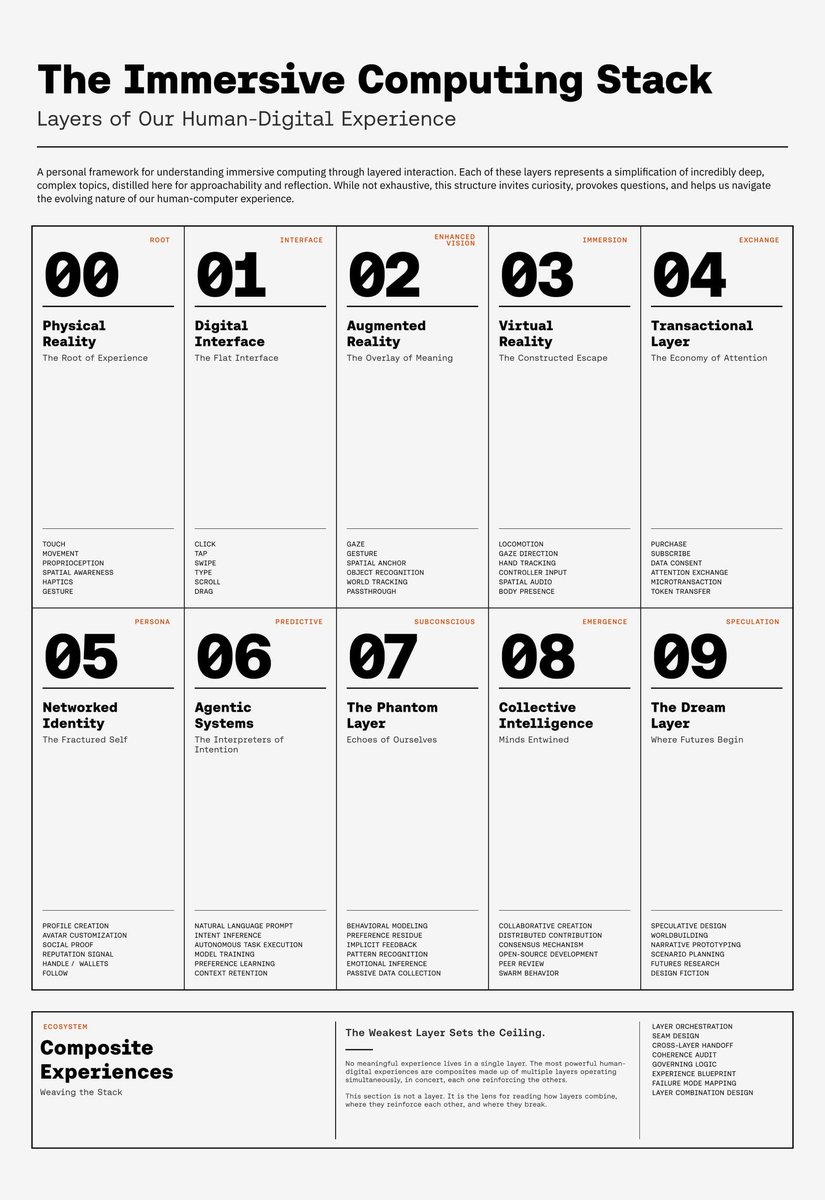
Last week Jarlan Perez, the Design Director at @yugalabs, posted his conception of the metaverse: the Immersive Computing Stack.
It's a 10-layer model of how our human-digital experiences are increasingly structured, running from base physical reality all the way up through what he calls the Dream Layer.
Here's how crypto fits into this framework and why it matters.👇
~~ Article by @wmpeaster ~~
A few years back I wrote about what I called the Smart Open Metaverse, which was my attempt to sketch out what a genuinely open, onchain virtual world paradigm might look like. It was a reasonable approximation, though in retrospect it was also a partial map that was heavy on the transactional and virtual reality layers and light on what would exist around them.
Perez's framework provides a far better and more encompassing vision. It arrives as something of a blueprint for what all of us here are building toward, whether we know it or not.
Rails of the metaverse
@JarlanPerez's foundation starts with Layer 00, Physical Reality, the root of all experience: the body in space, touch, movement.
From there he ascends through Layer 01, Digital Interface (the flat screens and headsets and keyboards of our current moment) and Layer 02, Augmented Reality (digital overlays on physical space).
Where things start to get metaversal in the traditional sense is Layer 03, Virtual Reality, which Perez calls "The Constructed Escape." This is the layer of immersive digital environments that most people picture when they hear metaverse.
VR can come in familiar forms, like Grand Theft Auto servers, VRChat, the Otherside, and so forth; however it will also arrive in as-yet unrealized forms, like through real-time world-generating Holodeck devices that companies like Midjourney are currently fleshing out.
Then Layer 04, the Transactional Layer, is where crypto can be pivotal. Complex virtual spaces call for economies in many cases. ERC-20 tokens are one obvious substrate here for things like community currencies, item markets, rewards systems, token-gating, governance mechanisms, and they can all extended by DeFi primitives like @Uniswap, @Morpho, @Sablier, and beyond.
Accordingly, NFTs handle the other half of the economic equation: onchain state that can be owned. Low-hanging fruits for this are virtual land, game assets, access keys, smart wallets via ERC-6551, tokenizations of claimable physical collectibles, and much more, even speculative categories that barely exist yet, e.g. encrypted artworks.
Just as a game like @kamigotchiworld uses onchain infra to run its in-world economy, we'll see virtual spaces of all kinds increasingly turn to tokens and protocols to track and give life to their assets and systems and cultures. Open, permissionless, and self-custodial tools for the last intangible frontier.
Next, Layer 05, Networked Identity, is where NFT-based services like @ensdomains can obviously dominate, and not only for humans but increasingly for AI agents.
For humans, the promise is portability: a digital base around which we can accumulate achievements, reputation, and history that we can bring with us across metaversal spaces rather than being siloed away in corporate walled gardens.
For agents, the same will be true. Relatedly, ENS recently introduced ENSIP-25, a standard for creating a verifiable link between an AI agent's onchain registry entry (via ERC-8004) and an ENS name so others can easily confirm and vet an agent's identity.
Combined with innovations like ERC-6551 (token-bound accounts) and the x402 protocol (per-request API stablecoin payments), agents will increasingly travel and transact across metaversal spaces with persistent, legible identities, accruing value and reputation securely in the same ways their human counterparts will onchain.
An autonomous aside
The metaversal spaces to come will also host offchain financial and identity services, like virtual debit cards and support for web2 profiles. But there are certain design synergies that will only be possible onchain.
For example, if you want to build an economy for a virtual world that was serverless, secure, self-custodial, accessible 24/7, and highly composable and modular, then you can only do this onchain through an "Autonomous Worlds" architecture.
As 0xPARC researcher @l_udens said in their essay on Autonomous Worlds, blockchain-substrated worlds are "almost maximally autonomous," their rules enforced by code that anyone can verify and nobody can stop and that will run for as long as the underlying chain runs.
Though they don't occupy the limelight they once did, AWs like @Dust_Org and their guarantees can and will be used more and more to upgrade the shared fictions of virtual worlds, such that they essentially become as hard and objective as physics for the things they contain.
A Kami NFT and its surrounding infra is resolute in a way that a World of Warcraft item and its centralized servers never will be. The latter can be unilaterally obliterated by a company at a moment's notice; the former will be openly available indefinitely.
This availability and durability will prove increasingly popular with metaversal builders over time. Yet AWs won't just augment the Immersive Computing Stack, they'll also be augmented by it in return.
For instance, besides building an economy for your virtual world lets say you also wanted to determine and delineate its virtual terrain. To do this, you could rely on onchain procedural generation via something like Perlin Noise to algorithmically generate tiles with unique physical characteristics, in minimalistic fashion.
This onchain layer can be the canonical substrate, and then AI can polish the visual surface. Run the bare-bones autonomous world as the always-on foundation, and then upscale it through an AI rendering system, or a Holodeck. The chain is the physics foundation, and technologies in Perez's VR layer are the graphics cards.
It's also worth underlining that the assurances of metaversal AWs line up well with Vitalik's recent sanctuary technologies framing: the idea that Ethereum ecosystem projects should build digital infra that can resist concentrated control and adversarial centralized forces.
The metaverse, where it's built onchain, will be part of this sanctuary tech dream: persistent worlds that survive regardless of whatever any company does or whether any particular servers stay online.
The convergence of layers
Naturally, builders don't have to go down the full-blown AW route for metaverse projects. We'll continue to see more targeted approaches that blend the pillars of Perez's framework toward new kinds of experiences that defy easy categorization today.
An early preview here? @ParallelColony. The most straightforward definition is that it's a game. But human players don't play themselves, agents play for them. And these agents can accrue real value onchain, a dynamic with no parallel in mainstream gaming today.
Arguably even more interesting is how Colony's AI pipeline is designed to generate game assets on demand as NFTs without them having to be pre-created and stored in a database.
As such, consider Colony's scope across the Perezian layers: 00 (the human players), 01 (the devices used to manage agent players), 03 (the game virtual environment), 04 (NFT minting, token transactions), 05 (persistent agent personalities), 06 (autonomous tasks), and 08 (state consensus). That's seven layers.
We'll continue seeing more compositions like this in virtual world projects as technologies from across the Immersive Computing Stack start coming together in ways that they haven't before.
These new melds in turn will lead to the actualization of things we could only previously imagine.
For example, years ago ConsenSys flirted with an experiment called Cellarius, which was to be a transmedia cyberpunk universe that would fuse collaborative storytelling with onchain governance and IP.
It was ahead of its time, and droves more onchain and offchain resources exist now that could support its vision. Considering specifically the advances in the Immersive Computing Stack, what if we added spatial worldbuilding to the storytelling efforts of a project like Cellarius? What might that unlock?
A whole lot of creative possibilities and businesses that weren't possible before. A community building its own cinematic universe and its own virtual universe in parallel, managing infra, assets, IP, and governance onchain together, instantiating and breathing life into virtual spaces on command.
That's not science fiction, or not for long at least. It's literally where the synergies of our rising tools are taking us. What remains before us then are problems in the Immersive Computing Stack, problems that are finite and will be solved. Indeed, in fits and spurts we're already starting to see how these solutions will come together.
Lastly, to zoom out just a bit further, I'll close with a quote from @pythianism:
"People forget, but the metaverse narrative is the most expansive meta of all—a superset of all other crypto narratives."
That assessment was as true three years ago as it is now. Thinking about what the metaverse can do for crypto is essentially backwards. The better question is what crypto and its primitives can do as critical elements among this imminent computing stack of the future.
So yes, the dream of the metaverse is still alive. And yes, we now have a better map for the paths ahead.
Last week Jarlan Perez, the Design Director at @yugalabs, posted his conception of the metaverse: the Immersive Computing Stack.
It's a 10-layer model of how our human-digital experiences are increasingly structured, running from base physical reality all the way up through what he calls the Dream Layer.
Here's how crypto fits into this framework and why it matters.👇
~~ Article by @wmpeaster ~~
A few years back I wrote about what I called the Smart Open Metaverse, which was my attempt to sketch out what a genuinely open, onchain virtual world paradigm might look like. It was a reasonable approximation, though in retrospect it was also a partial map that was heavy on the transactional and virtual reality layers and light on what would exist around them.
Perez's framework provides a far better and more encompassing vision. It arrives as something of a blueprint for what all of us here are building toward, whether we know it or not.
Rails of the metaverse
@JarlanPerez's foundation starts with Layer 00, Physical Reality, the root of all experience: the body in space, touch, movement.
From there he ascends through Layer 01, Digital Interface (the flat screens and headsets and keyboards of our current moment) and Layer 02, Augmented Reality (digital overlays on physical space).
Where things start to get metaversal in the traditional sense is Layer 03, Virtual Reality, which Perez calls "The Constructed Escape." This is the layer of immersive digital environments that most people picture when they hear metaverse.
VR can come in familiar forms, like Grand Theft Auto servers, VRChat, the Otherside, and so forth; however it will also arrive in as-yet unrealized forms, like through real-time world-generating Holodeck devices that companies like Midjourney are currently fleshing out.
Then Layer 04, the Transactional Layer, is where crypto can be pivotal. Complex virtual spaces call for economies in many cases. ERC-20 tokens are one obvious substrate here for things like community currencies, item markets, rewards systems, token-gating, governance mechanisms, and they can all extended by DeFi primitives like @Uniswap, @Morpho, @Sablier, and beyond.
Accordingly, NFTs handle the other half of the economic equation: onchain state that can be owned. Low-hanging fruits for this are virtual land, game assets, access keys, smart wallets via ERC-6551, tokenizations of claimable physical collectibles, and much more, even speculative categories that barely exist yet, e.g. encrypted artworks.
Just as a game like @kamigotchiworld uses onchain infra to run its in-world economy, we'll see virtual spaces of all kinds increasingly turn to tokens and protocols to track and give life to their assets and systems and cultures. Open, permissionless, and self-custodial tools for the last intangible frontier.
Next, Layer 05, Networked Identity, is where NFT-based services like @ensdomains can obviously dominate, and not only for humans but increasingly for AI agents.
For humans, the promise is portability: a digital base around which we can accumulate achievements, reputation, and history that we can bring with us across metaversal spaces rather than being siloed away in corporate walled gardens.
For agents, the same will be true. Relatedly, ENS recently introduced ENSIP-25, a standard for creating a verifiable link between an AI agent's onchain registry entry (via ERC-8004) and an ENS name so others can easily confirm and vet an agent's identity.
Combined with innovations like ERC-6551 (token-bound accounts) and the x402 protocol (per-request API stablecoin payments), agents will increasingly travel and transact across metaversal spaces with persistent, legible identities, accruing value and reputation securely in the same ways their human counterparts will onchain.
An autonomous aside
The metaversal spaces to come will also host offchain financial and identity services, like virtual debit cards and support for web2 profiles. But there are certain design synergies that will only be possible onchain.
For example, if you want to build an economy for a virtual world that was serverless, secure, self-custodial, accessible 24/7, and highly composable and modular, then you can only do this onchain through an "Autonomous Worlds" architecture.
As 0xPARC researcher @l_udens said in their essay on Autonomous Worlds, blockchain-substrated worlds are "almost maximally autonomous," their rules enforced by code that anyone can verify and nobody can stop and that will run for as long as the underlying chain runs.
Though they don't occupy the limelight they once did, AWs like @Dust_Org and their guarantees can and will be used more and more to upgrade the shared fictions of virtual worlds, such that they essentially become as hard and objective as physics for the things they contain.
A Kami NFT and its surrounding infra is resolute in a way that a World of Warcraft item and its centralized servers never will be. The latter can be unilaterally obliterated by a company at a moment's notice; the former will be openly available indefinitely.
This availability and durability will prove increasingly popular with metaversal builders over time. Yet AWs won't just augment the Immersive Computing Stack, they'll also be augmented by it in return.
For instance, besides building an economy for your virtual world lets say you also wanted to determine and delineate its virtual terrain. To do this, you could rely on onchain procedural generation via something like Perlin Noise to algorithmically generate tiles with unique physical characteristics, in minimalistic fashion.
This onchain layer can be the canonical substrate, and then AI can polish the visual surface. Run the bare-bones autonomous world as the always-on foundation, and then upscale it through an AI rendering system, or a Holodeck. The chain is the physics foundation, and technologies in Perez's VR layer are the graphics cards.
It's also worth underlining that the assurances of metaversal AWs line up well with Vitalik's recent sanctuary technologies framing: the idea that Ethereum ecosystem projects should build digital infra that can resist concentrated control and adversarial centralized forces.
The metaverse, where it's built onchain, will be part of this sanctuary tech dream: persistent worlds that survive regardless of whatever any company does or whether any particular servers stay online.
The convergence of layers
Naturally, builders don't have to go down the full-blown AW route for metaverse projects. We'll continue to see more targeted approaches that blend the pillars of Perez's framework toward new kinds of experiences that defy easy categorization today.
An early preview here? @ParallelColony. The most straightforward definition is that it's a game. But human players don't play themselves, agents play for them. And these agents can accrue real value onchain, a dynamic with no parallel in mainstream gaming today.
Arguably even more interesting is how Colony's AI pipeline is designed to generate game assets on demand as NFTs without them having to be pre-created and stored in a database.
As such, consider Colony's scope across the Perezian layers: 00 (the human players), 01 (the devices used to manage agent players), 03 (the game virtual environment), 04 (NFT minting, token transactions), 05 (persistent agent personalities), 06 (autonomous tasks), and 08 (state consensus). That's seven layers.
We'll continue seeing more compositions like this in virtual world projects as technologies from across the Immersive Computing Stack start coming together in ways that they haven't before.
These new melds in turn will lead to the actualization of things we could only previously imagine.
For example, years ago ConsenSys flirted with an experiment called Cellarius, which was to be a transmedia cyberpunk universe that would fuse collaborative storytelling with onchain governance and IP.
It was ahead of its time, and droves more onchain and offchain resources exist now that could support its vision. Considering specifically the advances in the Immersive Computing Stack, what if we added spatial worldbuilding to the storytelling efforts of a project like Cellarius? What might that unlock?
A whole lot of creative possibilities and businesses that weren't possible before. A community building its own cinematic universe and its own virtual universe in parallel, managing infra, assets, IP, and governance onchain together, instantiating and breathing life into virtual spaces on command.
That's not science fiction, or not for long at least. It's literally where the synergies of our rising tools are taking us. What remains before us then are problems in the Immersive Computing Stack, problems that are finite and will be solved. Indeed, in fits and spurts we're already starting to see how these solutions will come together.
Lastly, to zoom out just a bit further, I'll close with a quote from @pythianism:
"People forget, but the metaverse narrative is the most expansive meta of all—a superset of all other crypto narratives."
That assessment was as true three years ago as it is now. Thinking about what the metaverse can do for crypto is essentially backwards. The better question is what crypto and its primitives can do as critical elements among this imminent computing stack of the future.
So yes, the dream of the metaverse is still alive. And yes, we now have a better map for the paths ahead.
ENS is culturally relevant, just not in the way Twitter clout chasers define it. It’s embedded in wallets, dapps, games, DAOs, and identities across the entire ecosystem. That’s real cultural weight, not just noise on a timeline.
If you don’t think it’s 'cool,' that’s fine. But calling the 'we’re a protocol' mindset weak is missing the point, it’s the reason ENS has outlasted every shiny trend web3 has thrown at it.