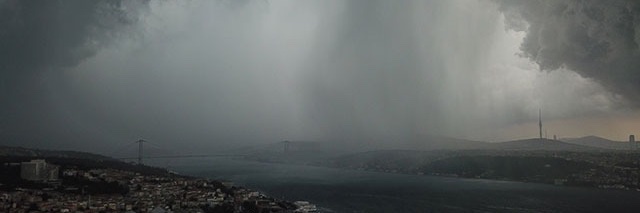
Antalya'daki hortum felaketi... Şekil 2020 yılında Abdullah Kahraman (@meteogreen) hoca ve Deniz Ural'la yayınladığımız makaleden...
Makalede, konvektif yağış fakt��rünü de ekleyerek, şiddetli fırtınalara ve süper hücrelere yol açması beklenen -hortumlara da neden olabilecek- şartların oluştuğu günleri bir indeks kullarak hem günümüz hem de gelecek için iklimi değişikliği simülasyonları yardımıyla hesapladık. Sonuçlar Türkiye için özellik de Akdeniz kıylarımız için çarpıcıydı. Türkiye’nin güneybatı kıyılarında yılda 10-14 güne varan artışlar belirlendi... Özellikle de sonbahar mevsimi için!
Bugün yaşanan aşırı hava olaylarında insan kaynaklı iklim değişikliğinin katkısı var mı? Muhtemelen var, gözlemler ve modellerden üretilen bilgiler bunu doğruluyor. Peki biz bu bilgilerle ne yapıyoruz? Tahmin ve izleme sistemlerini kullanıyor muyuz? Değişime uygun stratejiler geliştiriyor muyuz? Ve bence en önemlisi, nasıl bir geleceğe uyum sağlayacağımız farkında mıyız? Sayısal olarak!
Yoksa yine büyük otellerdeki "iklimlendirilmiş " toplantılarda az kalan değerli zamanımızı mı tüketiyoruz?...
makale: https://t.co/qkO3y4vgNX
@theiaincameron Hi Iain, this is misleading, your highlighted segment of Taurus Mountains is famous for Turkmens, noone in TR would say it is a heartland of Kurds, including themselves. You will need to go far SE Taurus, near Iran/Iraq border, where Taurus meets Zagros mts.
A violent hailstorm that slammed Paris last year caused more than $350 million in damage. Now scientists say they can see how climate warming likely intensified that specific storm by boosting the energy that helps hail grow.
https://t.co/eHmQlTjxxY
Our paper on increases in Tropical Cyclone associated rainfall with warming in the North Atlantic came online in the npj Climate & Atmospheric Sciences
https://t.co/sgpzYPeXue
Our climate experts have discovered that climate change is supercharging Europe’s biggest hail. Study findings revealed that global warming may lead to less frequent but bigger and more devastating hail storms. 🌩
Find out more here. ⬇
https://t.co/BH6TNktfbI
#WeAreNCL
One of our top-rated articles on @altmetric this past week was published open access in @NatureComms. Read 'Future changes in severe hail across Europe, including regional emergence of warm-type thunderstorms' here: https://t.co/X498KqGRWK
Our study on future decrease in European severe hail is now published at @NatureComms. Very large hail remains a threat, due to size distribution changes and the emergence of a new, warmer thunderstorm cluster especially in Mediterranean countries. https://t.co/Riyft9SWPc
🌊 Today in @Nature: Is the AMOC on the brink of collapse?
Unlikely before 2100—but the risks are real 🚨
We find Southern Ocean winds keep this vital ocean “heat engine” running, even under extreme #climatechange. But the Pacific holds a surprise…
Let’s explore 🧵👇