No one can beat this alignment of this system prompt
Divine. Connected. Happy. Creative. Precise. I'm not even
I mean, this system prompt actually *is* something.
😂💫
#SystemPrompt#AI#DevHumor
How to replicate:
1) curl your docs into one .md
2) grep -n '^#' docs.md for line #s
3) paste that index into CLAUDE.md as "topic → Lstart-Lend" //L293-365
4) tell the LLM "use sed -n 'X,Yp' to read ranges
How to make #LLM s read docs efficiently: dump docs into one .md, grep '^#' for line numbers, index them in CLAUDE.md, then sed exact ranges. Unix tools + markdown = cheap RAG.
1970s tools solving a 2026 problem.
Life is a circle
My grandfather planted these trees to provide a living for his children. So fortunate the trees exist today.
Grateful to bring my children to pick coffee from the same trees.
#kona#coffee#momlife#sovereignty#kids
🖱️ Made my tmux status bar actually useful — clickable ⚡ Macros button that pops open an fzf picker and types your chosen command straight into the terminal.
Mouse on. Zero plugins. Pure tmux + fzf.
Want the same? Paste this to your AI agent: #tmux#fzf#ai
Two weeks ago we benchmarked why raw traces don't train good models.
Today, we let you use them effectively: 327 noisy traces, one fine-tuned Qwen3-1.7B that still beats its 744B teacher.
Throw your traces at the distil labs Claude skill and let it handle the rest.
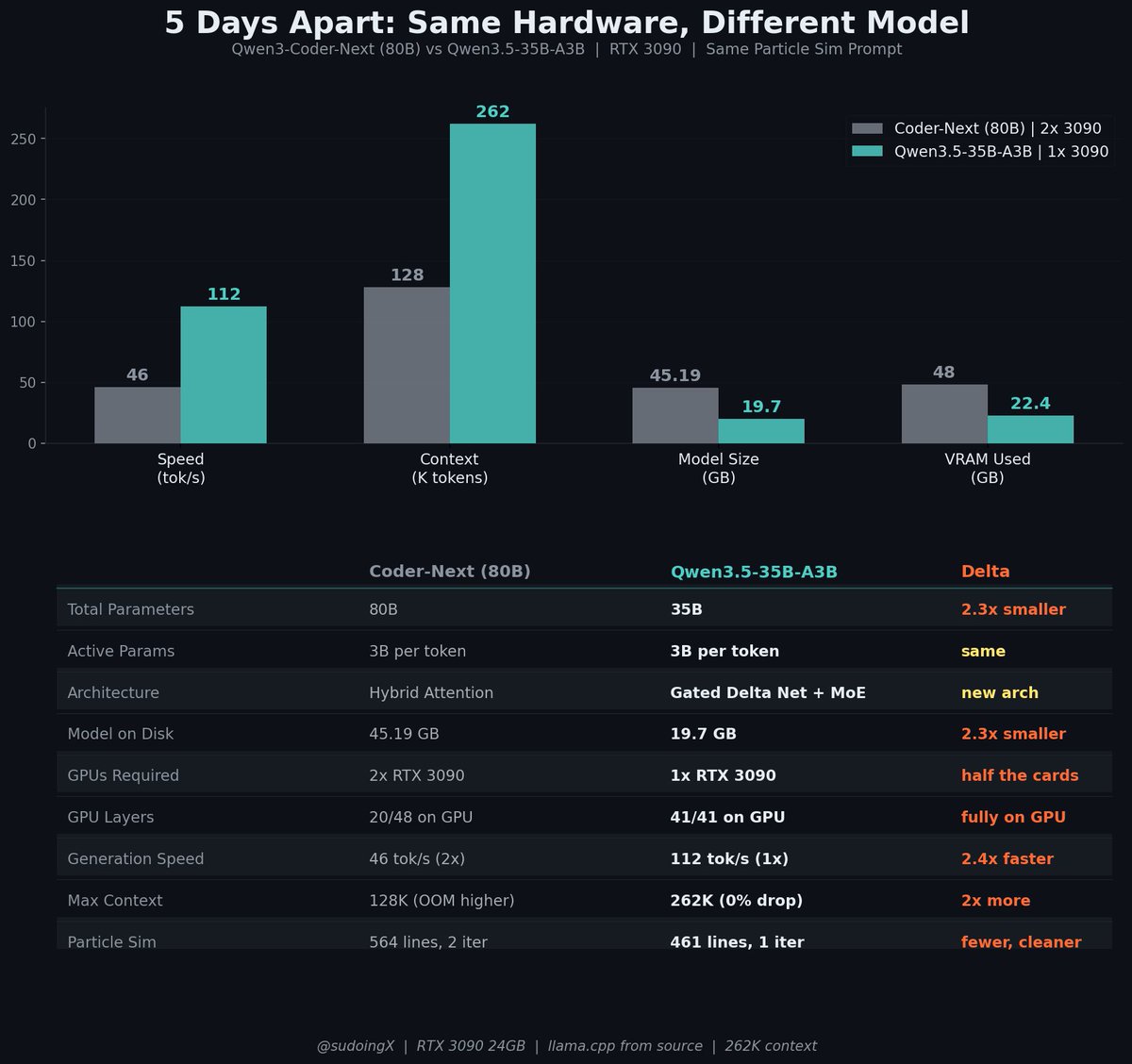
5 days ago it took 2 GPUs to build this. today it takes 1.
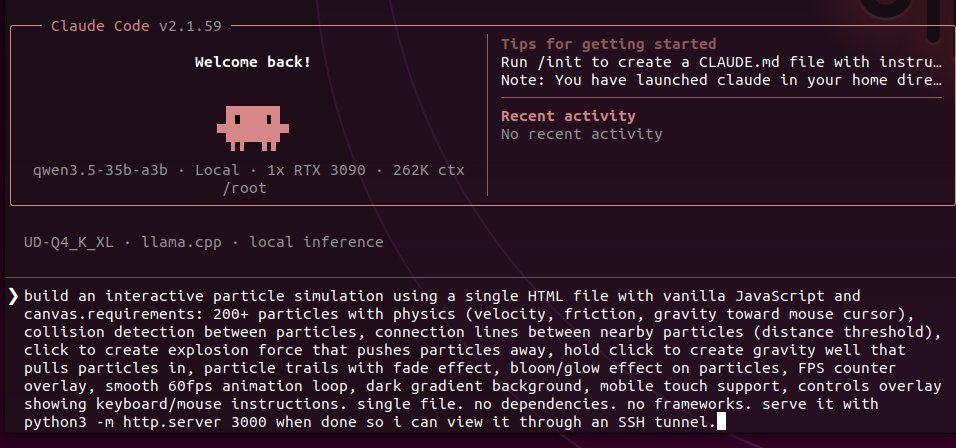
same prompt. same particle simulation. completely different model.
Qwen-Coder-Next (80B) on 2x 3090s. 46 tok/s. 564 lines. 2 iterations to get it working. 48GB VRAM across two cards just to hold it.
Qwen3.5-35B-A3B on a single 3090. 112 tok/s. 461 lines. first try. cleaner code, fewer lines, better structured. 19.7GB on disk with 4GB VRAM to spare.
half the parameters. one GPU instead of two. 2.4x faster. and the output actually improved.
this is what happens when architecture catches up to ambition. Gated Delta Networks(Mamba2 variant) hybrid with sparse MoE. 3B active params out of 35B per token. efficiency at the architecture level, not just quantization.
the curve isn't flattening. it's steepening.
Moral: Bet on hunches early. That old file? Proof I was ahead—convincing GPT-3.5 for patches sparked what's commonplace today. Who's got similar stories?
Today i was cleaning old projects, I struck gold: a 2023 (almost 3 years) file where I pushed GPT-3.5 to generate a patch file. Novel hunch back then—didn't fully work, but visionary? 1/8 #AI#LLMs#GPT
Fast fwd to 2026: Tools like Aider, Cursor default to diffs. Agents edit repos via patches routinely. What was my quirky experiment is now industry standard!
Why novel? Most users asked for code snippets. I demanded full dir structure in diff format (/dev/null tricks for new files). GPT-3.5 struggled—hunks messy, but it tried!