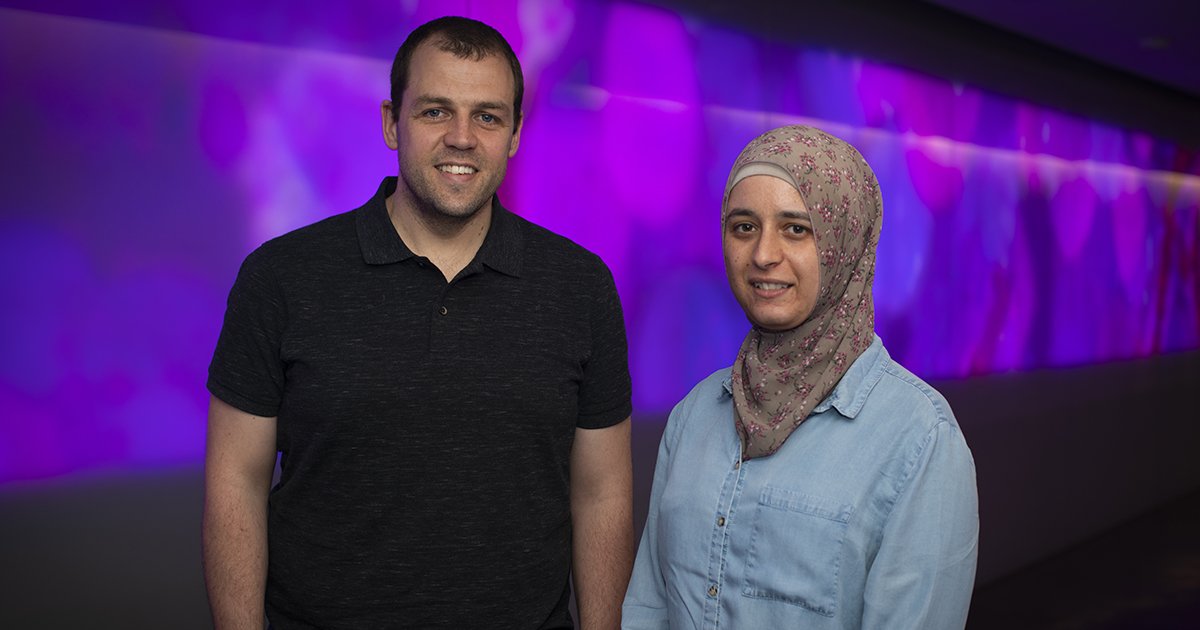
Fantastic experience attending #GETA2022 and having the opportunity to speak with and hear from families of people living with genetic epilepsy and share some of our research with them
Understanding genes, getting a diagnosis and working through variants of unknown significance is complex, with many processes and people to get a result for families. Bioinformatics is an important piece of this puzzle #GETA2022
New bioinformatics position at the Epilepsy Research Centre, University of Melbourne, working closely with the Bahlo lab at WEHI.
Come work with us! Fantastic team and lots of exciting epilepsy genetics research to be a part of!
Epilepsy bioinformatics job on offer with strong links to the Bahlo lab led by Michael Hildebrand, ERC. Lots of exciting families and cohorts to work on! https://t.co/VMTronWulI
Trying to wrap your head around the genetics of epilepsy?
Dr Mark Bennett (@mf_bennett) from @WEHI_research will be talking to the ESA @yesILAE group about some of the 'basics' of genetics in epilepsy - Wed 29 Sept @ 5.30PM AEST 🧬
#epilepsy#genetics
1/ New preprint up! superSTR is an alignment-free method for screening short tandem repeats in NGS and RNA-seq data with @melaniebahlo and @mf_bennett.
https://t.co/hCGWFuELay
Most STR detection methods look for STRs in an alignment.
Congrats to @DrDJSheerin and @jo_hildebrand - winners of the 2021 Eve Mahlab Awards for Blue Sky Research, and to @mf_bennett as People's Choice winner.
These awards fund the most exciting and promising research ideas from our talented #WEHIPostdocs. Congrats all! 👏👏👏
Thank you @CUREepilepsy for supporting Dr Mark Bennett’s research into the genetic causes of epilepsy.
The Taking Flight Award enables Mark to extend his bioinformatics research into epilepsy undertaken w @MelanieBahlo & @EpilepsyRC:
https://t.co/98FnTVijmO
I'm delighted to say that our paper on ExpansionHunter Denovo just came out. Great work by @egor_dolzhenko@mf_bennett and @Phil_A_Richmond. Please give it a try if you are looking to discover novel pathogenic repeat expansions in your cohort or pedigree. https://t.co/F4H96GzOzO
This work is proof that team science and collaboration, even when it spans 3 continents and several timezones, is a major driver of innovation. I'm lucky to collaborate and learn from talented scientists, especially co-authors @egor_dolzhenko and @mf_bennett.
Pleased to present ExpansionHunter Denovo, a catalog-free computational method for repeat expansion detection in WGS datasets. Hopefully, deploying this method across undiagnosed cases can help end the #diagnosticOdyssey of some #rareDisease patients. https://t.co/kvkHOfKs9q
Our latest work on repeat expansions in epilepsy just published in @ejhg_journal. Familial adult myoclonic epilepsy in Sri Lankan and Indian families is caused by an ancient, ~17,000 year old repeat expansion. https://t.co/O93tuCS5Rw
TTTTA and TTTCA repeat expansions in SAMD12 were previously shown to cause FAME1 in Japanese and Chinese families. We found that all families are distantly related and estimate expansion arose ~17,000 years ago and has spread across a wide region of Asia.
The TTTCA repeat in SAMD12 was first identified in Japanese patients with myoclonic epilepsy. This study identifies the same genomic variant in Sri Lankan and Indian families. A shared haplotype suggests the expansion arose almost 17 000 years ago in a common ancestor.
Delighted to announce that our work identifying a new frontotemporal dementia -motor neuron disease gene, CYLD, has finally been published in @Brain1878! #FTD#ALS#MND https://t.co/7uOSVvwYP9
One of our collaboration papers: CYLD is causative for MND/ALS & FTD:
https://t.co/AJzDfWzWtM. Work was led by @caroldstone, includes @mf_bennett and @derm_scientist.
Specialised tools developed by our bioinformaticians to hunt for hard-to-detect ‘repeat expansions’ in DNA have helped to identify the genetic cause of a rare epilepsy, as part of an international effort @NatureComms@HaloomRafehi@mf_bennett@MelanieBahlo
https://t.co/zT6Sbp0VIy
It's a pleasure to contribute to this international collaboration and bring improvements to tandem repeat expansion calling in #WGS data. A diverse team from @illumina@WEHI_research@BCCHresearch@sickkids@UMCUtrecht. Try it on undiagnosed WGS cases.
https://t.co/56xKvcWlwF
Our scientists have contributed to a global effort to identify two genes that cause a rare type of hereditary #epilepsy@NatureComms 1/3
https://t.co/7kwyinxqor
https://t.co/aPd8VxUQtR