Christopher Luxon the PM of NZ is interrupted by our sorry excuse for a Prime Minister when asked about capital gains tax.
Albo tried to deflect the question to sport - which demonstrates the total extent of his mental capacity.
Albo thinks sport is more important than the economy. He hopes you do too.
Pro tip - it isn't.
Sport does not provide food, housing or anything else beyond entertainment - for all but the privledged few directly involved in the business.
Sport, particularly amateur and community sport has an important part to play in people's mental and physical well-being. Especially the youth - no doubt.
But the economy is the lifeblood of the country. Which makes it orders of magnitude more important.
Luxon, a business man, has more than a basic, abstract and theoretical understanding of the economy.
He has driven an economic recovery in NZ, and even as it is recovering he rightly thinks adding a capital gains tax would put a "wrecking ball" through it.
Our genius in chief has our economy on the ropes, and is warming up the wrecking ball as you read this.
The man is totally out of his depth, and dare I say 'out of his league'.
Australia deserves better than the careerist hacks and losers that fill out parliaments around the nation.
We really do and fast.
Because people are suffering. People can't afford to eat, get a roof over their heads or find meaningful work. Our economy is dying. And the Wallabies won't fix it.
It is totally unacceptable.
I just want Australia back.
#BREAKING MP Kevin Hogan blasts PM
Anthony Albanese in Parliament for destroying Australia's risk reward economic model.
Hogan's critique is razor sharp, the government has systematically inverted incentives for private enterprise.
Historically, risking capital meant keeping the return.
Now, the framework forces a parasitic transfer of wealth “You take the risk and the Albanese Government gets the reward” Hogan argued.
Hogan then rages that this isn't just failed policy, it's a calculated “unforgivable" deception of the Australian electorate.
Hard to argue.
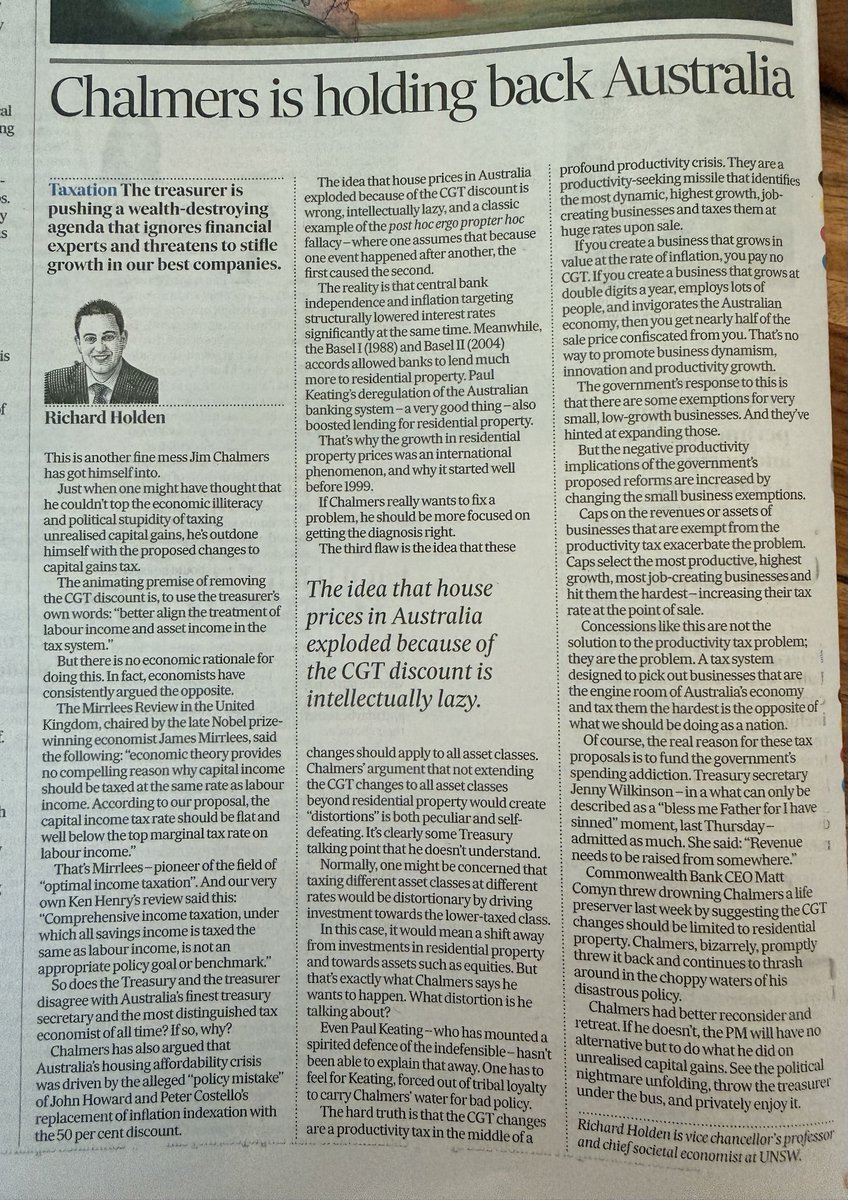
Great article in the AFR today from @profholden. The proposed changes to CGT are an act of self-harm which will incentivise businesses to stay small and grow slowly--the opposite of what we should be doing in a productivity crisis.
Labor clearly can’t defend why its CGT changes extend beyond property if the intent is to remove tax incentives for property.
But I’m seeing a new wave of defence being that a) they only apply to the ‘wealthy’ and b) ‘small businesses’ are exempt – so let me tell you why these are categorically wrong.
• The ‘wealth’ data is fundamentally flawed: It’s based on single year transaction data, rather than lifetime earnings. About 90% of Aussie taxpayers earn under 135k per year, so when an investor sells a long-held asset, that single transaction for a single year pushes them into the ‘top 10%’. This doesn’t mean they’re in the top 10% of wealthiest Aussies – it simply means that for that specific year, they earned over 135k, which could be off the back of decades of earning much less per year.
• The small business concessions aren’t indexed: The $2m threshold for annual turnover and $6m threshold for asset value haven’t increased for almost 20 years (a problem that extends to many of our taxes). This means modest family businesses are being dragged into a tax regime originally designed for much larger operations – specifically, where it was designed to exempt 95% of businesses entities in 2007, it now only exempts about 60% in 2026 (and rapidly shrinking).
• The path to building wealth is being cut off: Financial independence is rarely achieved by earning a wage and spending it. For people to become comfortable or modestly wealthy, they generally need to save and invest the wages they earn. Enforcing a minimum 30% floor rate on all forms of capital gains, even for people whose income puts them below the 30% marginal tax bracket, makes it harder for wage earners to build wealth.
The bottom line is that this budget suppresses aspiration and socio-economic mobility – and I don’t think that’s what Aussies voted for at the last election.
The Chalmer Delusion: Outcome Bias & The Static Pie Fallacy
https://t.co/X5uAtgEL0y
I encourage you all to look at the excellent interview of Jim Chalmers by Philip Coorey of the AFR.
What struck me is that he appears genuinely sincere that he has a good policy and that it will work in delivering intergenerational equity and productivity.
It reminded me of Oscar Wilde's letter when he was in jail...
"Most people are other people. Their thoughts are someone else's opinions, their lives a mimicry, their passions a quotation".
Jim Chalmers is not you, and he is certainly not me, so how can his mind arrive at such bizarre conclusions.
I think the answer lies in the field of psychology: outcome bias combined with the static pie fallacy.
Jim Chalmers sees the successful founder, investor or business owner - but not the thousands who failed, lost capital, went bankrupt or spent years building nothing. Capitalism’s winners are visible; its graveyards are invisible.
Then comes the static pie fallacy: treating wealth as something merely to be redistributed rather than created through risk, incentives and relentless trial-and-error.
He doesn't see that for the pie to grow, incentives must be rewarded, and that outcomes are destined to be fundamentally inequitable If the model works properly. However if the pie grows large enough we have enough wealth to bring up those at the bottom. But we will never be all the same, and rewarded the same, if we were that would be socialism.
But he cannot see that, as trapped in his own psychology, Jim Chalmers feels taxing success is morally righteous rather than economically destructive.
The problem is that innovation only exists because extreme rewards compensate for extreme failure.
The argument is not one of intelligence, but of philosophy, and there is no common ground or resolution.
This is a very old dilemma, and Thomas Kuhn would say Jim Chalmers and the business community have "incommensurable frameworks", and trapped in his own paradigm he is unable to view the world differently. What we see as an apparently rational disagreement is actually a failure of shared meaning rather than a failure of intelligence.
The conclusion is sobering that the only way to resolve the problem is to remove Labour through the election box because the framework in which they make decisions is so foreign to economic reality that they will inevitably fail to interpret the world around them in a way that will grow the pie.
They are prisoners of their own ideology.
https://t.co/X5uAtgEL0y
Gaslighting by @JEChalmers. The master gaslighter. Not answering the question. He thinks all Australians particularly the young are idiots. Have a listen. Make the government @AlboMP not to change the tax on Australian companies, shares, LICs and ETFs
How dumb is this tool.
Chalmers asked why are they changing the tax on shares not just property? He says because shares have been under compensated for the past 2 decades.
So he will now compensate them by increasing tax on them?
Hey @JEChalmers - finally, I have found someone to explain your budget to solve the housing crisis in plain English!
And by the way - this explanation is not a lie!
@LofayPeter
Jim Chalmers’ fifth budget may ultimately be remembered for three political miscalculations:
1.Believing Gen Z has given up on aspiration
2.Believing Gen X and Millennials won’t feel betrayed
3.Unintentionally favouring Baby Boomers
My opinion piece in today’s Australian.
There are two other dire consequences of this budget that nobody is talking about. The first is that the budget’s introduction of an effective capital gains tax of up to 45 per cent - 47 per cent – previously capped at 23.5 per cent for assets held more than 12 months – hits younger savers hardest, precisely because they have the highest portfolio exposures to high-growth assets such as listed global equities, Australian shares, crypto, venture capital and private equity.
When anyone builds a portfolio for younger investors, they rationally load them up with the highest-growth and most volatile assets on the basis that a long investment horizon allows them to weather the inevitable volatility storms.
As investors age, these portfolios shift into more stable and income-rich asset classes such as cash and bonds, which are net beneficiaries of the CGT increase, because their post-tax returns now look more attractive relative to growth assets.
As many investors have noted online, why would you allocate to a bunch of high-risk growth companies when Albanese and Chalmers are going to take almost half the upside while wearing none of the downside? Rather than helping younger generations, the highest CGT rate in the developed world will hammer them.
And it is a double whammy because the many early-stage companies that have historically employed 20- and 30-somethings will now consider moving overseas. Their investors will simply not want to trade away half of their upside to the public oligarchs.
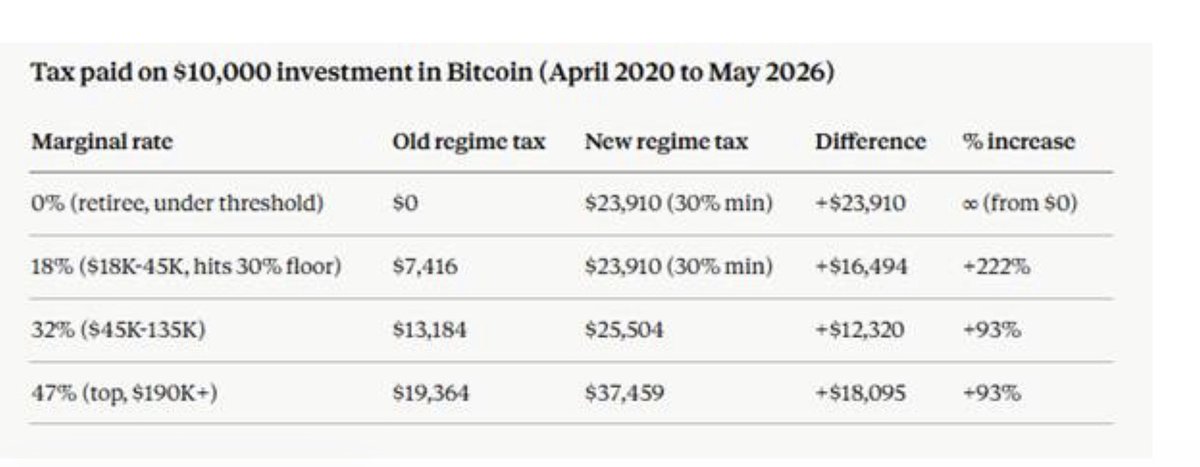
If you allocated $10,000 to bitcoin after the March 2020 pandemic shock – which many young punters did, and which would now be worth approximately $92,000 – the new CGT regime imposes vastly higher amounts of tax.
A self-funded retiree on the tax-free threshold would go from paying nothing to almost $24,000. Somebody earning between $18,000 and $45,000 a year would see their tax bill jump from $7400 to $23,900 – a 222 per cent increase. Those in the $45,000 to $190,000-plus tax brackets would have their bill rise by 93 per cent.
Since the new CGT regime is, by definition, much more costly on higher-growth investments, it will punish younger investors who have much greater risk appetites and lower average incomes.
https://t.co/MJKvQZXvKw
The government just cut private health insurance rebates for 2.6 million seniors to save $482M — but actuaries say it'll cost public hospitals $547M extra.
So they slugged the elderly, gutted private health, and lost money doing it.
Intergenerational equity? More like an intergenerational own goal. 🤦
Labor’s budget is a national disgrace and Jim Chalmers has zero shame.
Labor didn't have the guts to field a candidate in Farrer and has no no clue what everyday Aussies are furious about.
Massive deficits, $1 TRILLION in gross debt next year, $77 BILLION in new taxes, inflation heading to 7%… yet they still lecture young people about “helping” them into homes while interest rates climb to 10%?
They’re deaf to the anger over immigration, integration and people who refuse to speak our language or accept Australian values.
They’re addicted to net-zero handouts and renewable scams while ignoring our own resources. Last night proved exactly why voters have had enough.
Here’s the good news: One Nation just delivered a political earthquake.
We smashed it in South Australia and won the seat of Farrer, our first ever House of Representatives seat. The protest party myth is dead.
One Nation WILL take Australia back for the majority. We WILL put the next generation first. We WILL end the age of reckless spending, open borders and bribing voters.
The message from Farrer is loud: Australians want their country back. Welcome to the team, David Farley for Farrer. Let’s get to work