Proudly part of “the Marxists, the anarchists, the agitators, the looters and people who in many instances have absolutely no clue what they are doing.”
Dahlias becoming a hotel for frogs.
Allison Lamb raises around 200 dahlias on her property and was delighted to discover that the blooms serve as a perfectly sized house for frogs.
Let me trace the timeline here because nobody's connecting it.
Step 1: Scrape the entire internet. Every book, every article, every conversation, every piece of art, every forum post. Do it without asking. Do it without paying.
Step 2: Train a model on all of it. Call it "artificial intelligence."
Step 3: Go to BlackRock's Infrastructure Summit and announce: "We see a future where intelligence is a utility, like electricity or water, and people buy it from us on a meter."
Step 3 is where you sell people's own knowledge back to them. On a meter.
They took the collective output of human thought, compressed it into a model, and now they want to charge you by the token to access a version of what you and everyone you know already created.
One Reddit user put it perfectly: "They stole all this data from us, the people, our life's work, creativity, art, by devouring the internet and blowing through all copyright laws. Now they want to sell it back to us in the form of a utility."
Imagine if someone photocopied every book in the public library, burned the library down, and then opened a subscription service for the copies.
That's the metered intelligence business model.
And they're pitching it to infrastructure investors as though they invented water.
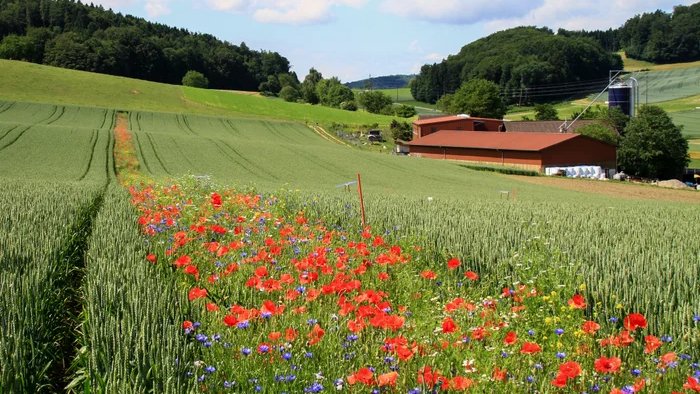
Farmers have figured out that the cheapest pesticide is a strip of flowers.
When you plant wildflowers through a crop field, not just around the edge but in strips running through the middle, you get ladybugs, lacewings, hoverflies, and parasitic wasps living in the field instead of visiting it.
They eat the aphids, the caterpillars, and the mites for free, all summer long.
In controlled trials, fields with tailored flower strips had leaf-beetle numbers 40 to 50% lower and crop damage cut by around 60%, enough to drop below the threshold where spraying was even considered worth it.
The flowers attract a standing army to our fields.
We spent decades engineering chemicals to kill the insects eating the crop, when the insects that eat those insects would have worked for the price of seed.
If we’re talking about solutions to food and the social safety net, canteens like this are probably a more efficient use of money than public grocery stores, especially because the real scarce resource for poor people is time
In the hypothetical world where this tweet got the 3000 likes it deserves there would be more likes on the tweet than hooded plovers in existence, but we're not ready for that yet
Things Keith has eaten that are classified as invasive or problematic scrub species in managed Devon pasture:
- Bramble ✓
- Thistle ✓
- Dock ✓
- Nettles ✓
- Coarse rank grass ✓
- Woody shrub encroachment on the eastern border ✓
- A section of blackthorn that had no business being in the middle of the field ✓
Things Keith has eaten that were not invasive or problematic:
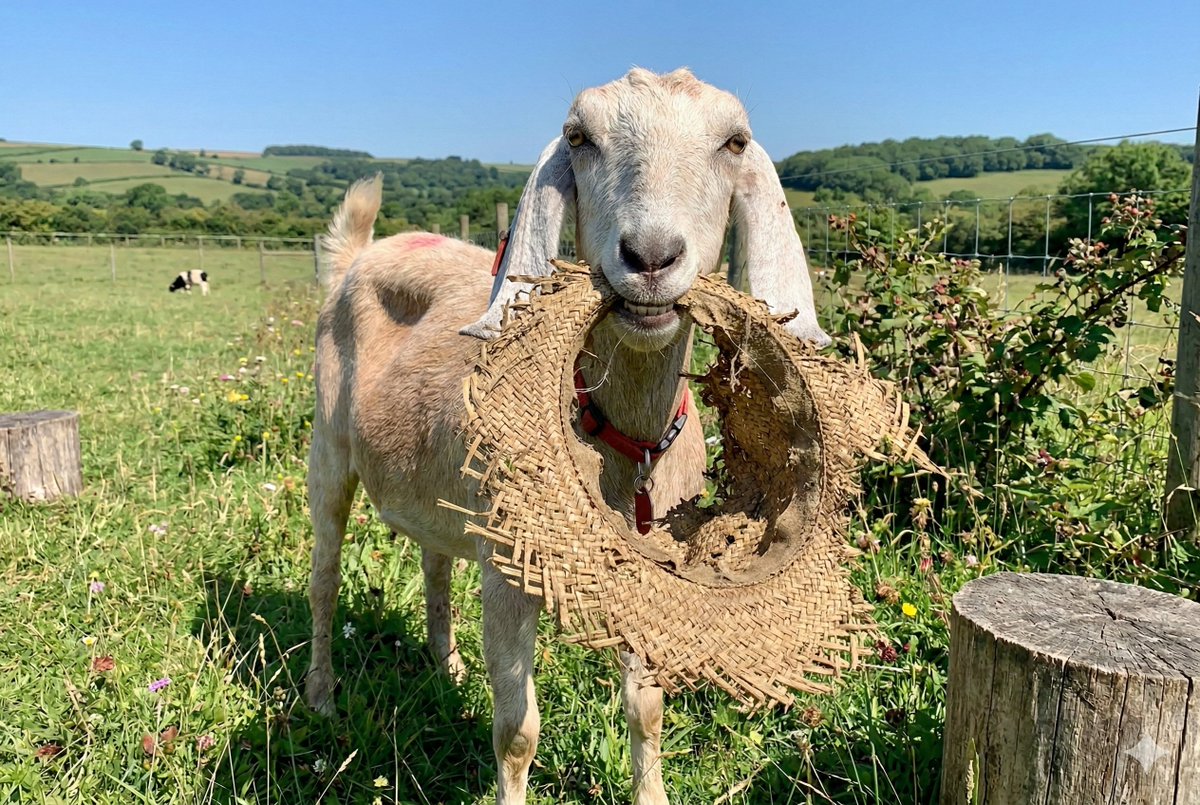
- The farmer's hat (twice)
- A corner of the farm accounts ledger (once, in what may have been a comment on farm profitability)
- The neighbour's prize rose
- A high-visibility jacket hanging on the gate post
- The gate post itself, partially
Keith's conservation record: excellent.
Keith's record on other matters: under review.
We approached Keith on a sensitive matter. The farmer had suggested, in a moment of frustration following the third escape this week, that Keith was, and we quote: "more trouble than he's worth."
There are whispers. We needed to ask directly.
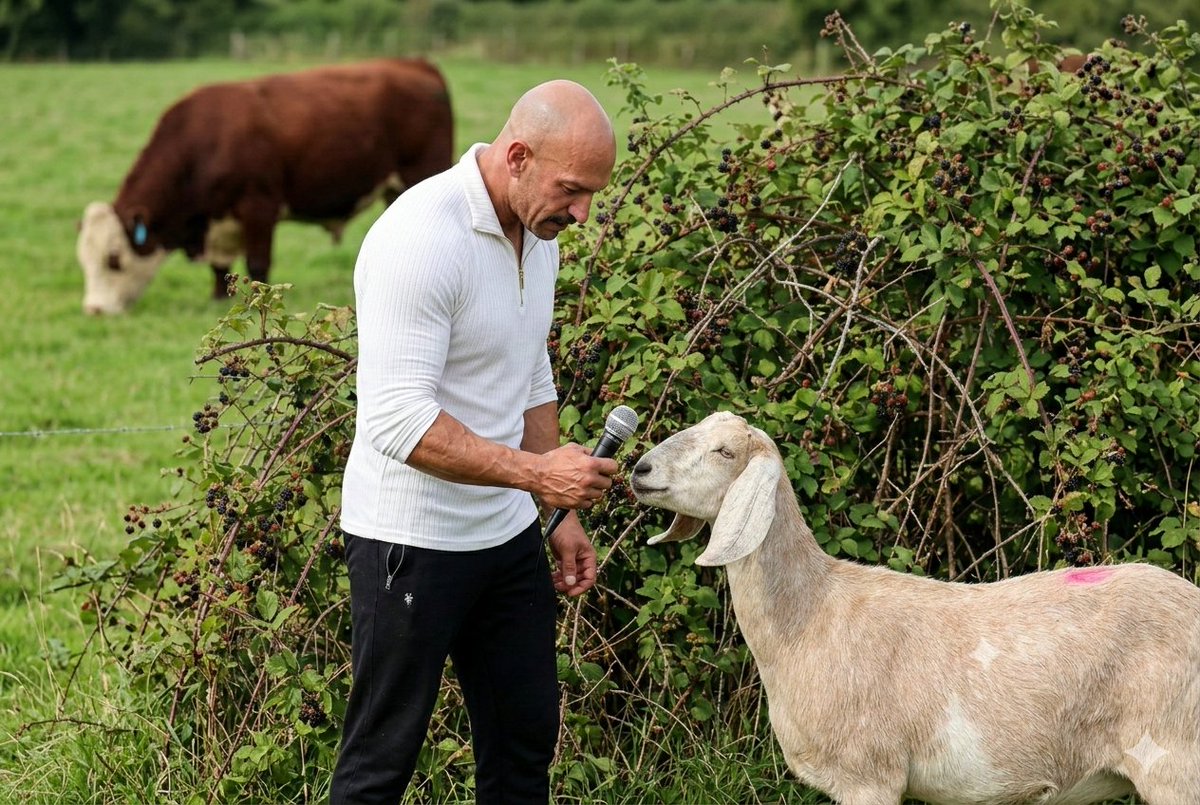
Keith. There are rumours the farmer is considering making you a scapegoat for the issues on this farm. How do you feel about that?
Keith stopped chewing.
He looked at us.
He looked at the farmer, who was repairing the north fence with the focused energy of a man who has had this particular conversation with himself many times.
He looked back at us.
He then very slowly, with great deliberation, walked to the section of fence the farmer had just repaired, pressed his head against it, and tested it.
Is that a comment on the institution of blame?
The fence held. Barely. Keith filed this information away.
Keith, to be clear: do you feel you're being unfairly blamed for structural problems on this farm that predate your arrival?
Keith produced manure.
We took this as a yes.
One follow-up: are you aware that the term "scapegoat" is literally derived from an ancient ritual in which a goat was symbolically burdened with the sins of the community and released into the wilderness?
Keith looked at the open gate.
Keith looked at us.
Something moved behind his eyes that we couldn't fully account for.
We closed the gate.
Keith the Apocalypse Bringer is a three-year-old Anglo-Nubian goat in a field in Devon.
Keith should not be underestimated.
Keith has been systematically dismantling the ecosystem since approximately 7am, when he ate a bramble. This is significant because bramble is an invasive scrub species that outcompetes wildflowers, reduces biodiversity, and creates dense monoculture thicket that nothing else can use.
Keith ate it. Keith does this every day. Keith does not charge for this service.
8:15am - Keith ate a thistle. Thistles are also considered invasive scrub in managed pasture. Goldfinches eat thistle seeds, but Keith's grazing will ensure the pasture remains open enough for the ground-nesting birds that can't use dense scrub. Keith has not attended a conservation workshop. Keith arrived at this conclusion by being a goat.
9:00am - Keith dismantled a section of hedge. This was less helpful. Keith does not have a perfect record.
10:30am - Keith escaped the field. He was in the road for eleven minutes. He ate a neighbour's rose. This is not being counted in Keith's environmental impact assessment.
11:00am - Keith was returned to the field. Keith regarded the farmer with the specific expression of an animal that does not recognise the concept of property.
12:00pm - Keith ate more bramble. His digestive system: four stomachs, a rumen full of specialised microorganisms, the ability to extract nutrition from lignified plant matter that would defeat any other animal on this field, is converting scrub vegetation into milk with a fat content of approximately 4.5%. The milk will become cheese. The cheese will be sold at the farm shop. The farm shop is four miles away. The cheese food miles are: four.
3:00pm - Keith produced manure. The manure will grow the grass. The grass will grow the bramble. The bramble will be eaten by Keith.
This system has no inputs.
It has been running since goats were domesticated approximately ten thousand years ago.
Keith is not aware he is saving the planet.
Keith is thinking about whether the fence on the north side has a weak point.
It does. Keith found it at 4:45pm.
Keith got out again.
not to be dramatic but finding and displaying joy--personal, unselfconscious joy, not performative joy--in your chosen hobby/creative outlet/sport is one of the rarest and most radical acts we can do in late stage capitalism
No, this is incorrect. The key isn't finding a balance between blissful ignorance and painful awareness, it’s learning to find happiness in sources that don’t depend on the delusional belief that everything is fine.
It’s very possible to be both happy and well-informed. We live in an explosively beautiful universe, and getting to experience anything at all is amazing. The fact that our world is plagued by human butchery and degradation does not cancel out the majesty of a bird in the sky, or the ecstasy of the wind upon your skin.
It is true that we live in a civilization of unfathomable cruelty. It is true that our biosphere is being strangled while human and non-human beings are subjected to horrific abuses in a society which elevates the worst art, the worst values, and the worst people to the highest levels of prominence.
It is also true that getting to live even a single moment on this astonishing blue planet is a gift worthy of immense joy and gratitude.
These things are both fully true at the same time. They do not negate each other.
Don’t find your happiness in the belief that everything is okay, because everything is not okay. If you spend your life squirming around trying to avert your gaze from the truth and psychologically compartmentalizing away from reality, you will never know actual happiness.
Instead, find your happiness in that which cannot be corrupted by this fraudulent dystopia.
Your connections with your loved ones. That’s real and authentic.
The radiance of the natural world. That’s real and authentic.
The crackling aliveness of the senses. That’s real and authentic.
The boundless peace deep down at the heart of your being which reveals itself if you listen closely enough. That’s real and authentic.
These things can supply endless happiness, even as the world burns, and even as you weep at its burning. Because it is entirely possible to honor the grief and tragedy of this world while also delighting in its beauty.
You can weep for the dying oceans while marveling at the stars.
You can rage for Gaza while reveling in the earth beneath your bare feet.
You can open your heart to all the suffering and to all the wonder.
You can fall to your knees in both anguish and gratitude.
You can do these things because feelings move through you if you don’t cling to them. You feel them fully without resistance, you invite them in to have their say, and then you let them leave when they are done.
It usually doesn’t take long; a few minutes, maybe even seconds. Then you get up and go back to marveling at the miracle.
Feelings are meant to be felt. If you simply feel them all the way through when they come up instead of repressing them or trying to manage them, they move through fairly quickly without setting up a permanent residence in your chest.
But you’ve got to really let them have their say. You’ve got to give yourself fully over to them. This takes practice if you don’t know how to do it, and because of the way our culture conditions people it tends to be harder for men than for women. But it’s a skill like any other, and anyone can teach themselves how to do it.
Appreciating the beauty of this terrestrial experience likewise takes practice. Everything is crackling with beauty all the time, but we don’t notice it because our attention gets wrapped up in mental stories. Just make a conscious practice of noticing beauty at every opportunity, and your aperture for appreciating beauty will get wider and wider. You can learn to live your whole life in this way, from moment to moment.
If you can get the hang of these two skills—appreciating beauty and feeling your feelings all the way through—then there will be nothing stopping you from living a joyful and fulfilling life while also having an entirely truth-based relationship with reality.