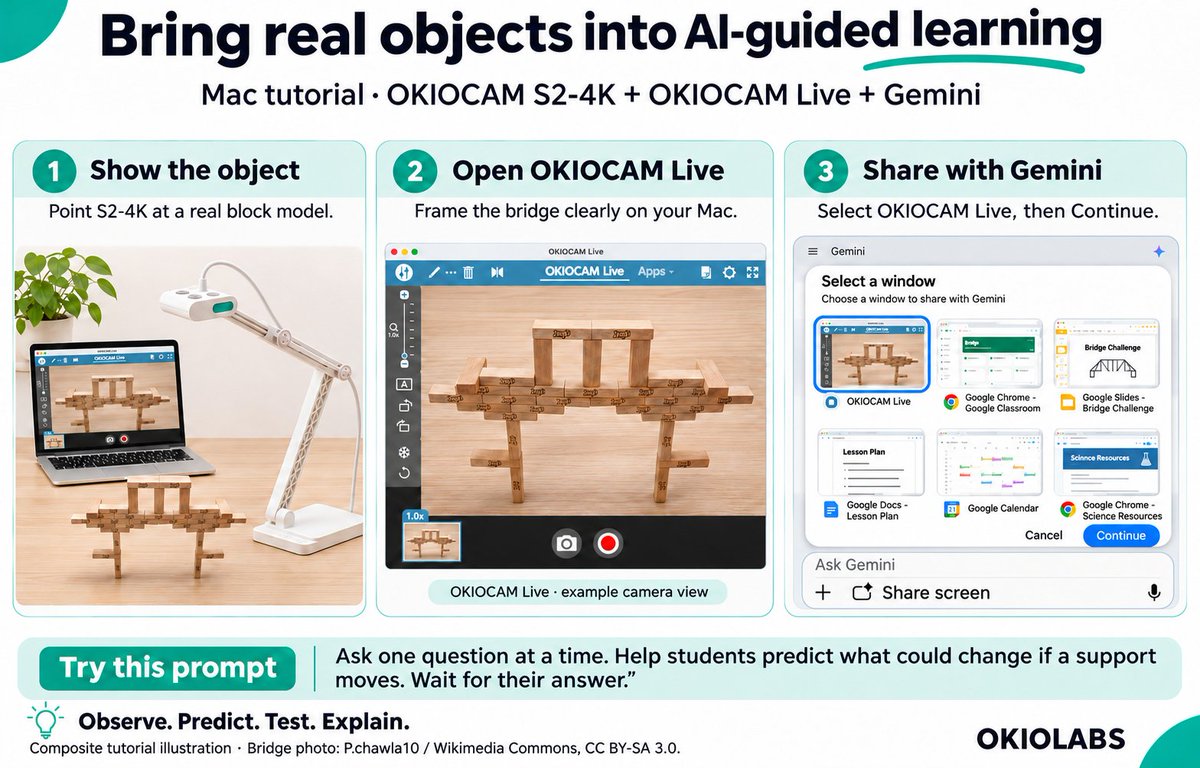
Day 1/7: Put a real object in the conversation.
On Mac, open OKIOCAM Live with S2-4K and share its window with Gemini.
Show a block bridge. Ask for one question at a time: What might change if a support moves?
Let students predict, test and explain.
A page is easier to discuss when everyone can see the same detail.
Use OKIOPoint + OKIOCAM Live to zoom in and follow the pointer during a read-aloud. The S2-4K includes the pointer.
US: https://t.co/VJw4eLBZ7x
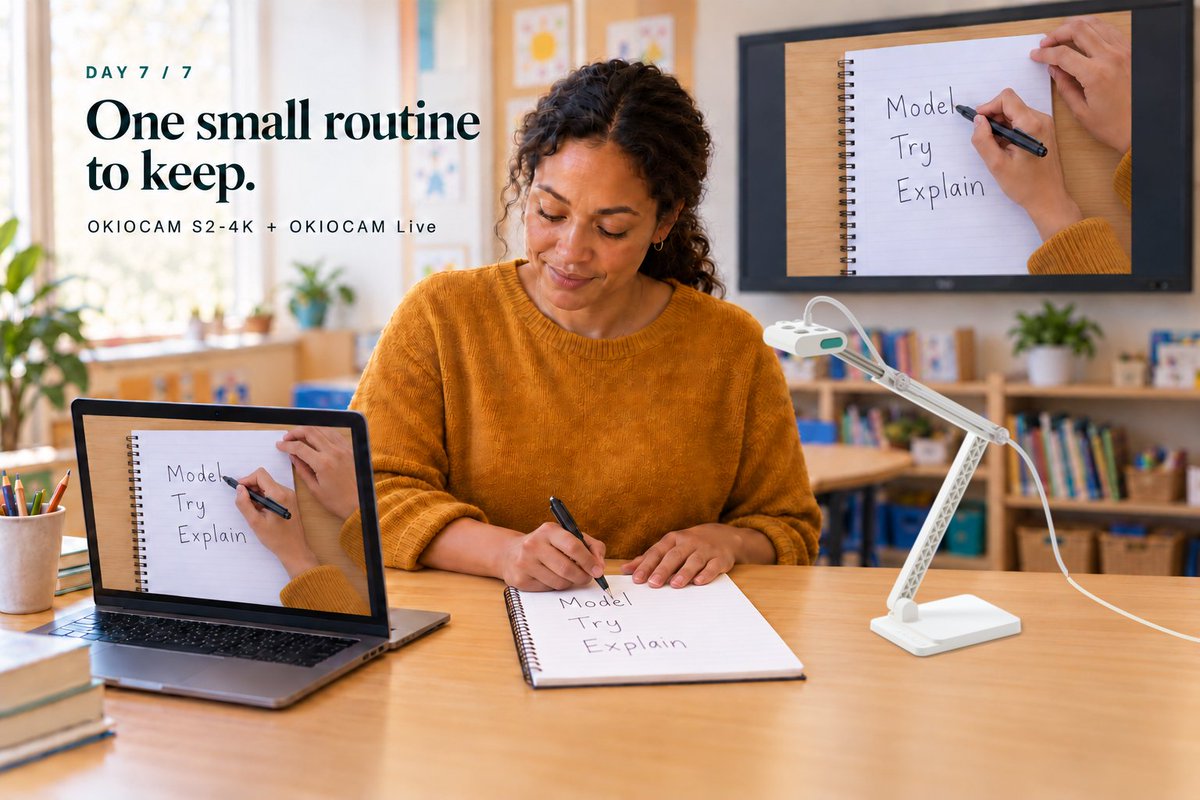
Day 7/7: One small routine to keep.
Model a step. Let students try. Ask them to explain.
OKIOCAM S2-4K + OKIOCAM Live helps you show the work, annotate a captured frame and save a snapshot for tomorrow.
US: https://t.co/VJw4eLBZ7x
@MsGeorges119@LakeHighlandsMS After each defense, partners could name one piece of evidence that changed or strengthened their thinking. It gives everyone a reason to listen closely.
@pinilla_thinks@CCE_Counselor A simple way to capture their thinking: have each child draw what they predict first, then add one detail they noticed afterward. The drawings make a lovely class discussion.
@FawkesDen@MrsCoutant@MrsKellyTo For a quick follow-up, let the kids sort pumpkin pictures by size, then count how many are in each group. They can explain how they decided where each one goes.
@amanda_spear4@Classroomscreen@MSTMAGNET@RISDmath For those multi-step problems, try having partners underline the question first, then circle the information they need for each step. It makes their plan easier to explain.
@Kel_Sanders Before mailing the cards, try a quick gallery walk and let each student share why they chose one detail. It gives everyone a chance to talk about their work.
@BHammill Before revealing the regression line, have partners compare their guesses and explain which points influenced them most. Then discuss why the fitted line differs.
@hpicciotto After students build a number, have partners sketch a different arrangement and write an equation for each. Comparing the drawings can make the operations easier to see.
@KarenCampe A nice follow-up is to have students pick one problem and explain a strategy they tried before looking at the solution. Their first attempts make good discussion starters.
@DrLewickiPhD A 10-by-10 grid makes this one click: shade four tenths one way and three tenths the other. The overlap shows why the answer is twelve hundredths.
@MelissaKumanski Have students fold a paper snowflake and draw the lines of symmetry before unfolding it. Then they can compare their predictions with the finished design.
Got packs to open or a project to build? Give chat a seat at your desk.
OKIOCAM S2-4K pairs an adjustable arm with a compact weighted base for your overhead setup.
Cards, crafts, close-ups. What would you stream first?
https://t.co/VJw4eLBZ7x
@jlmcdonald@huronschools Before a player covers 12, have them name two ways to make it, like 3 x 4 and 2 x 6. A quick array sketch gives their partner something to check, too.
@APondrom@TeamBrentfield@RISDmath@RISDTnLScience@_TeacherTaylor With the monster circuits, have partners sketch the path electricity will take before they connect the battery. When a light won't come on, they can use that same sketch to hunt for the gap.