Hello there,I felt it was the perfect moment to offer a brief introduction or re-intro for those who've been with me since my early I’m Micheal Williams, 🇺🇸31 Year Old , Full Stack Developer , Certified White Hat Hacker InfoSec (SOC) Account Recovery Specialist (coder).
PostgreSQL 101: The Everything Database https://t.co/er6YAIuuoB
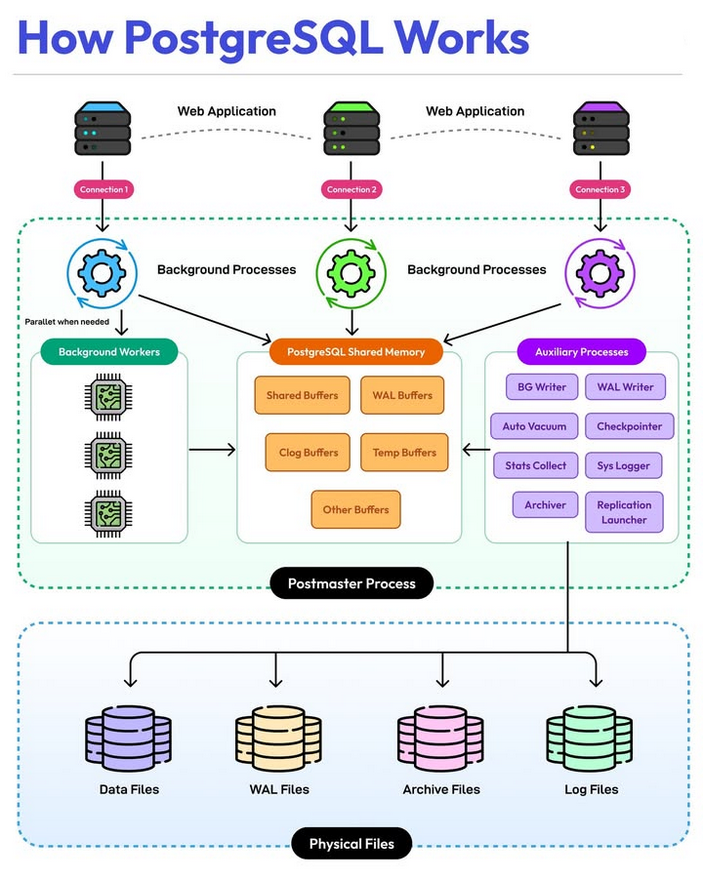
Built using C language, PostgreSQL is the most popular choice of database from small web apps to enterprise systems. It runs as a multiprocess system and follows ACID principles.
The key points about PostgreSQL’s Architecture are as follows:
1 - PostgreSQL supports concurrent client connections independently. Each client connection to PostgreSQL creates a dedicated server process.
2 - The Postmaster Process is the main supervisor that manages all other PostgreSQL processes. It controls the entire database instance.
3 - Background workers run parallel processes when needed to handle specialized tasks.
4 - PostgreSQL shared memory is a central memory area containing multiple buffers such as Shared, WAL, Clog, and Temporary buffers. All components communicate through this shared memory.
5 - PostgreSQL also has several auxiliary processes such as:
- BG Writer: Manages background writing
- WAL Writer: Handles write-ahead logging
- Auto Vacuum: Maintains database cleanliness
- Checkpointer: Ensures data consistency
- Stats Collector: Gathers statistics
- System Logger: Manages Logging
- Archiver: Handles archiving
- Replication launcher: Manages replication
6 - PostgreSQL has different types of physical files for varied needs such as:
- Data Files: Stores actual database data
- WAL Files: Write-ahead log storage
- Archive Files: Backup and recovery data
- Log Files: System and error logs
Over to you: What else would you add to understand more about PostgreSQL’s architecture?
#PostgreSQL #database #python #programming #developer #programmer #coding #coder #softwaredeveloper #computerscience #webdev #webdeveloper #webdevelopment #pythonprogramming #pythonquiz #ai #ml #machinelearning #datascience
Networking Crash Course - Gratuitous Address Resolution Protocol (GARP)
Gratuitous Address Resolution Protocol (GARP) is a specialized feature of ARP where a device sends ARP messages without being explicitly requested.
Unlike standard ARP, which is reactive (responding to ARP requests), GARP is proactive. It is used to announce a device's presence, update ARP tables, or claim ownership of an IP address on a network.
When a device sends a GARP message, it broadcasts its IP and MAC address to all hosts on the network. This helps devices update their ARP caches without waiting for communication requests.
Here is how GARP works:
1. Broadcast: A device sends an ARP packet with its own IP address as both the source and destination, ensuring all devices on the network see it.
2. Switch Forwarding: The switch forwards the GARP message to all interfaces, excluding the one it was received on.
3. Table Update: Other devices update their ARP tables with the IP/MAC mapping of the broadcasting device.
We’re aware that a technical issue is impacting some users’ ability to access our apps. We’re working to get things back to normal as quickly as possible and apologize for any inconvenience.
Here are a few tips to stay safe on Snapchat:
* Be careful about what you share online.
* Don't share personal info with people you don't know.
* Be aware of your surroundings.
* Trust your gut and report suspicious activity.
Here’s how to report something in the app: