My first time-lapse. Thanks to some instruction and tips from @Astro_Ayers, I caught my first aurora. After seeing the result, I told her this felt like fishing. Prepping the camera, the angle, the settings, the mount, then setting your timer and coming back to hope you got a catch. And after catching my first fish, I think I’m hooked. Thanks, Vapor!
Beautiful auroras passing over southeastern Asia and Australia.
@ianmiles@elonmusk@SciGuySpace It doesn't seem geopolitically smart to leave the moon unattended. We need bases there, and then continue missions to Mars.
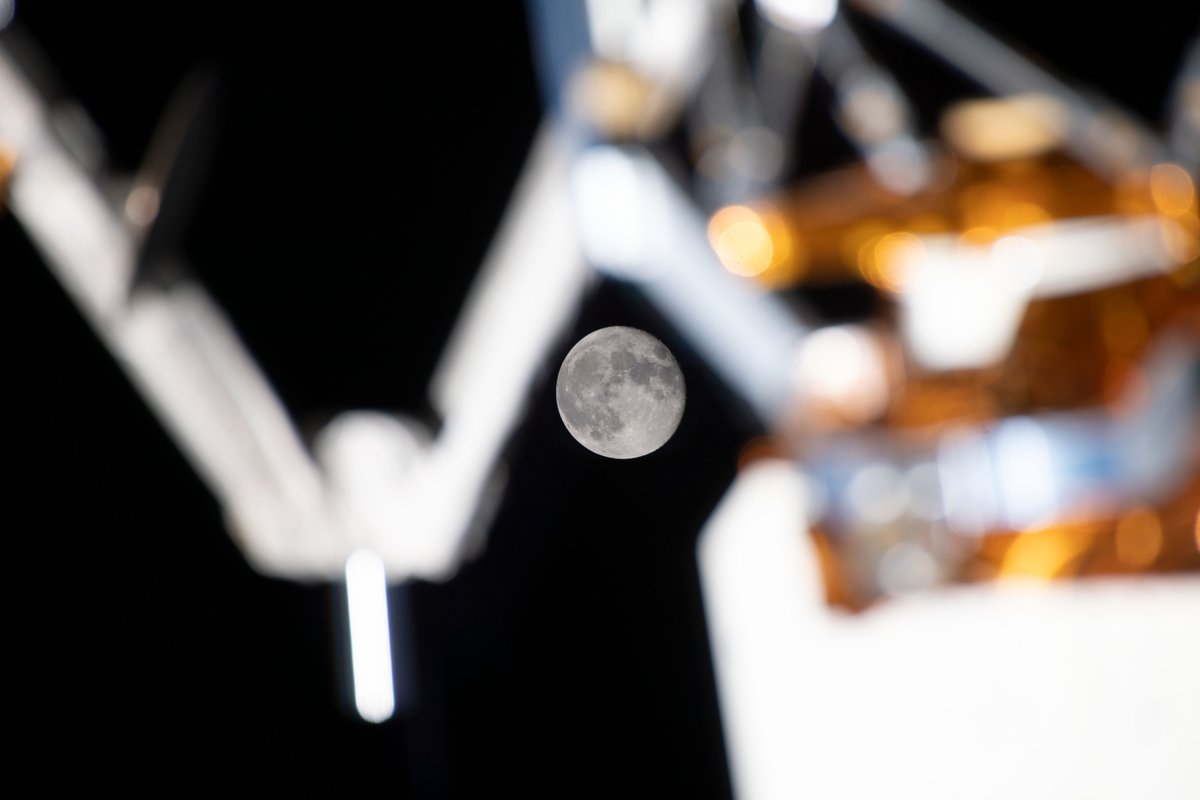
Will you catch the full moon tomorrow?
April’s full moon is also known as the Pink Moon and is named after an herb, moss pink. This plant is native to the eastern United States and is one of the earliest widespread flowers of spring.
🇺🇸NEURALINK OPENS GLOBAL REGISTRY FOR BRAIN-COMPUTER IMPLANT VOLUNTEERS
Neuralink is now inviting people worldwide with quadriplegia to join its Patient Registry.
The goal? Let volunteers control a computer using only their thoughts.
This marks the next step in Elon’s vision of merging mind and machine.
Apply here: https://t.co/lH21MfSASL
Source: Neuralink
It's important that we continue to develop a destinations in Low Earth Orbit, especially with the ISS's end in sight. Uninterrupted and continuous human presence is fundamental to continuing the legacy of the ISS and opening the door to greater discovery.
We know the main origins of hard plastics found in the Great Pacific Garbage Patch (GPGP), but about half of the total plastic mass in the GPGP consists of fishing nets.
Our Research team is now working to identify their origins by analyzing these nets based on their size, color, and polymer.
A brief history of Quantum computers 👇
1905: Albert Einstein explains the photoelectric effect and suggests that light consists of quantum particles or photons
1924: Max Born uses the term quantum mechanics for the first time
1925: Werner Heisenberg, Max Born, and Pascual Jordan formulate matrix mechanics, the first formulation of quantum mechanics
1925-1927: Niels Bohr and Werner Heisenberg develop the Copenhagen interpretation, one of the earliest and most common interpretations of quantum mechanics
1930: Paul Dirac publishes The Principles of Quantum Mechanics, a standard textbook on quantum theory
1935: Albert Einstein, Boris Podolsky, and Nathan Rosen publish a paper highlighting the counterintuitive nature of quantum superposition and arguing that quantum mechanics is incomplete
1935: Erwin Schrödinger develops a thought experiment involving a cat that is simultaneously dead and alive, and coins the term “quantum entanglement”
1944: John von Neumann publishes Mathematical Foundations of Quantum Mechanics, a rigorous mathematical framework for quantum theory
1957: Hugh Everett proposes the many-worlds interpretation of quantum mechanics, which suggests that every possible outcome of a quantum measurement actually occurs in a parallel universe
1961: Rolf Landauer shows that erasing a bit of information dissipates a minimum amount of energy, known as Landauer’s principle
1965: John Bell proves that quantum entanglement cannot be explained by any local hidden variable theory, known as Bell’s theorem
1973: Alexander Holevo proves that n qubits cannot carry more than n classical bits of information, known as Holevo’s theorem or Holevo’s bound
1980: Paul Benioff proposes a model of a quantum Turing machine, a theoretical device that can perform any computation using quantum mechanical principles
1981: Richard Feynman suggests that simulating quantum systems would require a new type of computer based on quantum mechanics
1982: David Deutsch generalizes Benioff’s model and proposes the concept of a universal quantum computer
1984: Charles Bennett and Gilles Brassard develop a protocol for quantum key distribution, which allows two parties to securely exchange cryptographic keys using quantum states
1985: David Deutsch and Richard Jozsa devise an algorithm that can solve a specific problem faster than any classical algorithm, known as the Deutsch-Jozsa algorithm
1991: Artur Ekert proposes another protocol for quantum key distribution based on quantum entanglement, known as the E91 protocol
1992: David Deutsch and Richard Jozsa extend their algorithm to handle multiple inputs, known as the Deutsch-Jozsa algorithm
1994: Peter Shor discovers an algorithm that can factor large numbers in polynomial time using a quantum computer, known as Shor’s algorithm
1996: Lov Grover invents an algorithm that can search an unsorted database in square root time using a quantum computer, known as Grover’s algorithm
1997: Isaac Chuang, Neil Gershenfeld, and Mark Kubinec demonstrate the first implementation of Shor’s algorithm using nuclear magnetic resonance (NMR) techniques
2000: David DiVincenzo proposes five criteria for building a practical quantum computer, known as the DiVincenzo criteria
2001: IBM researchers implement Grover’s algorithm using NMR techniques and achieve a modest speedup over classical algorithms
2007: D-Wave Systems claims to have built the first commercial quantum computer, but its validity is disputed by many experts
2019: Google announces that it has achieved quantum supremacy by performing a calculation on a 53-qubit quantum processor that would take a classical supercomputer thousands of years to complete
2020: IBM demonstrates that its 65-qubit quantum processor can perform calculations beyond the reach of any classical computer
📷 An IBM QC photographed by James Estrin