I am incredibly grateful to everyone who supported my book launch last week. We hit best seller on Amazon and exceeded my wildest expectations.
None of this would be possible without you!!!
https://t.co/1disP9Pka9
The Anduril x @NASCAR Collection. Get in gearThe Anduril x @NASCAR Collection. Get in gearThe Anduril x @NASCAR Collection. Get in gearThe Anduril x @NASCAR Collection. Get in gear.
The Anduril x @NASCAR Collection. Get in gearThe Anduril x @NASCAR Collection. Get in gearThe Anduril x @NASCAR Collection. Get in gearThe Anduril x @NASCAR Collection. Get in gear.
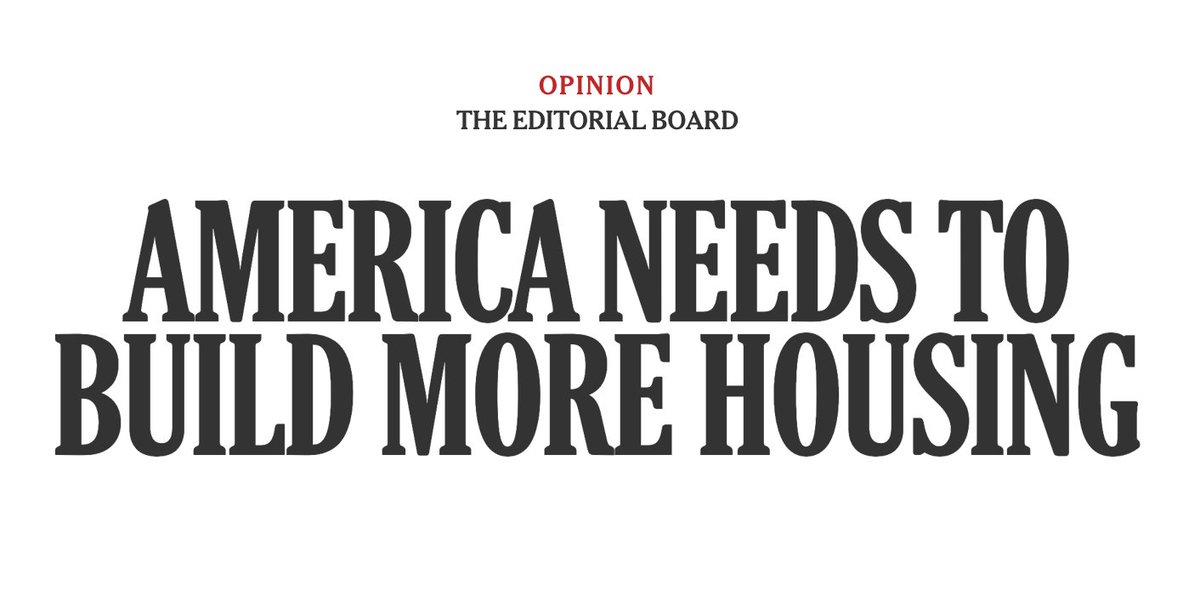
What every voter and apparently, the NY Times Editorial Board, should know about housing policy:
1. Rents reflect the balance of supply of apartments and demand for those apartments in a given area. That’s it; there’s no magic. If you want lower rents, you can hope for a recession that destroys jobs and, therefore, demand. Or you can add supply.
2. There is no amount of money that any big city government could feasibly spend that would add materially to supply. This is because, depending on the location, new apartments cost $250,000-1,000,000 to develop… building even a few hundred of those starts to stress any city budget, and many big cities need tens or hundreds of thousands.
3. On the other hand, investors (including pension funds and endowments, insurance companies, rich families, etc.) can collectively **easily** provide enough capital to build as much housing as we need **so long as they are confident they can get a reasonable return**.
To get those investors to fund the creation of the housing our society needs, we must do two things:
1. Dramatically reduce the time & complexity associated with securing governmental permission to develop housing. This means reviewing and simplifying the overlapping regulations that constrain housing production: zoning codes, building codes, parking, ADA, etc. But it also means changing the cultures within the relevant governmental agencies from “default no” to “how can we help you?”.
2. Provide certainty around on-going regulation of apartment operations.
The way investors get a return from building rentals is as follows: They hire managers to lease the apartments, collect the rents, pay operating expenses and any mortgage payments, and then send the investors the cashflow that remains.
But governments all over the country have been restricting the manner in which apartment buildings can be operated in all kinds of ways.
For example: Cities have been making it harder to screen tenants, while also making it much harder to evict tenants who don’t pay. You can see why both of those measures are politically popular. After all, who doesn’t want people to get second chances? And who wants anyone to get evicted? But, as a manager, the combination of those two regulations makes it much harder to predict, with any certainty, that the rent will get paid… and that makes it very difficult to get investors to provide capital to create more housing.
Another example: Rent control. Again, I understand why renters love rent control and why politicians want to give it to them. But, if, as has been the case in NY, LA and San Francisco, city governments hold annual rent increases below the rate of growth in the operating expenses of the buildings, the cashflow payable to the investors shrinks… making them much less likely to invest capital in building more apartments.
In conclusion: For ~every other good or service in the economy, we allow the market to function, and the result is that we have a surplus of choice at all price points (think of food or clothes or cars), which is spectacular for the consumer. If we want a surplus of choice at all price points in housing, we need to get comfortable with the idea of allowing the market to provide it.
And that means allowing investors to build rental apartments *and* allowing them to operate those apartments in a manner consistent with making a reasonable profit.
Remember: Every developer of rentals is either a landlord-in-waiting or hoping to sell to one.
I'm going to get killed for this but I think this is a good idea.
After digging into the data about depression, sleep deprivation and external locus of control in kids who are active on socials early, I'm sold.
Social media as late as possible in life.
Congrats to LiveRamp and the team for the sale to Publicis. This deal was a steal for Publicis (more on that below).
LiveRamp was a shining gem and still is such an important part of the ad tech and marketing tech industry. It has so many amazing people and has a really incredible product, which has not changed that much over the last 10 years or so. It has bittersweet seeing a company that one created and was a part of for almost a decade go into decline.
But despite that, the company is still in really good position. Unfortunately they were not able to take advantage of their position. For the last decade they traded long-term positioning for short-term gain. That trade resulted in the ire of their customers and even more so their partners.
Now that they will be in a new home in Publicis, I hope that we will see a renaissance of LiveRamp and LiveRamp will continue to be an incredible part of the industry going forward.
The company has a lot it needs to do:
It needs to focus on the core product. The core product is 70% of their revenues and 500% of their profits.
They need to focus on making that product better. The core product really hasn't changed in about a decade.
They have to focus on making the middleware product better: making it easier to use, making it so you can onboard partners faster, onboard customers faster, onboard connections.
the most important LiveRamp metric The number of connections per customer is the most important metric for LiveRamp. That number is surprisingly low.
Most customers only have a small number of connections using the LiveRamp system, not because they don't want to use LiveRamp but because either LiveRamp is way too expensive or takes too long or it's too bureaucratic or too burdensome (or usually all of the above). Now that there is going to be new ownership of LiveRamp, hopefully they can focus more on the product and customers can go from, let's say, 10 connections in LiveRamp to 400 connections, 500 connections, even 1,000 connections. That's how we know LiveRamp is really doing a good job.
Also the next way we know LiveRamp is doing a good job is if they can increase the number of customers. Today most of the customers that use LiveRamp are quite large ... which is great. They have still the largest B2C customers in the world. It would be amazing if everybody can use LiveRamp: mid-market companies ... even small companies (would be awesome to have a self-service system).
all that said, I'm long the core engineering team and product team of LiveRamp and LiveRamp's position in the market. This deal was a steal for Publicis. It was a great deal for Publicis, assuming they can even make LiveRamp a tiny bit better. this definitely could be a deal that transforms Publicis. There's no reason why LiveRamp can't be a $100 billion market cap company by itself. It should be. It should have that position. It should be well over $100 billion and with the right product vision. it can get there. Let's make LiveRamp great again!
this is the kind of messaging you craft for public education when you believe the purpose of public education is giving unions money rather than educating children
The @NFL’s media rights re-negotiations may prove so costly that it results in a “7% cut to scripted TV, film, and every other sport,” per @michaelbeach & @xscreenmedia.
As you go to work today and settle into the week, please study the form below. You will soon need to fill this out EVERY year and tell the government what you own and then allow them to tell you how much its worth.
That is the framework that is enabled by the Trojan Horse "Billionaire Tax" that is trying to get passed.
Give them credit: they cleverly use Billionaires as the hook, but build in the language and the framework that will allow the Legislature to simply extend the tax to everyone and make it yearly.
And this is where the form below comes in...
In this case, ask yourself, will it be you or the Billionaires that will be able to fill this out properly and avoid penalties.
As much as Billionaires can be pushed to do more for society, we all know that they have the infrastructure to manage these kinds of disclosures...middle class Californians do not and they will be the ones that get penalized in the end.