The official X account for MichaelMaths — interesting math videos covering a range of different topics, mainly analysis focused (studying MDSAI @ UWaterloo)
@CharlieYYang@Almost_Sure I’ve seen a number of regularized results where the answer ends up being the same as the constant term in the series expansion. Same thing with harmonic series converging through Ramanujan summation or a limit of averaging with the Zeta function to the Euler Mascheroni constant.
I really enjoyed Apoorva's essay. It's rare these days to hear what a *student* thinks about what's going on in AI and Math, and I highly recommend you take a look at her piece – it's thoughtful, curious, idealistic, and unmistakably human.
Projective plane: visualising solutions to
x/(y+z) + y/(x+z) + z/(x+y) = 4
A surface in 3d space.
Invariant under scaling: if (x,y,z) is a solution then so is (ax, ay,az).
Solutions are a set of lines through the origin. Or a cubic curve on the plane z=1, or on unit sphere.
"This was a great shock to existing thinking about the foundations of mathematics. And indeed to this day Gödel's Theorem has continued to be widely regarded as a surprising and rather mysterious result..."
—@stephen_wolfram
https://t.co/023gpog2yE
Here at [famous scientist’s name].ai, we’re developing tools to accelerate science. Unlike academia, which has stifled the production of high quality scientific work by demanding it be correct, here at [fsn].ai, we know that you can just do (wrong) things.
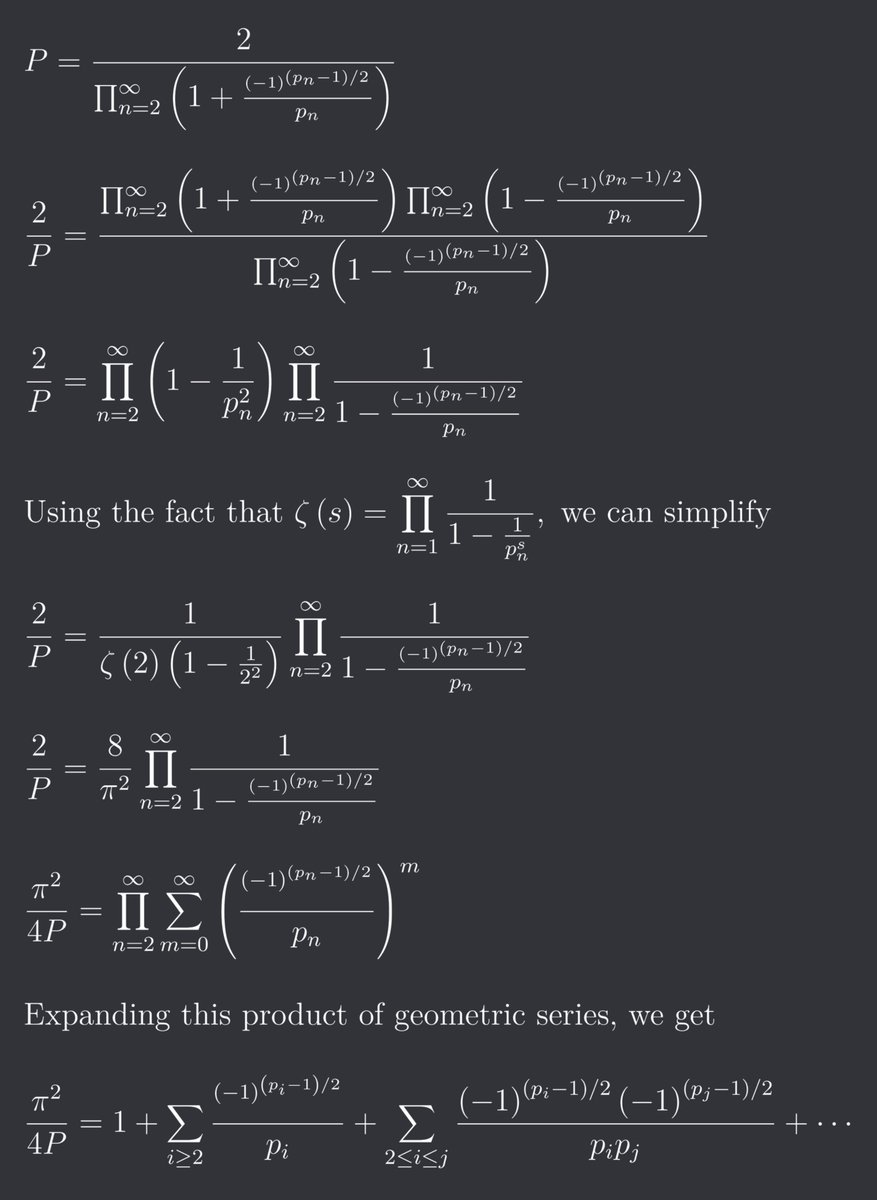
Here's a neat proof of an Euler-type product representation of π. The way multiplicativity allows the Euler product to unfold into a Dirichlet series, which then coincides with the Leibniz series for π/4, is especially elegant and satisfying.
@chris_juravich I remember a while back I found another proof of the trivial zeros of ζ(s) being at s = -2n using Abel regularization for η(s). The resulting polynomials, I believe called Euler or Eulerian polynomials, had symmetric alternating coefficients, forcing them to vanish as t→1.
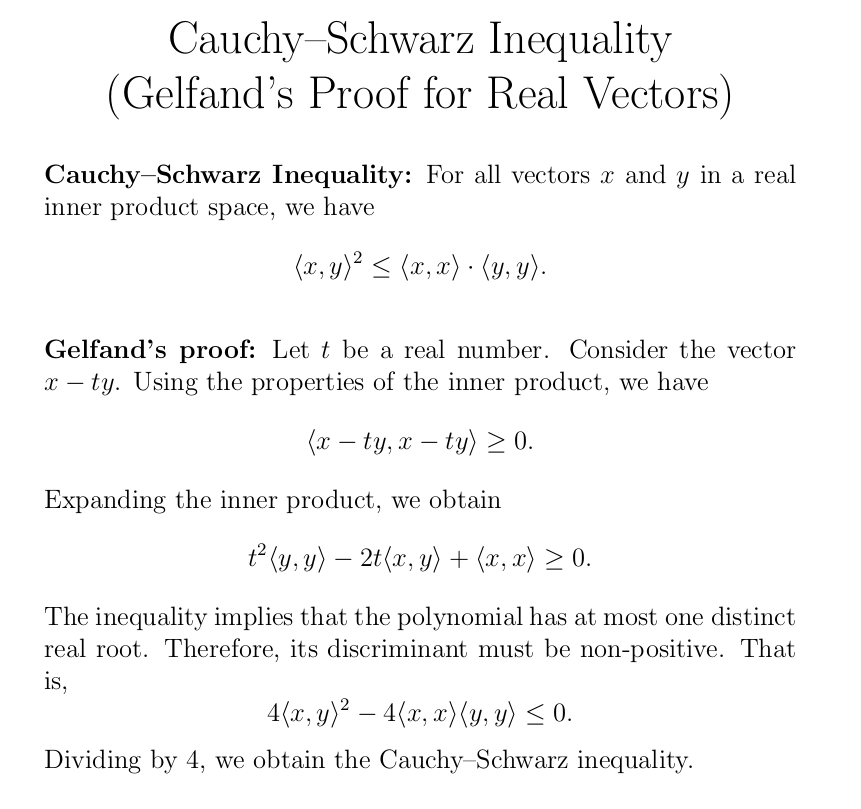
Gelfand's proof for Cauchy-Schwarz Inequality for real inner product spaces
Source: I.M. Gelfand, "Lectures on Linear Algebra" (https://t.co/uOq1RO2bz6).
for years, society was limited to only 16 syrup squares per waffle but with recent combinatorial optimization breakthroughs our research department has achieved previously unheard of densities of waffle syrup
@chainmonkey2@KenOno691 That would be more like Willan’s formula, that essentially encodes a brute force sieve for primes using Wilson’s theorem in a sum
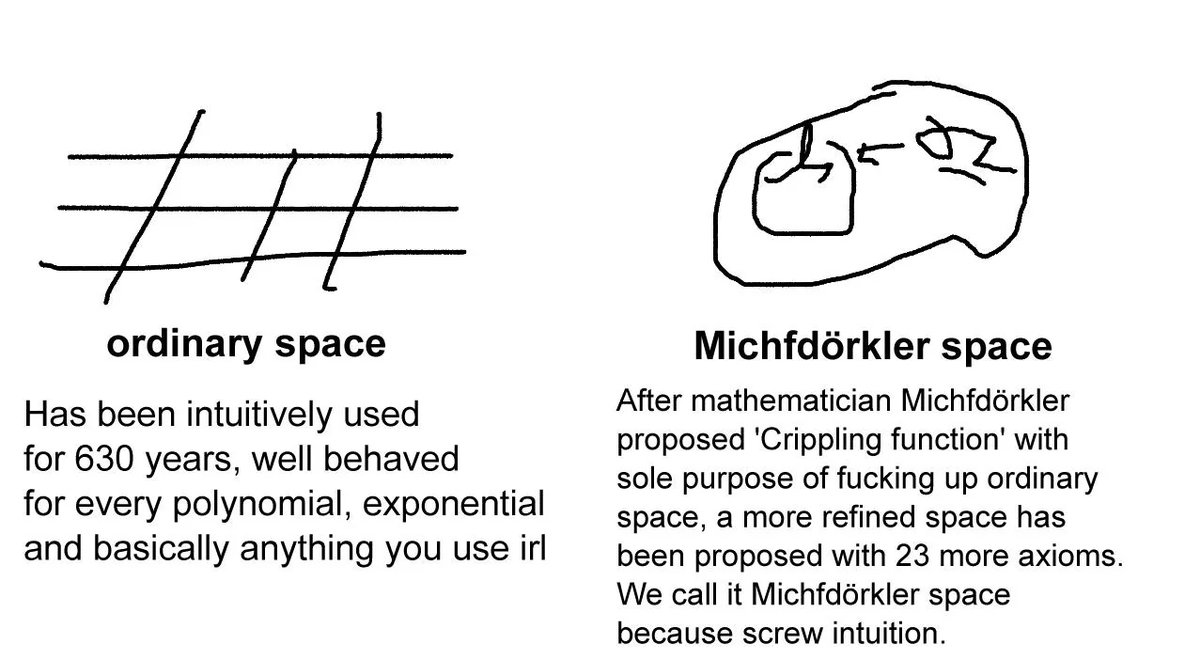
Well, math terminology being what it is, something like this was bound to happen eventually.
(If you're curious about why these balls are so puny, the full talk is up on YouTube)