I am glad to see @Carr12Brandon & @jyjamespark engage w/ my second island chain strategy proposal & offer their view.
I'll briefly respond to their critiques here:
1. They argue that if the U.S. pulls back militarily, China will be able to use economic & political power to force Japan, ROK, & others to its side. However, countering China's economic and political influence is not a job U.S. military power can accomplish. To do this, the U.S. needs a coherent economic strategy. Look at Latin America where Chinese economic influence continues to increase even as the U.S. surges military power to the region. U.S. military power in Asia cannot counter Chinese economic hegemony.
2. They are concerned about the risks of nuclear proliferation to allies if the U.S. retrenches. As I note in the paper, this is possible. But I also see some proliferation as inevitable & the result of Trump administration policies, including the war with Iran. The U.S. nuclear umbrella already lacks credibility. My view is some proliferation can be managed & is better than continue U.S. overextension.
3. They argue that the United States essentially cannot defend the first island chain from the second. This is correct, but I don't suggest it should. I acknowledge there are a small set of contingencies where the United States might use force to protect core interests & these contingencies could be managed without a major first island chain presence. Moreover first island chain bases are not survivable or defensible, so what's the logic for keeping them & planning to fight from them?
4. They leave unaddressed several of the core drivers of my recommendations, including the unsustainability of the current strategy (cost wise & limits of military power) & the effect of any U.S. first island chain presence on the risk of war with China, which they seem to accept. The status quo simply doesn't work any more, so any recommendation for future U.S. policy has to address these underlying issues, even if the changes recommended aren't the ones I propose.
Overshadowed by a blunder in Iran, the US withdrawal from Iraq is a victory for everyone who opposes Washington's endless wars.
This builds on withdrawals from Syria and Afghanistan. The logic of withdrawal applies throughout the Middle East, where US bases remain liabilities.
.@jekavanagh & @dandcaldwell's 2025 op-ed is cited in today's @washingtonpost report on the military footprint in the Middle East:
"A recent policy proposal from Defense Priorities, a think tank that advocates for military restraint, calls for closing U.S. bases in close striking range of Iran's missiles and drones, such as Kuwait. The proposal also calls for moving forces dispersed in the United Arab Emirates, Jordan and Bahrain to more secure facilities such as the Prince Sultan Air Base near Riyadh." https://t.co/IwuPTigVDV
It's far better to shed the veil of ideology and admit when choices are about the naked pursuit of power.
Next step is getting people to admit the uncomfortable truth that power overrides ideology and legality alike.
Congress and "international law" are as toothless as ever.
Thoughts on the capture of Maduro:
-The operation was skillful, though should have avoided any civilian casualties.
-A deal could have and should have been made to avoid this operation.
-The US taking control of Venezuela is unnecessary and risks taking a turn for the worse.
This looks good now, but the question was never about whether the U.S. could get Maduro. The question is: what comes after?
We got Saddam.
We got Gaddafi.
What came after???
@defpriorities
Regime change and nation-building are different things but the U.S. doesn't have a good track record in either.
Fundamentally, it would have been better for Trump to use his mantle as "president of peace" and negotiate a deal favorable to US interests.
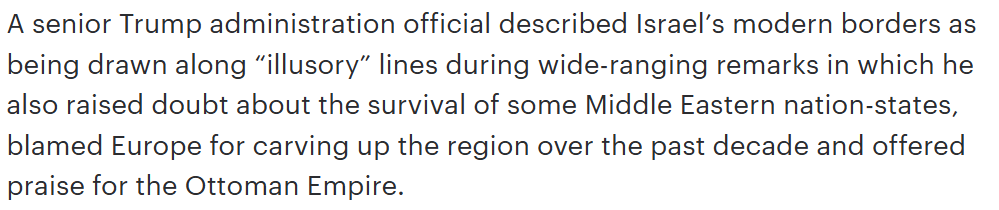
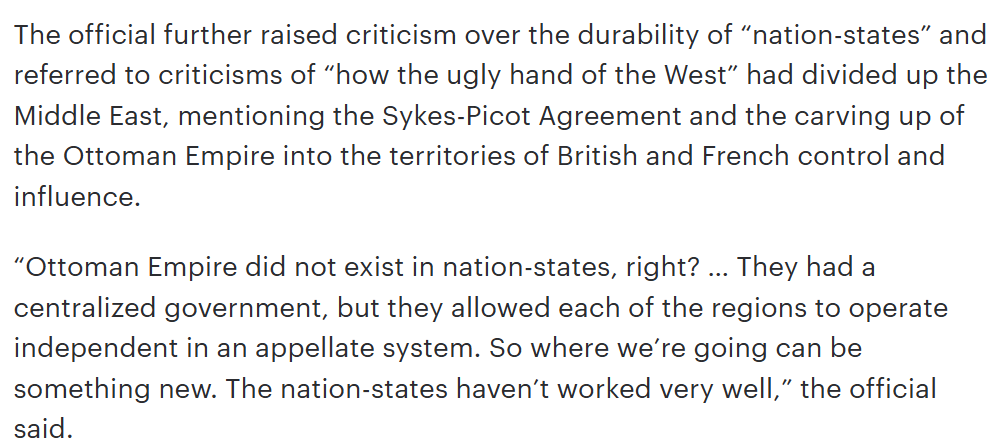
A Trump official called Israel's border agreements illusory, condemned "the ugly hand of the West," adding that the nation-state idea hasn't worked out in the Middle East, and seemingly yearned for the region's future to take cues from the Ottoman Empire.
From @HelloLauraKelly:
Israel wants to be a regional hegemon (in truth, a great power) but that dream is only conceivable because of the immense and unconditional support America gives Israel.
A big question here: What do we get in return?
Among all the flashing warning signs that Trump was planning to bomb Iran, I can't get this clip out of my head.
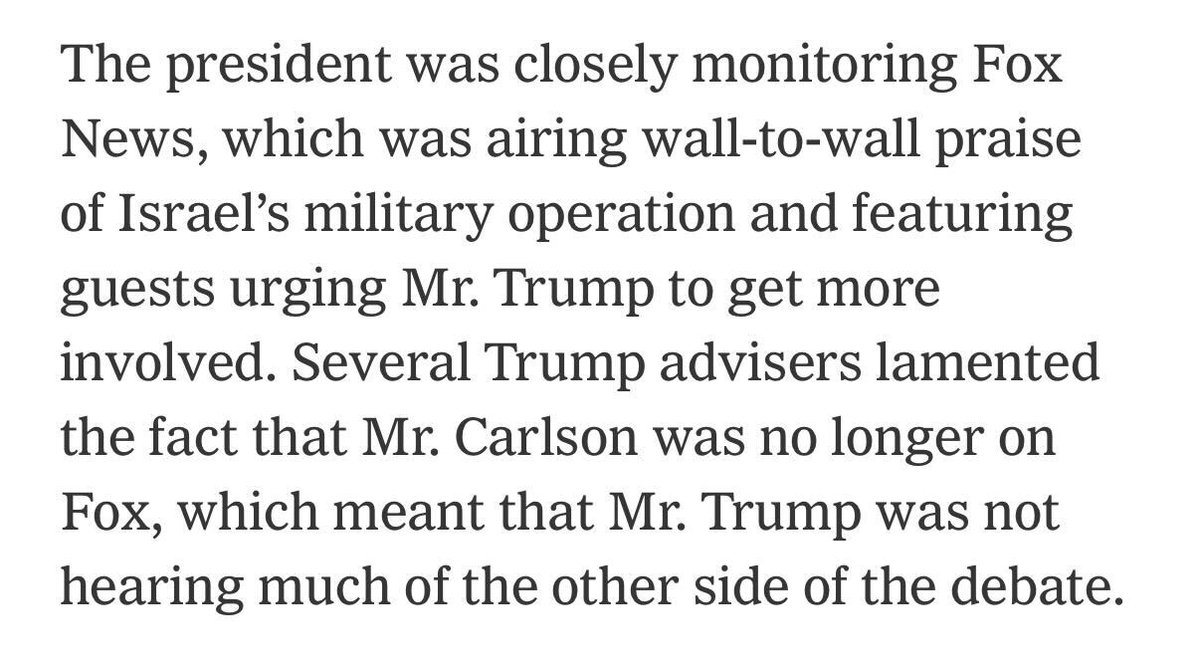
Why does Trump think Tucker Carlson (and by proxy, noninterventionist views) has a smaller audience now than when he was on network television?
Reporter: How did you respond to @TuckerCarlson criticizing you, saying that you were complicit in the war?
Trump: I don’t know what Tucker Carlson is saying. Let him go get a television network and say it so people actually listen.
Trump’s “speech” was rushed, bizarre and depressing. Mere minutes. He was stressed like he’s rarely ever seen (like ever— even under indictment!).
He “thanked” Netanyahu, when of course, it should be Netanyahu who should be thanking him. Everyone understands that thanks isn’t justified both ways.
I fear that Trump stepped in the bear trap last night.
Iran may opt for a symbolic retaliation against the US but they have plenty of incentive to keep hitting Israel, which will pressure Trump to get more involved in the war. Diplomacy seems like a dream at this point.
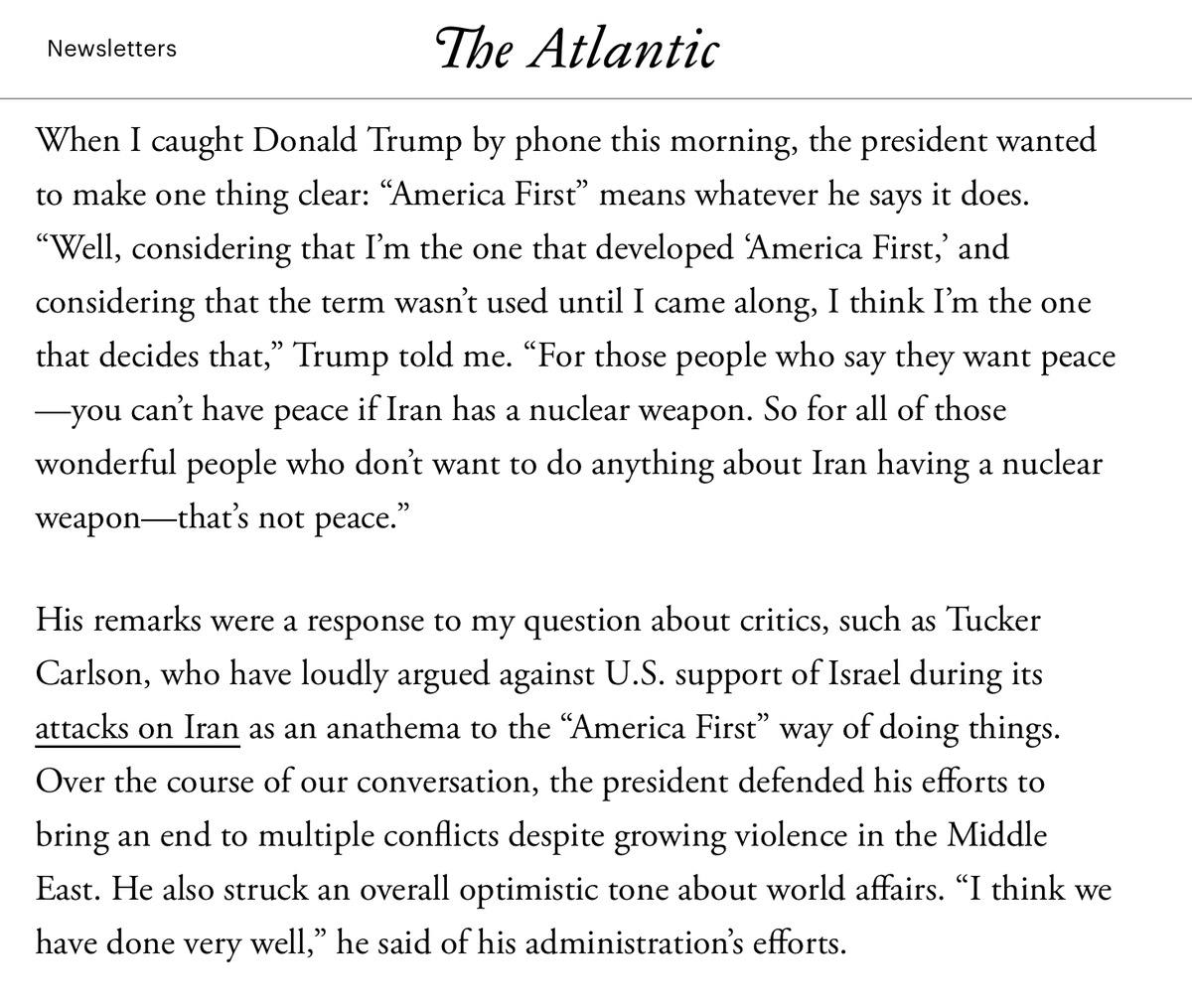
The "America First" idea was developed before Trump was even born and it will survive past his presidency.
Fighting Israel's war is "America Second."
The stakes are high here and I hope Trump doesn't make a tragic miscalculation.
My take in NYTimes: “A war with Iran would be a catastrophe, the culminating failure of decades of regional overreach by the United States.” Trump must keep us out. @defpriorities gift link: https://t.co/S2i3KOi8tv
My take in NYTimes: “A war with Iran would be a catastrophe, the culminating failure of decades of regional overreach by the United States.” Trump must keep us out. @defpriorities gift link: https://t.co/S2i3KOi8tv
I recently visited Hiroshima, and stood at the epicenter of a city scarred by the unimaginable horror caused by a single nuclear bomb dropped in 1945. What I saw, the stories I heard, and the haunting sadness that remains, will stay with me forever.