Genealogy of how the American Psychiatric Association came to promote the lie that humans can change sex.
The Society for Existential Analysis refused to publish this article.
"The majority of the voters do not get to decide the outcome..."
Um. Huh?
These people hate democracy. They want to just be weirdo self-appointed elites and experts making all the rules for the rest of us and shouting "No Kings!" all the time. While acting like kings.
The only reason any state had to ban cutting off the breasts of 12-year old girls and removing the testicles of 17-year old boys is that the medical industry became an adjunct to an online cult of self-harm that eagerly colluded in rendering minors sterile, sexually dysfunctional, and tied to a medical leash for life in order to affirm a delusion that can never be true. It's an abomination that this could only be done against the opposition of the Colorado government and that the Colorado government may act to deny the will of the people expressed in this vote.
A Stanford professor looked at MBA grads 10 years after graduation to see who got ahead.
The ones who went furthest all had one skill in common. Here's what it was 🧵
Excellent documentary highlighting the chaos, destruction & harm caused when the category of sex is replaced with “gender identity.” Thank you to @TessH_ROGD_Mum, @salltweets, @Bernard_Lane, @Jilliantweeting, & many others in this incredible film. This ideology destroys everything it touches.
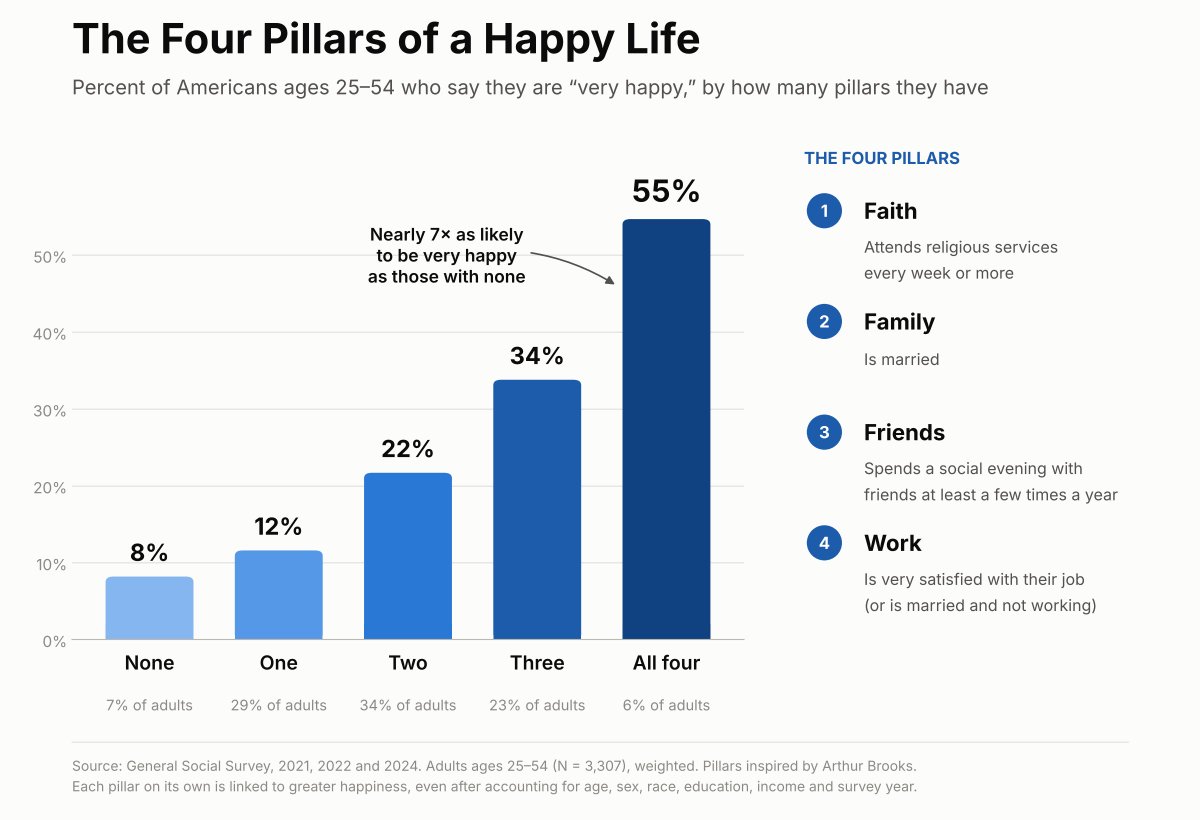
.@arthurbrooks nails it: faith, family, friends & meaningful work are 4 pillars of a happy life.
The data tell us:
✅ 0 pillars: 8% "very happy"
✅ All 4 pillars: 55% "very happy"
Marriage & work matter most. Money?
It barely registers, after you control for the pillars.
First Lady Melania Trump’s 5 PILLARS OF WOMENS HEALTH INNOVATION //
1. Direct research funding towards finding cures that affect women in a disproportionate and unique way.
2. Use super intelligence to enhance our insight of female biology and speed up medical discoveries.
3. Accelerate the process of getting promising therapeutics from laboratories to female patients, while maintaining strict safety standards.
4. Ensure that medical breakthroughs are accessible and affordable to women, regardless of their financial circumstances.
5. Replace generations of silence with open conversation, education, and compassion surrounding women’s health.
🚨 BREAKING: By stroke of pen, President Trump just SIGNED with Melania Trump a landmark executive order for for women's health, creating a brand-new Women's Health Division at the National Institutes of Health
Second Lady Usha Vance even brought her baby to the EO signing! 👏🏻
TRUMP: "THERE IT IS."
It also sets up a White House Women's Health Task Force, co-led by Chief of Staff Susie Wiles and RFK Jr.
The order targets:
- Osteoporosis
- Alzheimer's
- Heart disease
- Stroke
- Maternal health
- Mental health
- Endometriosis
Melania pushed for this!
@jbvconnor For many, a fixed trans identity provides a rigid psychological structure that hides underlying uncertainty and doubt about who they are and where they fit in. They may believe that a trans identity is the solution to their underlying insecurities. It may also create an idealised avatar that promises, in effect: “If only I’d been born differently, I’d be much happier with myself and free of self-hatred.” Any invitation to think or explore the nature of this belief system can be experienced as a threat, causing psychological pain. The young person’s own doubts and confusion may be disowned and attributed to therapists or parents.
Good therapy involves two stages: first, understanding the way the individual sees the world; then, helping them gain enough distance from that identification to become interested in other perspectives and ways of thinking about themselves. This means bringing their beliefs and the function they serve into view. The affirmation model can bypass this process by supporting the young person unreservedly without first bringing those beliefs and their function into view, or helping them consider other perspectives. In this way, there can be a collusion between the patient and the clinician. What remains unexamined is that the capacity to tolerate psychological turbulence is essential for psychological development.
Therapeutic work requires experienced therapists who can support the individual over time, often working uncomfortably between two risks: on the one hand, pushing the patient to face reality in a way that may rupture the therapeutic relationship; on the other, avoiding the difficulty by becoming collusive and ineffective.
In effect, the affirmation model exchanges short-term relief from doubt, confusion and uncertainty for security, leading to a psychic retreat from developmental opportunities. In this way, it protects both the patient and the clinician from the psychic pain and turbulence involved in exploring and thinking things through. Another problem is that these psychic defences flatten the capacity to experience pleasure as well as pain. Tragically, short-term solutions to psychic pain can have hidden long-term consequences.
A symptom of this problem is clinical teams’ proud boasts that they knew the patient should transition because the young person was so certain. These boasts treat the young person’s certainty as a sign of health, rather than a red flag that they may be caught in a rigid belief system that exchanges thought for certainty.
A more in-depth version of this argument is available in this open-access paper: https://t.co/Bim2Y1Ghit @CASCltd@rachelbaxendale@stellaomalley3
I didn’t really get the problem with gender ideology at first.
I’m liberal-minded about most things. ‘Live and let live’ has generally been my motto. I believed in inclusion, kindness and not causing unnecessary offence.
I knew some adults chose medical treatments or surgery to resemble the opposite sex. That seemed to me a matter of personal autonomy. Adults can do what they wish with their own bodies.
What I hadn’t realised — and I feel slightly embarrassed admitting this — was that I’d misunderstood what was being claimed.
I thought “transgender” meant a form of self-expression. A man who liked wearing women’s clothes. Someone changing their name. Gender non-conformity.
What I hadn’t grasped was that some activists weren’t just asking for tolerance. They were asserting that declaring yourself the opposite sex made you the opposite sex. Not metaphorically. Literally.
And that this wasn’t just cultural. It had legal consequences.
It meant men who said they were women were demanding access to women’s sports, prisons, domestic violence shelters and hospital wards.
It meant the rewriting of healthcare language — “pregnant people”, “bodies with cervixes” — to avoid saying “women”.
It meant children struggling with identity being affirmed onto medical pathways with lifelong implications.
And also redefining same-sex attraction. Lesbians called ‘bigoted’ for not wanting relationships with men who identify as women. Gay men accused of prejudice for saying they’re not attracted to female bodies.
I’d also overlooked how deeply this had spread into public institutions, schools and workplaces.
And how easily disagreement was framed as cruelty. Speaking up felt risky — because others were being publicly humiliated for doing so.
None of this is abstract.
Because sex is the basis on which safeguarding works. On which data is collected. On which cancer screening programmes run. On which fair sport and single-sex spaces depend. It’s written into law — including the Equality Act — because material differences matter.
If sex becomes a ‘feeling’ rather than a biological category, those protections become unstable.
And once reality becomes negotiable, everything does.
Once I saw it, I couldn’t unsee it.
But I needed to be sure.
So I read. Books, research papers, policy documents. When I finally spoke publicly, there was backlash from all directions.
Many women thanked me, while some feminists criticised me for speaking too late.
Others were angry about a past interview I’d done with the parent of a transgender person, accusing me of promoting harm.
It takes courage to speak when you know your reputation, friendships or livelihood may be on the line — when you know raising your voice could strain, or even end, relationships you value.
Once I understood what was at stake, staying silent was no longer an option.
I lost my livelihood simply for saying I didn’t like the phrase “pregnant people”. That alone tells you something is deeply wrong.
It shouldn’t be this way.
I don’t expect praise for admitting it took me far too long to understand what was happening. Or to say so publicly.
I can only be honest about what I believed then and what I understand now.
But it does take courage to admit publicly that you got something wrong. All I hope is that by acknowledging I wasn’t paying enough attention, another woman (or man) might feel emboldened to do the same.
Because, as many of us know first-hand, there can be professional, social and financial consequences to speaking out.
And I won’t pretend I understood something before I did, simply to make myself more acceptable to those who got there sooner.
Which is why I will never judge another woman for how long it takes her to find her voice.
Because every voice matters. Whenever it is raised.
When Lauren Friedman showed up at Amherst College, she was surprised to discover that almost every single girl in her dorm and on her athletic team was already taking SSRIs.
Inside jokes about Zoloft & Lexapro were common on campus, and everyone seemed deeply grateful their persistent anxiety and depression from teenage years was magically disappearing from a pharmaceutical drug.
Like her peers, @lololizzle had struggled earlier in life with both anxiety and depression -- so Zoloft seemed like a perfect solution. After all, all of her friends were taking it too, so how bad could it be?
Little did she know, SSRIs are causing a silent epidemic among Gen Zers called Post-SSRI Sexual Dysfunction, or PSSD. Like untold tens of thousands of other people just like her, Lauren now has completely lost her libido, sensation in her genitals, and even a sense of emotional connection with the people around her... PERMANENTLY.
She says she and others like her were NEVER given informed consent about the risk of developing PSSD, and American doctors will rarely even diagnose the condition at all.
Whether it's birth control being thrown in the faces of teenage girls to magically "regulate your hormones" or Zoloft instantly prescribed to "make you happy," one thing is clear--the young women of Generation Z are being poisoned en masse without any understanding of what may happen to them down the line.
Every glib, arrogant, virtue-signalling celebrity who’s broadcast the lie that kids will kill themselves if not allowed to transition deserves to have this read aloud to them non-stop through a megaphone for a year.
A new Finnish nationwide register study has been published.
They looked into every under-23 who contacted Finland’s gender clinics from 1996–2019.
2,083 children and young adults vs 16,643 matched controls, followed in mandatory national health registers (so basically the full country picture).
What they found
- Gender-referred youth had far more serious psychiatric illness than peers — before referral (~46% vs ~15%) and it increased ≥2 years after (~62% vs ~15%).
- Kids referred after 2010 arrived with more psychiatric need than earlier cohorts.
- Among those who got medical “gender reassignment,” psychiatric morbidity INCREASED over follow-up (about 10% → 61% for feminising pathways; ~22% → ~55% for masculinising).
- Authors’ bottom line: psychiatric needs do not go away after medical reassignment!
Detransitioners are proof that the "gender question" for children is far from settled. ❤️🩹
A growing movement of detransitioners is coming forward, slowly uncovering the damage behind gender treatments for children.
Puberty blockers, cross-sex hormones, and invasive surgeries are neither natural, nor without lasting effect.
Children and teenagers grow up. They change their minds. They blossom into who they are. But only if given the time, space, and guidance needed to flourish.
When doctors quickly medicalize gender dysphoria, they rob these children and young adults of the futures they later might have embraced.
The cost of that regret is high. ⚠️
Many will never know the feeling of nursing their own child or experience a “proper” puberty. Others live with chronic pain, scarring, or medical complications. Almost all detranstioners carry the mental and emotional exhaustion of piecing life back together after transition.
But their healing has given them a voice that warns of something important: "gender ideology" harms children and comes at a high price.
We applaud the courage of detransitioners and their bravery in speaking out.
Children deserve protection. 🩹
The Centers for Medicare and Medicaid Services has introduced new ICd-10-CM billing codes for insurance coverage for detransitioners. Many detransitioners have complained that insurance readily paid for their gender transition interventions, but seeking coverage for detransitioning was nearly impossible.
The codes, per @DoNoHarm include:
F64.A, “Gender Identity Disorder, in remission,” otherwise termed “Gender dysphoria, in remission (desistance).” This code will be applicable to those patients who no longer meet the diagnostic criteria for gender dysphoria — that is, those for whom a marked incongruence no longer exists between their “experienced/expressed gender” and their “assigned gender.”
“Personal history of social gender transition” (Z87.8901)
“Personal history of medical gender transition” (Z87.8902),
“Personal history of surgical gender transition” (Z87.8903) will be added for further specificity under the already existing header “Personal History of Sex Reassignment.” This will allow for more accurate recordkeeping and thus improve real-world data collection on the status of patients’ “gender transitions.” (Within this section, two additional codes will also be available to providers: “Personal history of intersex surgery” (Z87.8904) and “Personal history of unspecified gender transition” (Z87.8909).)
“Personal history of gender detransition” (Z87.893)
Rather than masking grads for one semester (just kicks the can down the road) a better approach might be to help young adults cope with pressure, acknowledge failure is a part of life, teach resilience, strive for excellence, and help people build identities beyond their grades.
This is a superb, must-read post. I will disagree with one point, however, which is not central to the thesis of the article but still very relevant.
"The gender benders of the 1980s were doing something genuinely radical. They demonstrated that biological sex and gender presentation could be separated without requiring a claim about inner identity. Boy George did not claim to be a woman. Annie Lennox did not claim to be a man. The affirmative model collapses precisely this distinction, insisting that cross-sex presentation is evidence of cross-sex identity and that discomfort with gender norms is evidence of gender incongruence. The gender benders suggested something different and developmentally more liberating. They suggested that the norms themselves were the problem, not the person failing to fit them."
The distinction being described here, even if possible in theory, seems to me very hard if not impossible to maintain in practice. I don't think it's an accident that Judith Butler, who helped lay the theoretical foundations for the erasure of sex, gained prominence in the context of 1980s gender bending culture. At some point, radical gender bending is bound to invite speculation followed by forthright criticism of the very idea that humans are sexually dimorphic and that sex is defined by the organization of the body toward production of one of two distinct gamete types. (Trans, in the contemporary sense, is the theoretically incongruent marriage of this idea to that of "gender identity," which evolves out of 1960s psychology.)
That's not to suggest that deviation from traditional sex roles is bad or should be condemned. It can, of course, be liberating and, up to a point, good. And it must be tolerated in a society that values free expression. But the notion that a clear, bright line can be drawn and--crucially--enforced between David Bowie-like gender bending and what we've come to know as gender ideology is one I find unconvincing. The attitudes and institutions that permit the one will, with time, almost certainly compel the other.
Shocking article when you consider the implications.
Overdiagnosis is ruining lives and many of the people whose lives have been ruined don’t know that overdiagnosis was the problem
https://t.co/B499OwbkYE