BTW, for an in-depth look at the growth in the managerial and administrative ranks since the late 1990s, see this post I wrote a while back
https://t.co/ByLqeHnvs2
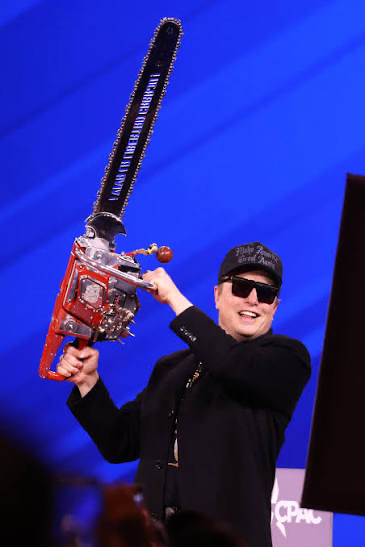
In February 2025, Elon Musk waved a "chainsaw for bureaucracy" at CPAC. Eighteen months later, what had DOGE actually done to the ranks of federal managers and administrators, which had soared in prior decades? Some basic facts from the latest @USOPM data
(1/7)
So headcount is lower, but the underlying mix isn't that different from the past (it's still top-heavy), and there's little evidence we've gotten a more responsive or productive government. That would take a far more thorough and deliberate effort. Here's hoping it happens soon—we sorely need it.
(7/7)
@yanche Transitioning to an MBA CEO had little impact on sales, productivity, employment, or investment. So beyond the effect on workers, how effective is biz education after all? Perhaps even more damming
@Aviation_Intel Curious to get your favorite examples of inertia at the Pentagon, mostly driven by their inflexible, industrial-era processes for spotting opportunities/threats and allocating resources, vs. congressional mandates that tied their hands. 🙏
My wife clogged the shitter the other day.
I called the plumber, some 63 year dude.
When he was done I asked him: Why don't you use a RAG vector db on your own vibe coded app to onboard the clients and increase ARPU.
He looked at me like a cow, had no idea.
We are so early.
@Chris_arnade I’m going to suggest a book that takes a compatible (but I think more compelling) perspective with Mokyr, which is @DeirdreMcClosk’s Bourgeois Dignity.
https://t.co/oD2vZ0CxDa
"Débarrassez-vous des bureaucrates !" : le conseil radical d’un expert en management aux dirigeants @LEXPRESS @MicheleZanini
https://t.co/KGXMM33gjj
Cofondateur du Management Lab, @MicheleZanini alerte sur les ravages de la bureaucratie : "On assiste à une forme d’ossification des entreprises." Ceux qui lancent de nouveaux process doivent rendre des comptes, estime-t-il. ➡️ https://t.co/0imUMQxRtj
✍️ @Laurent_Berbon
In a recent newsletter, Ben Thompson called a portion of Jensen Huang’s keynote at NVidia’s GPU Technology Conference (GTC) in DC “an excellent articulation of the thesis that the AI market is orders of magnitude bigger than the software market.” While I’m loath to contradict as astute an observer as Thompson, I’m not sure I agree. Huang’s argument ran as follows:
“Software of the past, and this is a profound understanding, a profound observation of artificial intelligence, that the software industry of the past was about creating tools. Excel is a tool. Word is a tool. A web browser is a tool. The reason why I know these are tools is because you use them. The tools industry, just as screwdrivers and hammers, the tools industry is only so large. In the case of IT tools, they could be database tools, [the market for] these IT tools is about a trillion dollars or so.
But AI is not a tool. AI is work. That is the profound difference. AI is, in fact, workers that can actually use tools. One of the things I’m really excited about is the work that Aravind’s doing at Perplexity. Perplexity, using web browsers to book vacations or do shopping. Basically, an AI using tools. Cursor is an AI, an agentic AI system that we use at Nvidia. Every single software engineer at Nvidia uses Cursor. That’s improved our productivity tremendously. It’s basically a partner for every one of our software engineers to generate code, and it uses a tool, and the tool it uses is called VS Code. So Cursor is an AI, agentic AI system. that uses VS Code.”
At first this seems like an important observation, and one that justifies the sky high valuation of AI companies. But it really doesn’t hold up to closer examination. “AI is not a tool. AI is work. That is the profound difference. AI is, in fact, workers that can use tools.” Really? Any complex software system is a worker that can use tools! Think about the Amazon website. It is definitely a worker that can use tools. Here is some of the work it does, and the tools that it invokes:
* Helps the user search a product catalog containing millions of items using not just data retrieval tools but indices that take into account hundreds of factors;
* Compares those items with other similar items, considering product reviews and price;
* Calls a tool that calculates taxes based on the location of the purchaser;
* Calls a tool that takes payment and another that sends it to the bank, possibly via one or more intermediaries;
* Collects (or stores and retrieves) shipping information;
* Dispatches instructions to a mix of robots and human warehouse workers;
* Dispatches instructions to a fleet of delivery drivers;
* Follows up by text and/or email and asks the customer how the delivery was handled;
And far more. Every web application of any complexity is a worker that uses tools and does work that humans used to do. And often does it better and far faster. Amazon is a particularly telling example, but far from unique.
Even the analogy to hammers and screwdrivers is overblown. An old fashioned screwdriver or hammer may just be a tool, but an electric screwdriver or nail driver also actually does work. A plow is a tool, but a tractor does work. A horse drawn wagon is a tool, but an auto with an engine does work. Ships used to take hundreds or even thousands of sailors to manage, but now they can run with a small crew, because the machines do so much of the work. And so on.
Self driving cars are closer to the mark, and to some extent, the kind of agentic AI shown in powerful AI software development systems. But come on. Today’s AI systems are still tools. Just very powerful ones. The boundaries are far blurrier than the hype machine would have us believe.
https://t.co/79fLV64xQl
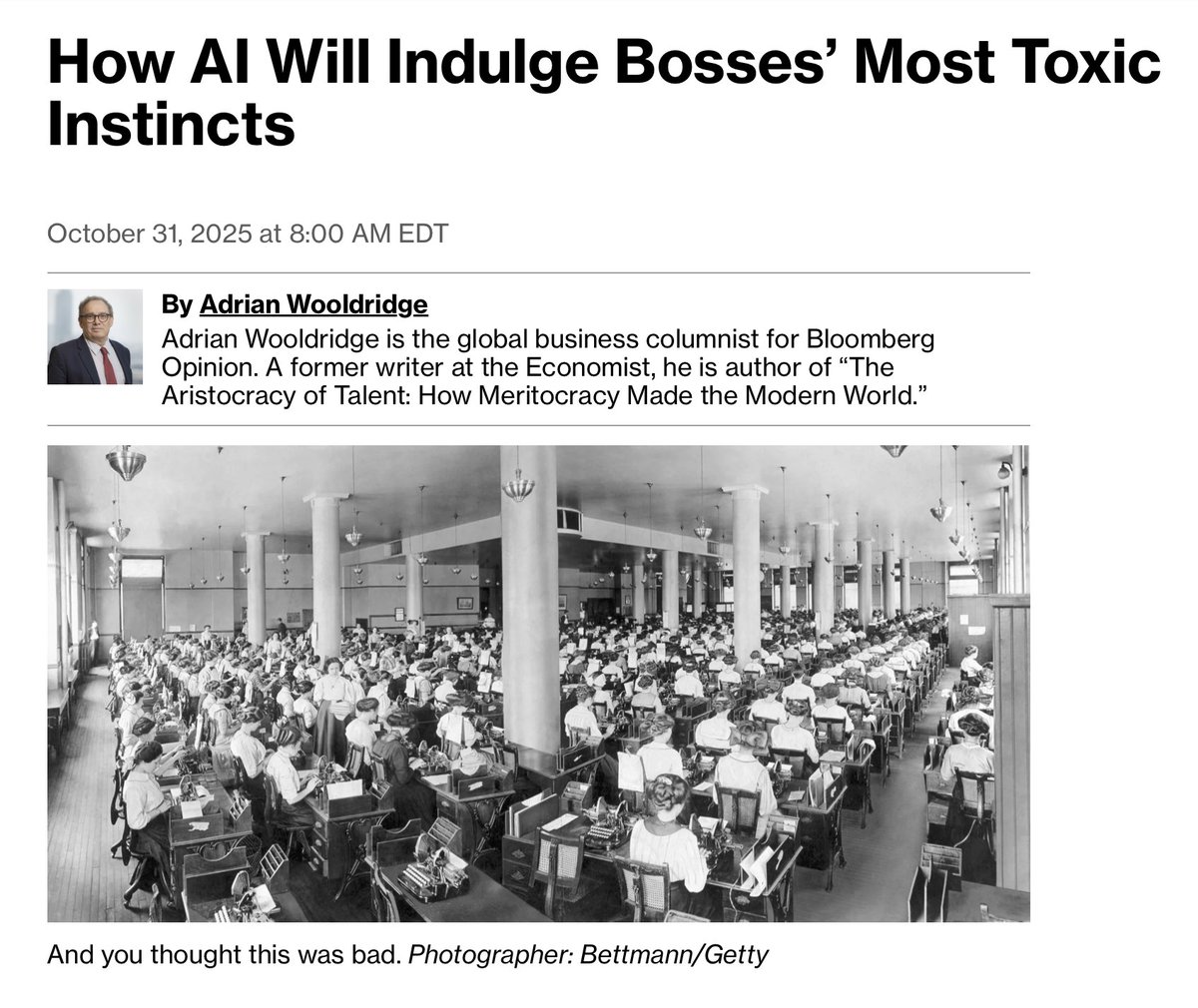
@adwooldridge has a sharp column in @opinion on how companies are deploying AI. His core question: Will we use AI to increase the power of managers or liberate front-line workers? Adrian suspects most companies will go for the former -- and that's a bad thing.
Based on some early evidence, he's right to worry. Amazon tracks warehouse workers' bathroom breaks. Algorithms determine fast-food schedules. JPMorgan uses AI to write performance reviews. Companies measure keystrokes per minute and analyze how "collegial" you are in Zoom calls. Workers find it galling: algorithms know everything about them, but they know nothing about the algorithms.
This is digital Taylorism—using AI to divide work into identical units, monitor every movement, and eliminate surplus workers. Companies are choosing this path because it offers a quick short-term boost: cut headcount, monitor slackers, measure precise contributions.
But if we deploy AI using industrial-era management assumptions, we won't get the sustained performance improvement that comes from unleashing the initiative and ingenuity of people at work.
We've seen this movie before. In the early 2000s, everyone predicted the web would democratize information and flatten hierarchies. Prediction markets, crowdsourcing, and open innovation were going to transform decision-making by tapping collective intelligence. Very little of it happened. By some metrics, the opposite happened in fact: the number of managers and administrators more than doubled between 1983 and 2024, while employment in all other occupations grew by just 40 percent.
And despite trillions in investment—global IT spending jumped from $2.6 trillion to $3.8 trillion between 2003 and 2023—productivity growth averaged just 1.7 percent annually over the past decade, substantially lower than the long-term average.
Technology alone doesn't make organizations better. Unless we rethink how we lead, manage, and organize, AI will be more money poured into the same broken system.
Thanks Adrian for the shout-out!