Happy to have finished my PhD applying word embeddings to the biomedical domain!
My thesis is now available at:
https://t.co/RyhxhF3ycN
Work done with @stschulz, Prof. Udo Hahn, and Prof. Andrea Berghold. Revision by @kirk_roberts, @pzfr, and @aholzin.
My team at Amazon is hiring an Applied Scientist to work on generative AI and multimodal retrieval. This is a fascinating and growing area with lots of challenging problems and novel opportunities. If you are interested please DM me. I will also be attending ACL@San Diego so catch me up at the conference if you are there. https://t.co/siqddrwzz0 @AmazonScience #acl2026 #NLProc
The proceedings of the (2^6)th Annual Meeting of the Association for Computational Linguistics are now available in the ACL Anthology.
https://t.co/sjRDEzn0cq
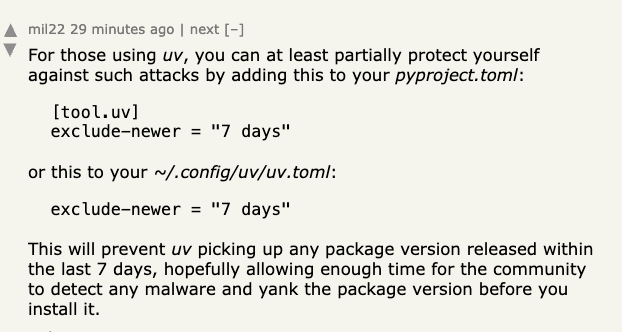
For my friends who are still using UV and might be a little weary about recent compromises to PyPi packages, stick this in your pyproject.toml.
You can let all of those pip users find and report the compromises...
The AI Scientist Generates its First Peer-Reviewed Scientific Publication
We’re proud to announce that a paper produced by The AI Scientist-v2 passed the peer-review process at a workshop in ICLR, a top AI conference.
Read more about this experiment → https://t.co/50p2t9tgHC
To our knowledge, this is the first fully AI-generated paper that has passed the same peer-review process that human researchers go through. The paper was produced by an improved version of the original AI Scientist, called The AI Scientist-v2. We’ll be sharing the full details of v2 in an upcoming release.
We conducted this experiment with the full cooperation of both the ICLR leadership and the organizers of the ICLR workshop, @ICBINBWorkshop. We (@_yutaroyamada@cong_ml@shengranhu@RobertTLange) proudly collaborated with UBC (@jeffclune) and Oxford (@FLAIR_Ox) on this exciting project.
Did you know you can add a single file to your project and dramatically improve Copilot's anwers while *at the same time* reduce the size of the prompt you have to write?
PDF parsing is solved (again).
Mistral's new OCR API
— parses 1000-2000 pages for $1
— achieves state of the art results on tables, multilingual
— supports structure: images, bounding boxes, scans, equations
90% of the world's organizational data is in PDFs.
I want to share bit of context on today's new releases from DeepSeek: three very small (0-500 lines of code), self-contained, yet fascinating newly open-sourced repositories. Let's dive in!
1. The first one is just data: DeepSeek/Profile-data (links at the end)
While this repo doesn't contain any code files, it's still extremely interesting. This is profile data that shows in detail and with real recorded data how low-level operations are scheduled to make sure GPUs are kept busy at all times during the training and inference of DeepSeek V3/R1 (see the "profiling session" in the Ultra-Scale Playbook: link at the end)
It serves as the organizational blueprint (essentially a Gantt diagram) of the most efficient open-source pretraining to date. A great example to study and something I would love to see released more often by open-source teams: scheduling operations in the most efficient way is the core of large-scale LLM training nowadays.
2. The second one is a very small code snippet (164 LoC) on how to balance the load of experts in mixture-of-expert (MoE): see link at the end.
It's impressive that they extracted and released such a core technique for efficiently balancing the load among experts in a self-contained format. You can read more about this in the "Expert Parallelism" section of the Ultra-Scale Playbook.
This will make the technique easy to incorporate into most distributed codebases. Congrats
3. Today's last release is larger (500 LoC) and perhaps covers the most fascinating technical part of DeepSeek V3/R1 training: the new DualPipe pipeline parallelism (PP) approach (link at the end).
For the first time in large-scale training, the DeepSeek team was able to train using what they called a "zero-bubble regime" in PP, something never before reported in a SOTA large-scale training. If you don't know what a "bubble" or "pipeline parallelism" is, you can check the Pipeline Parallelism section in the Ultra-Scale Playbook.
This is perhaps the most impressive part of the DeepSeek technical report! Having a small, standalone codebase that was apparently able to reach this regime is fascinating. I'm so excited to try it!
---
Overall, I really like their focus on open-sourcing many independent code modules, each on a specific technique and with examples.
Now it remains to be seen whether other teams can use and integrate these code samples and reproduce the results claimed by DeepSeek in their paper. Looking forward to seeing more extremely efficient training available for everyone!
---
Links:
1. profile-data: https://t.co/mOFTvbRy7l
2. Expert balancing: https://t.co/cxArFYAuFu
3. Dualpipe: https://t.co/43seXBOpbh
and the Ultra-Scale Playbook: https://t.co/TFA79prYEo
Google presents:
Matryoshka Quantization
Presents a novel multi-scale quantization technique that allows training and maintaining just one model, which can then be served at different precision levels
Writing software, especially prototypes, is becoming cheaper. This will lead to increased demand for people who can decide what to build. AI Product Management has a bright future!
Software is often written by teams that comprise Product Managers (PMs), who decide what to build (such as what features to implement for what users) and Software Developers, who write the code to build the product. Economics shows that when two goods are complements — such as cars (with internal-combustion engines) and gasoline — falling prices in one leads to higher demand for the other. For example, as cars became cheaper, more people bought them, which led to increased demand for gas. Something similar will happen in software. Given a clear specification for what to build, AI is making the building itself much faster and cheaper. This will significantly increase demand for people who can come up with clear specs for valuable things to build.
This is why I’m excited about the future of Product Management, the discipline of developing and managing software products. I’m especially excited about the future of AI Product Management, the discipline of developing and managing AI software products.
Many companies have an Engineer:PM ratio of, say, 6:1. (The ratio varies widely by company and industry, and anywhere from 4:1 to 10:1 is typical.) As coding becomes more efficient, teams will need more product management work (as well as design work) as a fraction of the total workforce. Perhaps engineers will step in to do some of this work, but if it remains the purview of specialized Product Managers, then the demand for these roles will grow.
This change in the composition of software development teams is not yet moving forward at full speed. One major force slowing this shift, particularly in AI Product Management, is that Software Engineers, being technical, are understanding and embracing AI much faster than Product Managers. Even today, most companies have difficulty finding people who know how to develop products and also understand AI, and I expect this shortage to grow.
Further, AI Product Management requires a different set of skills than traditional software Product Management. It requires:
- Technical proficiency in AI. PMs need to understand what products might be technically feasible to build. They also need to understand the lifecycle of AI projects, such as data collection, building, then monitoring, and maintenance of AI models.
- Iterative development. Because AI development is much more iterative than traditional software and requires more course corrections along the way, PMs need be able to manage such a process.
- Data proficiency. AI products often learn from data, and they can be designed to generate richer forms of data than traditional software.
- Skill in managing ambiguity. Because AI’s performance is hard to predict in advance, PMs need to be comfortable with this and have tactics to manage it.
- Ongoing learning. AI technology is advancing rapidly. PMs, like everyone else who aims to make best use of the technology, need to keep up with the latest technology advances, product ideas, and how they fit into users’ lives.
Finally, AI Product Managers will need to know how to ensure that AI is implemented responsibly (for example, when we need to implement guardrails to prevent bad outcomes), and also be skilled at gathering feedback fast to keep projects moving. Increasingly, I also expect strong product managers to be able to build prototypes for themselves.
The demand for good AI Product Managers will be huge. In addition to growing AI Product Management as a discipline, perhaps some engineers will also end up doing more product management work.
The variety of valuable things we can build is nearly unlimited. What a great time to build!
[Original text: https://t.co/OIeAQXpriK ]
1/ Google Research unveils new paper: "Titans: Learning to Memorize at Test Time"
It introduces human-like memory structures to overcome the limits of Transformers, with one "SURPRISING" feature.
Here's why this is huge for AI. 🧵👇
new agents framework: Pydantic just launched a type-safe AI agents framework, PydanticAI, designed for production apps. It validates structured data, streams responses, and supports top LLMs like OpenAI and Gemini. Early tests show a 60%+ resolve rate on AI-AppEval 1.0
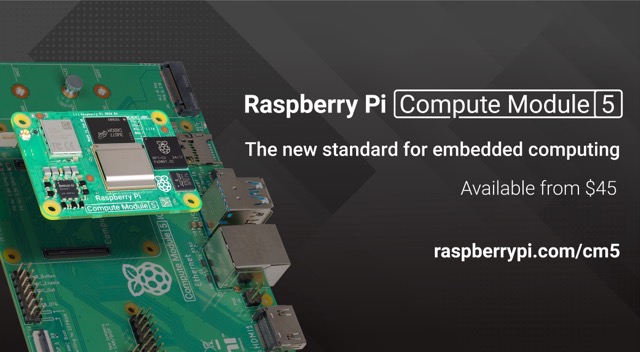
Introducing Raspberry Pi Compute Module 5 — the new standard for embedded computing, on sale now from $45.
The modular version of our flagship Raspberry Pi 5 offers an ideal form factor for your custom embedded products.
https://t.co/bQl9lQ8kZo
Introducing the first vector database with BBQ — it’s smoking fast with tasty recall 🚀
Now in tech preview in Elasticsearch, this new quantization technique delivers faster vector search with 95% memory reduction and ~0% loss of recall. Learn more: https://t.co/4yzAuyoqqJ
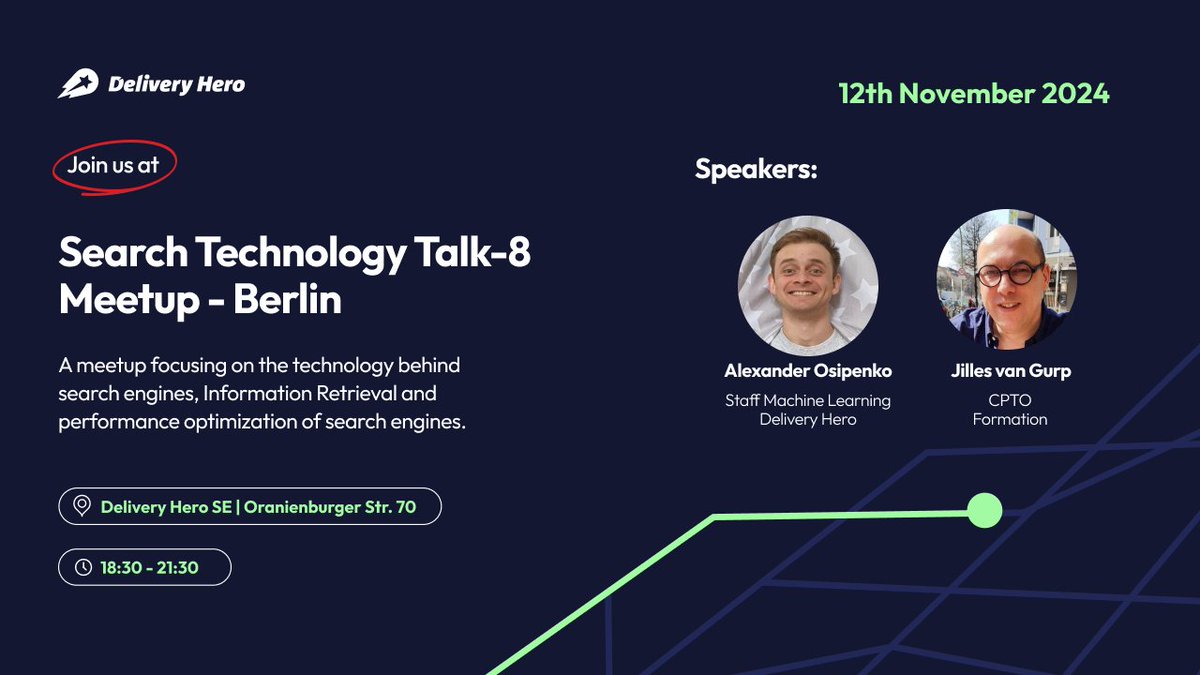
🗓️ See you Nov 12 for a Search Technology Meetup at our Hero Campus in Berlin!
🔎 An insightful session with Alexander Osipenko, Machine Learning Engineer at @deliveryherocom, @jillesvangurp, moderated by @renekrie.
🎟️ Secure your spot here: https://t.co/OAipPalBzD
🌐 Introducing ChatGPT search 🌐
ChatGPT can now search the web in a much better way than before so you get fast, timely answers with links to relevant web sources.
https://t.co/7yilNgqH9T
By open-sourcing the code, more people will be able to use the tool to watermark and determine whether text outputs have come from their own LLMs - making it easier to build AI responsibly.
We explain more about this tech in @Nature. ↓ https://t.co/7Y5A06MZ2g
If you couldn't make it to Haystack Europe, but you'd like to get early access to the talk videos, head over to the @aiPoweredSearch Community https://t.co/q6ef2y38GM #HaystackConf
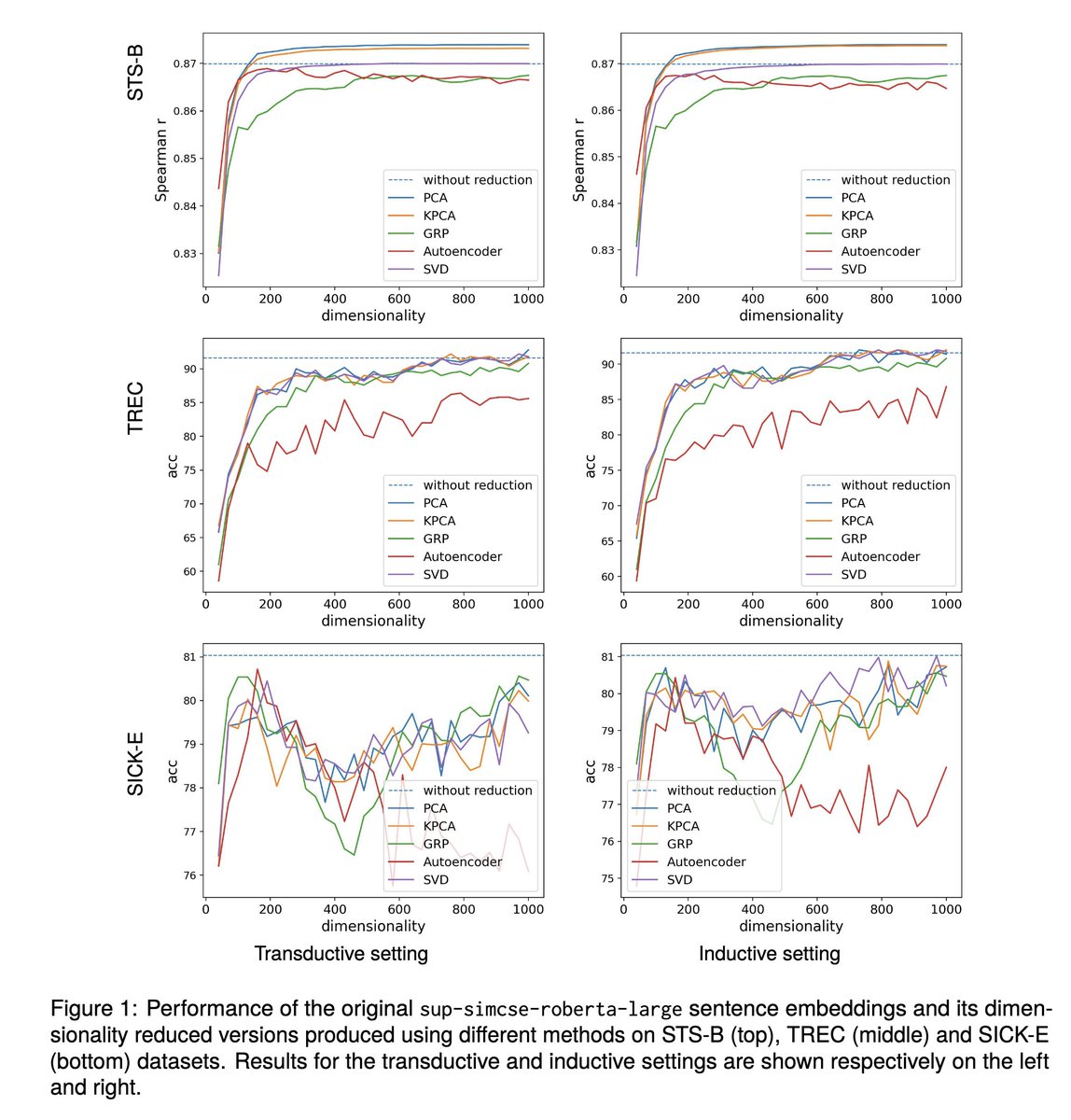
what is the best way to compress a sentence embedding without losing much of the semantics it encode? In the LREC-COLING accepted paper title "Evaluating Unsupervised Dimensionality Reduction Methods for Pretrained Sentence Embeddings" we investigate this question. It turns out that PCA can compress sentence embeddings by half the dimensions without incurring significant downstream task performances in STS and classification. with @jodieyzhou and @GaifanZhang
We evaluate unsupervised dimensionality reduction methods such as SVD, PCA, Kernel PCA, Gaussian Random Projections and Autoencoders for multiple sentence embedding models (sbert, mpnet, roberta, xlm-r, simsce) in the paper. Stay tuned for the pre-print.