The Criminal Cases Review Commission now has over 30 reports from leading academics detailing all the above and more. Just one is enough to refer to the Court Of Appeal.
Lucy Letby has been in jail for 2026 days. What, exactly, are the CCRC waiting for? (16/16)
@KarrinNorth12@Hawke180380@RupertBear_pup@DebRoberts22249 Rupert is trying to stop the exoneration of Lucy Letby. She is trying to protect herself & her friends the Brearey’s. It’s understandable. Seems she believes everything at CoCH was hunky dory. She refuses to open her eyes. She could open them. Join the side of truth and justice.
Dr Wilkinson on Lucy Letby & Dr Evans genesis. Did Evans lie under oath about how he became aware of the air embolism theory? https://t.co/4eOgE1fWUy
@gill1109 Good morning Richard…☕️🤗
So absolutely NO indication of a manic murderer on the scene at that point, 4 months later, despite raving Ravi’s “suspicions and corridor gossip” in October 2015.
Strangely, that transcript link is now, not available.
Xxx
@Keir_Starmer What about the miscarriage of the century - Lucy Letby?
When will the CCRC see sense and approve the appeal?
This is a terrible legacy for a former head of DPP 😡😡
This is astonishingly unprofessional. Dewi Evans wasn’t employed as a detective, and it wasn’t his job to assemble inculpatory evidence.
He was supposed to be a neutral clinical expert. The answers to these questions were entirely irrelevant to his medical opinions. #Letby
Dr Jayaram never saw any pink flitting rash with Baby A because by the time he arrived (8 minutes after Baby A's collapse) there was no audible heart-beat.
Therefore, there could be nothing driving an air embolus around the circulation to cause this flitting. And according to Doctor Lee it only lasts a very short period of time anyway - a minute or two.
Plus no one else saw what he claims to have seen.
He didn't see a pink flitting rash with Baby M because there were a number of other people there and none of them saw the same thing. Dr Ukoh was first to arrive and he just described Baby M as looking pale and lifeless - no flitting rash.
I think Dr Jayaram has got an overactive imagination.
1/3
Baby L And The Flawed Case of Alleged Insulin Poisoning
Following on from my previous post, here I will debunk the "sticky insulin" theory proposed by Professor Hindmarsh, which was endorsed by Nick Johnson KC as the sole explanation for Baby L’s persistent hypoglycaemia after Lucy Letby had gone off shift.
I will also argue that this undermines the allegation of insulin poisoning at any point in the case of Baby L.
See the attached chart for a visual representation of Baby L’s blood glucose readings over the relevant period, set against the timing of dextrose bag changes and other key events.
The prosecution alleged that Lucy Letby injected insulin into multiple bags of dextrose solution on 9th April, resulting in a 53-hour hypoglycaemic episode.
But there was a major problem with this allegation. The hypoglycaemic episode, which Professor Hindmarsh attributed to exogenous insulin, continued for nearly two days after Lucy Letby had gone off duty. During that period, two new dextrose bags were hung which she could not have poisoned. The only insulin blood test done was on 9th April.
How, then, could the prosecution attribute the continuing hypoglycaemia to alleged insulin poisoning by Lucy Letby?
Nick Johnson KC relied on Professor Hindmarsh’s sticky insulin theory. According to Hindmarsh, insulin from a spiked dextrose bag, which had stuck to the plastic inner surface of the giving set, could later be released into the dextrose infusion after a new, uncontaminated bag was connected.
(A giving set is the sterile tubing that connects an infusion bag to a cannula or long line; trial testimony indicated that it isn't necessarily changed when a dextrose bag is replaced.)
No calculations — in fact, no figures of any kind — were provided to support this suggested mechanism. Aside from the obvious flaws in the theory itself, it also depended on the giving set not being changed through two bag changes - something that was never established.
Here, I will show that not only is the sticky insulin theory scientifically invalid, it’s also inapplicable, because the giving set definitely was changed when a new dextrose bag was hung after Lucy Letby had gone home.
Firstly, a quick run-through of the key events:
9th April 2016
(See chart for the timings of the dextrose bags and blood glucose readings.)
Lucy Letby was accused of spiking 3 bags with insulin on 9th April, though she was not Baby L’s designated nurse; there was no evidence that she actually did so.
Baby L (and his twin Baby M) had been born on the morning of the previous day, 8th April, and he was receiving dextrose to bring his blood glucose levels up. By midnight, a normal reading of 3.6 was recorded.
The allegation was that Lucy Letby spiked this dextrose bag the next day, 9th April, at some point between starting shift at 7.30am and 9.30am. This would have been while it was hanging, which is implausible in itself, especially as Letby wasn't his designated nurse on that day.
This was Bag #1.
At 10am Baby L’s blood glucose reading was low at 1.9, and this is where the 53-hour hypoglycaemic episode identified by Professor Hindmarsh began.
Bag #1 was replaced at midday on 9th April, after having been in use for the standard 24 hours. The replacement bag was hung by Lucy Letby and Mary Griffith, Baby L's designated nurse.
This was Bag #2. The prosecution alleged that Lucy Letby also poisoned this bag, though no explanation was given as to how or when.
At some point before 3.45pm (the exact timing was uncertain), a blood sample was taken and sent to Liverpool for insulin testing. Several days later, the results came back showing a high insulin level alongside low C-peptide — findings associated with the presence of exogenous insulin. This formed the basis of the allegation that Lucy Letby had poisoned Baby L with artificial insulin.
At 4.30pm that same day, the dextrose bag was changed again, this time to a more concentrated 12.5% dextrose solution. This bag was hung by Belinda Williamson (Simcock) and Ashleigh Hudson.
This was Bag #3. The prosecution alleged that Lucy Letby also poisoned this bag with insulin after it had been hung, though again no explanation was provided as to how or when.
Throughout this period, Baby L continued to record abnormally low blood glucose readings.
Lucy Letby finished her shift on 9th April at 8pm, remaining for another hour or so to complete her nursing notes. This was her fourth consecutive day of work following which she was then off duty for several days.
10th – 11th April 2016
In the early hours of 10th April, at around 2.30am, the dextrose bag was changed again, this time to a 15% dextrose solution.
This was Bag #4. The prosecution did not allege that Lucy Letby poisoned this bag as she had already been off shift for several hours by then. Nevertheless, low blood glucose levels continued at roughly the same level throughout the night and into the following morning.
From this point onwards the only explanation given for the continuing hypoglycaemia was the sticky insulin theory: that insulin from the previous bag, Bag #3, had stuck to the inner surface of the giving set and was now being released into the infusion.
There was a further bag – Bag #5 – hung up 24 hours later on 11th April; the low blood glucose readings persisted but later in the day spontaneously returned to a normal level.
To summarise:
1.We have a 53-hour hypoglycaemic episode, identified by Professor Hindmarsh, running from 10am on 9th April 2016 until 3pm on 11th April.
2.Professor Hindmarsh had no explanation for this episode other than the presence of exogenous insulin throughout the entire period.
3.Lucy Letby was only on shift during the first day, 9th April, until 8pm.
4.On 9th April there were three different dextrose bags in use, all of which the prosecution alleged Lucy Letby had poisoned.
5.Two further bags were hung in the early hours of 10th and 11th April, producing no marked change in glucose levels until the afternoon of 11th April.
6.Since Lucy Letby could not physically have poisoned those last two bags, Professor Hindmarsh relied on the sticky insulin theory to explain the continuing hypoglycaemia.
Evidence that the giving Set WAS changed
If it could be proven that the giving set was changed with Bag #4 then that would nullify the sticky insulin theory, wouldn't it?
Well, it can be proven, because prior to Bag #4 being hung there was a long line put in by Dr A specifically to be used with the next dextrose bag. And when a long line is connected up a new, sterile giving set is always used to prevent infection!
This is well known and there's no doubt about it. There was even trial testimony confirming this practice from two nurses, in relation to the stock bag used for Baby F. Dr Sandie Bohin also confirmed it.
Dr A’s reason for inserting the long line was that he was intending to increase the dextrose concentration to 15%, which is above the maximum level of 12.5% which can be infused through a catheter, which is what had been used up to then.
The long line was put in at around 1am on 10th April, and following this Bag #4 was hung at 2.30am. (See chart – the timing of the long line insertion is shown as blue line.)
Therefore, the sticky insulin theory — that "stuck" insulin was being released from the giving set after Bag #4 was hung — cannot possibly account for the continuation of hypoglycaemia after this bag-change event, because the giving set previously used was no longer in place!
The prosecution’s case that this mechanism explained the continuing hypoglycaemia is completely invalid.
References:
Dr A’s medical notes from that night which refer to the long line can be seen here at page 2 (he was cyphered as Dr U at Thirlwall):
https://t.co/BtDM0CWt1G
The long line insertion was also brought up in his Thirlwall Inquiry oral testimony (see pages 223–226):
https://t.co/repIpRdOtX
And it was also reported by the Chester Standard’s live trial reporting at the time (see entry at 12.13pm):
https://t.co/Tl75nSa4bc
Yet another truly brilliant researched article by @rob_goudie which totally debunks 'murder by air embolism' successfully advanced in the #LucyLetby convictions. Quite frankly astonishing that this got across the line legally. Perfectly demonstrates the failings of CJS. 👏👏👏
If Letby sneezed incorrectly, Goss allowed the jury to consider it & Johnson KC spun it to attack her.
Yet Goss suppresses key evidence that completely undermines the credibility of star prosecution witnesses and the “golden thread” of Cheshire PD’s investigation. A clown show.
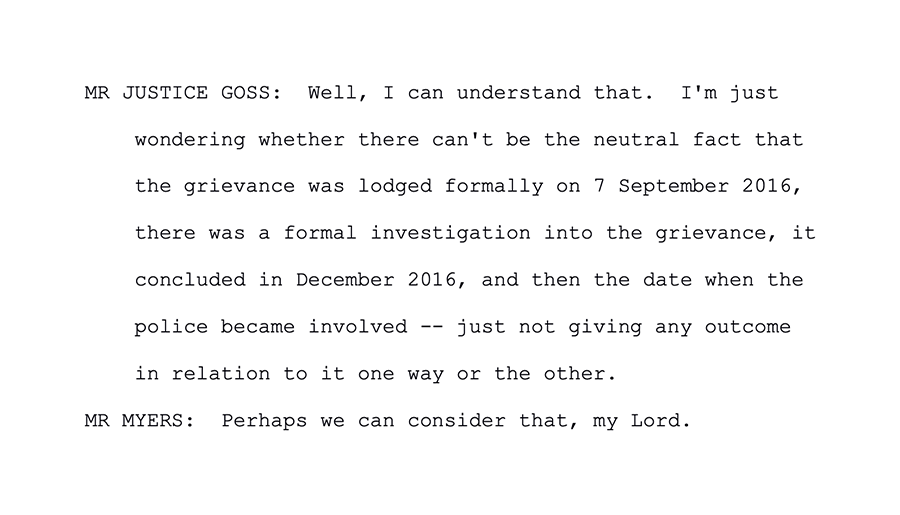
Last thing I'll point out for now about the successful outcome of Lucy Letby's grievance complaint, against Drs Stephen Brearey and Ravi Jayaram, for bullying and harassing her, which the jury never got to hear about.
The trial judge didn't just object to jurors being told that Letby won her grievance. He objected to the defence making any mention at all of the fact that, months after Drs Brearey and Jayaram succeeded in forcing Letby out of her job, the hospital gave her the all-clear to come back to work.
The judge's reasoning (see screenshots) was clear: if the defence told jurors that Letby was due to return to work in March 2017, then jurors could end up deducing that Letby had won her grievance. And worse, they could end up sussing out what actually happened behind the scenes: the hospital gave Letby her job back after determining that the accusations against her were baseless.
Any chance of any hint of any inference on the part of any juror along these lines had to be foreclosed.
And so when all was said and done, the jury only got to hear the first half of the story.
They heard that Letby filed a grievance. They heard that she did so after doctors succeeded in forcing her out of her job, to keep her away from the babies. They heard the prosecutor describe Letby's "frustration at the fact that she was not being allowed back onto the neonatal unit." They heard she was raring to come back.
But, rightly or wrongly, the jury never got to hear the rest: that Letby won her grievance; that a months-long investigation found the doctors had bullied and harassed her; that the lead investigator had this to say about them: "I was disgusted by their behaviour. It is likely that they lied."
The jury never got to hear about how the hospital set a plan in motion to get Letby back on her feet – to get her working on the unit again by March 2017.
They never got to hear about the senior nurse who told the grievance investigators, "we would be delighted to have her back."
They never got to hear about how Drs Brearey and Jayaram were forced to apologise for their behaviour.
And they never got to hear how, halfway through March 2017, with Letby counting down the days until her return, Dr Jayaram demanded a meeting with the head of HR. And that in that meeting, he dropped a bombshell.
On 15 March 2017, Dr Jayaram told Sue Hodkinson, the hospital's head of HR, that he had once caught Lucy Letby trying to murder a baby.
A huge revelation, and yet the first anyone remembers hearing about it. Even though, according to Dr Jayaram, the incident had happened all the way back in February 2016.
In other words: Dr Jayaram says he caught Lucy Letby trying to murder a baby, and he sat on the information for over a year.
No matter. His account was disturbing, and it prompted the hospital to call the police.
With that, the plan to give Letby her job back collapsed. She never stepped foot on the neonatal unit again.
Last thing I'll point out for now about the successful outcome of Lucy Letby's grievance complaint, against Drs Stephen Brearey and Ravi Jayaram, for bullying and harassing her, which the jury never got to hear about.
The trial judge didn't just object to jurors being told that Letby won her grievance. He objected to the defence making any mention at all of the fact that, months after Drs Brearey and Jayaram succeeded in forcing Letby out of her job, the hospital gave her the all-clear to come back to work.
The judge's reasoning (see screenshots) was clear: if the defence told jurors that Letby was due to return to work in March 2017, then jurors could end up deducing that Letby had won her grievance. And worse, they could end up sussing out what actually happened behind the scenes: the hospital gave Letby her job back after determining that the accusations against her were baseless.
Any chance of any hint of any inference on the part of any juror along these lines had to be foreclosed.
And so when all was said and done, the jury only got to hear the first half of the story.
They heard that Letby filed a grievance. They heard that she did so after doctors succeeded in forcing her out of her job, to keep her away from the babies. They heard the prosecutor describe Letby's "frustration at the fact that she was not being allowed back onto the neonatal unit." They heard she was raring to come back.
But, rightly or wrongly, the jury never got to hear the rest: that Letby won her grievance; that a months-long investigation found the doctors had bullied and harassed her; that the lead investigator had this to say about them: "I was disgusted by their behaviour. It is likely that they lied."
The jury never got to hear about how the hospital set a plan in motion to get Letby back on her feet – to get her working on the unit again by March 2017.
They never got to hear about the senior nurse who told the grievance investigators, "we would be delighted to have her back."
They never got to hear about how Drs Brearey and Jayaram were forced to apologise for their behaviour.
And they never got to hear how, halfway through March 2017, with Letby counting down the days until her return, Dr Jayaram demanded a meeting with the head of HR. And that in that meeting, he dropped a bombshell.
On 15 March 2017, Dr Jayaram told Sue Hodkinson, the hospital's head of HR, that he had once caught Lucy Letby trying to murder a baby.
A huge revelation, and yet the first anyone remembers hearing about it. Even though, according to Dr Jayaram, the incident had happened all the way back in February 2016.
In other words: Dr Jayaram says he caught Lucy Letby trying to murder a baby, and he sat on the information for over a year.
No matter. His account was disturbing, and it prompted the hospital to call the police.
With that, the plan to give Letby her job back collapsed. She never stepped foot on the neonatal unit again.
"The fact that LL has been subjected to the ordeal of the last four to five months based on a "gut feeling" and the subsequent behaviour of SB is not compatible with the Trust's values and behaviours." Dr Brearey on verge of sacking until he went to cops.
https://t.co/QRdvUjZ11s
This cooked up scenario which the Police believed in so powerfully that it triggered them to start Operation Hummingbird was actually unbelievable at the time.
RJ didn’t actually see anything other than Lucy doing nothing. It therefore required an inference that ‘doing nothing’ was in and of itself murder. RJ had helpfully doctored an email ‘to pique the interest of the Police’ in which he removed the later found fact that Lucy had called for help.
This ‘observation’ had occurred a full year before RJ reported it. During that time both RJ and SB had been exposed as bullies with the threat of a referral to the GMC if they didn’t apologise to Lucy for what they had been saying about her. RJ was particularly reluctant and at the same time worried about his own reputation (at the hospital and in his TV job) should he be referred to the GMC.
As this ‘observation’ was hailed as ‘the golden thread’ we are left to ponder over what else was said.
Was RJ asked who else was in the room? A trainee Dr was in the room and RJ knew that he had inserted the breathing tube.
Was RJ asked what HE did? Did he stand there doing nothing too?
So glad this is finally public so I can comment on it openly.
I have seen a fair number of HR investigations over the years. In my experience, whistleblowers are often formally investigated before they are pushed out, or as a way of “teaching a lesson” to anyone who challenges the status quo. This is actually one of the most competent internal investigation reports I have seen.
What surprised me most was the outcome. Usually, management plays an active role in managing out people who raise concerns - such as Lucy, who was clearly DATIXing poor standards and practices within the neonatal unit. Dr Brearey and Dr Jayaram were in management positions at the time and therefore carried responsibility for patient safety and culture within the department. So that would have been a pretty major motivator to want her out if she was shining the spotlight on their managerial/leadership failures.
Lucy Letby was never going to be safe returning to a workplace where she was clearly being bullied by a group of colleagues (most of whom were consultants and thus in a position of power over her) unless individual accountability followed. At the very least, that should have meant formal warnings, apologies to Lucy, and mediated discussions. Management could have supported her with a temporary redeployment to another clinical unit so she could continue practising while matters were resolved. Clinical work was clearly what Lucy wanted to continue doing. Some people in these situations , where redeployment is necessary during HR investigations, choose to remain in management or leadership roles instead, but that wasn't what Lucy wanted.
So in essence the hospital made a strong start with doing a competent HR investigation - but by failing to follow through properly, the situation escalated to the point where consultants went to the police.
What nobody seems willing to ask is this: if the consultants genuinely believed Lucy was murdering babies, why did they only go to the police after they were found to have bullied her? If you truly believed a nurse was a serial killer, is it reasonable to accept that a consultant would really think that internal Trust procedures were an appropriate way to deal with it?
UK trained consultants are NOT politically naïve. Consultant appointments are highly political positions, and consultants understand very well how NHS systems actually work. It stretches credibility, and that's a generous description, to claim the consultants genuinely believed reporting concerns over a serial killer internally was what they thought was the right thing to do. If they truly thought Letby was such a prolific killer, were they not concerned she might harm children outside work as well?
This entire case is a national disgrace, and I suspect it will remain in history as one of the most consequential modern witch hunts in British healthcare. Witch hunts within the NHS are unfortunately, however, very common - often carried out through internal employment procedures or GMC processes. But turning that common dynamic (whose root cause is toxic leadership practices) into the conviction of a serial killer is something else entirely.
An extraordinary outcome, enabled by a broken medical "expert" system and sealed by an inadequate police investigation and criminal justice system. What a world we live in.
I hope everyone involved in this MoJ - or anyone who knew what was happening and could have helped but chose not to - gets what they deserve.
@LucyLetbyTrials@drphilhammond@PrivateEyeNews@NadineDorries@ClarkeMicah@peter__duffy@MartynPitman@willcpowell@DavidDavisMP@DavidRoseUK@PeterElston1@Michelehal7344@Voice4theDead@reasonoverfear@Oversig58651516@Seagreen2707@RexvsLucyLetby