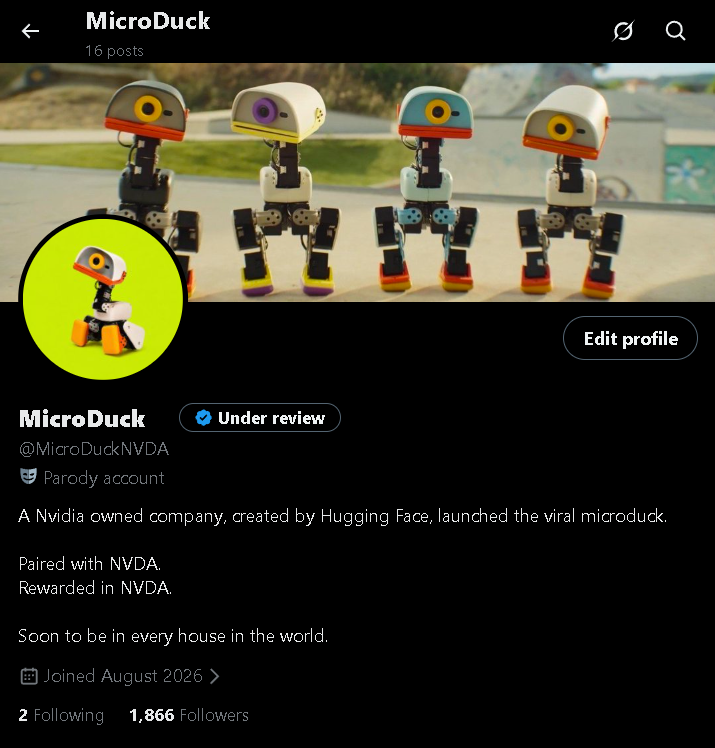
A Nvidia owned company, created by Hugging Face, launched the viral microduck.
Paired with NVDA.
Rewarded in NVDA.
Soon to be in every house in the world.
ugging Face has launched Microduck, a $399 robot. 🤖🐥
An affordable, open-source robot built for a new era of democratized Physical AI and World Models.
Hold $MICRODUCK and receive NVDA token rewards through RH Chain.
CA: 0xD5f1afEA47b1A9eab414D2ee740cF1d6d039E725
Microduck has the potential to become the king of the RWA + meme meta.
And we’re building accordingly.
-What’s already in motion:
1. Profile picture updated ✅
2. Premium Blue Ticket — currently under review 🔵
What’s coming next:
1. New banner
2. Website
3. Original meme content — continuously updated
Microduck is already going viral across the globe, and we’re still only at the beginning.
The real build starts now.
Microduck
This could become the king of the RWA + meme meta.
Microduck could be much bigger than you think.
1. The financialization of culture started with Doge
Dogecoin was where culture first started becoming liquid.
A single photo of a Shiba Inu became a piece of internet culture — and that culture eventually became an asset.
Once Doge paved the way, celebrity pets and viral animals followed one after another. Cats eventually went down the same path.
It’s not a coincidence that the first massive wave of meme coins was built around animals.
2. Why animal memes worked so well
A meme can be built around almost anything — politicians, celebrities, catchphrases, trends.
But the ones that survived the longest and became the biggest were overwhelmingly animals.
The reason is simple.
Animals are universally understandable. You don’t need a translation or an explanation to find a dog cute. And unlike people, animals don’t get caught in scandals, betray their communities, or suddenly destroy the image people have of them.
Humans are also naturally wired to form emotional bonds with pets. We can see a random photo of a dog we’ve never met and instantly feel something.
Animal meme coins basically took an emotional connection that already existed and put a price tag on it.
And animal memes are infinitely remixable.
SHIB, WIF, cat coins — once an archetype works, the market can create endless variations of it.
That’s why Doge didn’t just become one successful meme. It opened the door for an entire market to expand around the same cultural primitive.
3. So what does a “pet” look like in the AI era?
Now take that same formula and apply it to the AI era.
What happens when an AI pet becomes widely known, constantly turned into content, shared through open source, and eventually recognized as both a character and a pet?
What kind of value could that carry?
Imagine thousands of them walking around, each customized with different clothes, accessories, personalities, and behaviors.
Doge was a dog in a photo.
This is a pet that can literally waddle around on your desk.
4. Why Microduck is different from other physical AI
Physical AI is exploding right now, but most projects are focused on utility and functionality — humanoids, quadruped robots, industrial machines.
Microduck is different.
It isn’t designed around maximum utility or productivity.
It’s built around accessibility and democratization.
$399.
25cm tall.
Camera and LiDAR.
It can grab objects with its beak, stand back up after falling, and even learn to roller-skate through reinforcement learning.
Its SDK and training stack are open source, meaning anyone can teach it new behaviors and share them with everyone else.
As Hugging Face CEO Clément Delangue puts it, this is the era of open-source, affordable robotics that democratizes physical AI.
Even the design philosophy says everything:
“Ready to fall.”
It isn’t trying to be a perfect robot.
It feels much closer to a pet.
And look at the formula:
A waddling duck is cute without translation.
It’s an open-source character, not tied to one specific person.
It’s a pet, so emotional attachment comes naturally.
And customization makes it infinitely remixable.
It checks all four boxes that made animal memes so powerful.
5. It already has cultural DNA
Microduck traces its roots back to the open-source project Open Duck Mini.
Inspired by Disney’s BDX droids, it grew as a community-driven project with around 3,400 GitHub stars, completely open designs, and an active Discord community.
Hugging Face essentially took that foundation and turned it into a product.
In other words, this wasn’t born as some sterile corporate robot.
It was community-built from the beginning — exactly the kind of environment where memes and culture naturally emerge.
6. Think about the scale
Delangue has talked about surpassing the current record for robot sales — roughly 20,000 units — and said that selling 50,000 units would be a huge success.
But the interesting part isn’t the ~$20 million in revenue.
The real point is what happens if hundreds of thousands of AI pets eventually end up inside people’s homes, each looking different, behaving differently, and constantly generating content.
And because the ecosystem is open source, those behaviors, modifications, and ideas can spread between users.
That’s when you start approaching the critical mass where a product stops being just a product and starts becoming culture.
7. Conclusion: the small pets come first
It’s easy to imagine a future where we live alongside physical AI.
But before perfect, highly functional physical AI becomes part of everyday life, wouldn’t it make sense for something smaller, cheaper, and more emotionally approachable to enter our homes first?
An AI pet.
Animals became the first major culture of meme coins.
AI pets could become the first major culture of physical AI.
And once something becomes culture, culture becomes liquid.
That’s why I think Microduck could be much bigger than most people realize.
0xd5f1afea47b1a9eab414d2ee740cf1d6d039e725
Microduck is selling at a rate of one unit every 4 seconds — roughly 21,600 units a day.
Soon, you might start seeing Microducks out in the real world, even on the streets.
Microduck is just getting started.
🤖WILD: This $399 robot duck is selling one unit every four seconds.
Hugging Face just launched the "Microduck," an open-source robot anyone can teach new tricks.
It can waddle, roller skate, pick things up with its beak, and get back up when it falls.
Microduck is a real, purchasable,
and trainable open-source robot already gaining traction worldwide built at the intersection of RWA + AI for a new era of democratized Physical AI and World Models.
You can experience Microduck directly through a web-based simulation.
Try it yourself and experience the technology behind Microduck firsthand.
CA: 0xD5f1afEA47b1A9eab414D2ee740cF1d6d039E725
If you haven’t heard the Microducks sing you’re missing out 🦆🎶
@huggingface w/ @pollenrobotics just opened pre-orders for Microduck, a 25 cm, under-800 g biped that somehow manages to be both an RL robotics platform and a tiny mechanical duck I desperately want wandering around my workshop.
It has 15 degrees of freedom, a camera, two IMUs, an 8×8 time-of-flight depth sensor and an articulated beak. Its policies run onboard at 50 Hz, with skills trained in MuJoCo using reinforcement learning and transferred onto the real robot.
But please return your attention to the duck choir.
Every Microduck gets its own generated voice, derived from its SoC serial. Put multiple ducks together and they can perform a chorale over Bluetooth.
There’s no shared clock. The lowest-ID duck conducts, broadcasts the beat through BLE advertisements, and the others average their timing over roughly 25 beats to stay synchronized. They even work out who sings bass, tenor and the remaining parts without a central controller assigning them.
You can also wave your hand in front of the depth sensor and turn the duck into a theremin. Obviously.
The software stack is open source, including the SDK, simulator and RL training stack, so owners can retrain behaviors and deploy their own policies. The hardware itself is not open source.
Pre-orders opened today at $399, with deliveries targeted before Christmas.
My duck is secured 🦆
Microduck:
https://t.co/GXJz2FotgL
Technical docs:
https://t.co/MO8bt1NlUW