The Symposium will be looking at how these topics affect the borough of Kingston...
💷 House prices and employment
🌴 Tax Haven Owned Homes
🏠 Homelessness and Empty Homes
🏡 Retrofitting Homes for Climate Change
Interesting discussion today at the Dance Research Matters event in Coventry. Thanks to Vipavinee Artpradid (PhD) for inviting me and introducing me to this great research network
#dance#productivity
We are proud to welcome three #NobelPrize winners to LSE in Spring Term!
Register to attend online:
🗓️ 30 April - Joseph E. Stiglitz: https://t.co/rotztVt489
🗓️ 2 May - Claudia Goldin: https://t.co/I5FneGVCcE
🗓️ 2 May - Esther Duflo: https://t.co/GDcPbcyv2J
We are proud to welcome three #NobelPrize winners to LSE in Spring Term!
Register to attend online:
🗓️ 30 April - Joseph E. Stiglitz: https://t.co/rotztVt489
🗓️ 2 May - Claudia Goldin: https://t.co/I5FneGVCcE
🗓️ 2 May - Esther Duflo: https://t.co/GDcPbcyv2J
On April 19, 1995, in Pittsburgh, a middle-aged man robbed two banks. He did not hide his face and committed both robberies regardless of the surveillance cameras.
McArthur Wheeler was arrested a few hours later. When the police confronted him with the surveillance footage, Wheeler was astonished, exclaiming, “But I had juice on my face!”
Wheeler explained that he had smeared lemon juice on his face to become invisible to the surveillance cameras. He had read that lemon juice was used as invisible ink and thought that this property would also make him invisible.
He even tested this theory with a Polaroid camera pointed at himself. Clumsily, he aimed it incorrectly and photographed the ceiling. Not seeing himself in the photo convinced Wheeler that the lemon worked.
The police concluded that Wheeler was neither crazy nor drunk; he was simply a monumental fool, of incommensurable, Olympian stupidity.
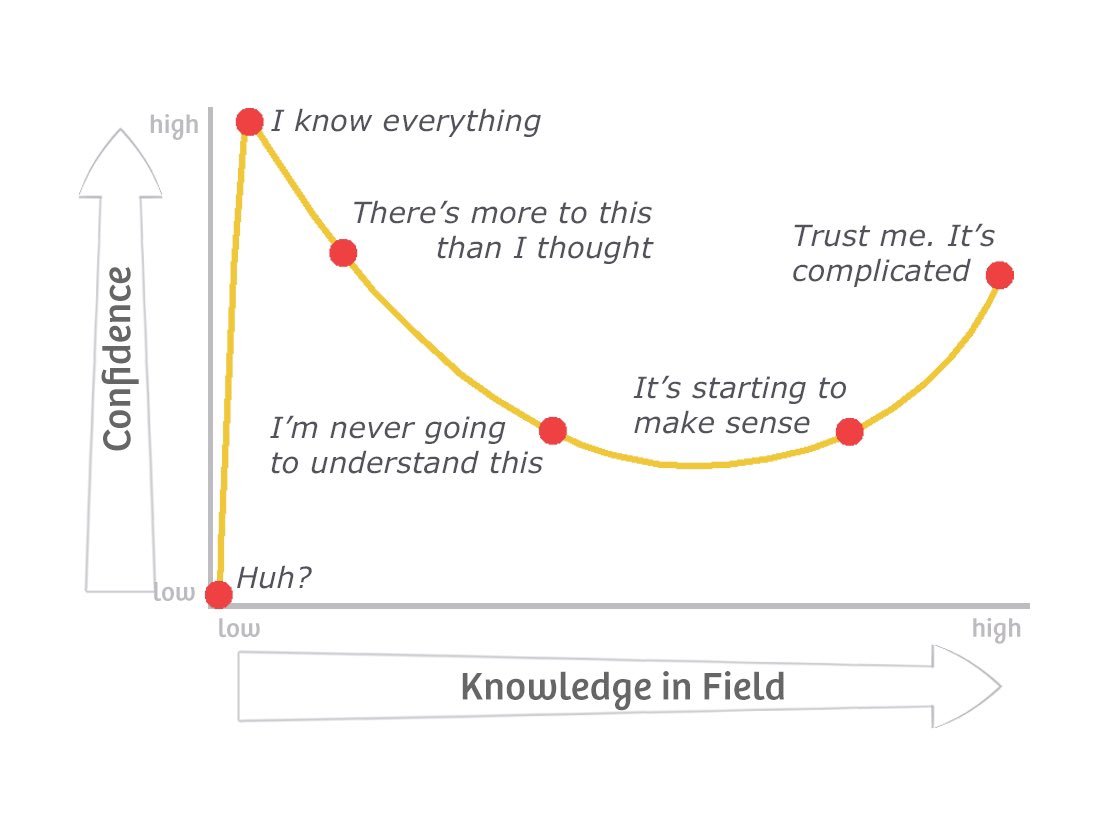
His story was read by David Dunning, a psychology professor, who wondered if Wheeler’s stupidity had universal characteristics. This insight led to the discovery of the Dunning-Kruger Effect.
David Dunning and his student Justin Kruger conducted a series of tests with students and at the end asked them to estimate their scores and assess how well they thought they had done compared to others.
The students with the lowest scores had an overly positive idea of their own performance. Dunning was surprised by the magnitude: those with the lowest scores thought they had skills superior to two-thirds of the other students. On the other hand, those who scored the highest had more accurate perceptions but underestimated their performance compared to others.
After all, the only way to know how well you have done on a grammar test is to know grammar. Those who lack this knowledge are the least capable of evaluating, unaware of their own ignorance.
So, from now on, whenever you meet a presumptuous ignoramus, think of McArthur Wheeler, the robber with lemon juice smeared on his face.
(Originally posted in Italian by @carlobenetti. I found it brilliant and worth translating and resharing)