funny to see spec sales guys breathlessly defending semis on a modest pullback saying META news is driving the wrong reaction, when in reality 1) didn't take much to correct a bit off stretched levels & 2) you don't need to backfill fundamental logic to every factor/flow related move
net - semis are fundamentally fine, don't need to overthink the "news"
Regarding the $META BBG article: note they are NOT currently selling compute. This isn’t a Neo deal announcement and two months ago META expanded deals w/ $CRWV and $NBIUS.
My view: this is $META giving themselves optionality around 2027 capex.
Depending on how successful their upcoming AI models and agentic/AI products are, META may find themselves still compute constrained in 2027, or with significant excess. They are planning for both outcomes.
META has outlined their AI / Agent product strategy (my thread on that below), they’ve demonstrated promising results at small scale w/ Muse Spark, now they are going to scale that model to the frontier.
Twice (GPT4 & Opus 4.6/Claude Code) we have seen how easy it is to be short inference capacity when AI products breakout.
If the model performs as they hope, it’s possible METAs new agent and subscription products see explosive growth. That’s why META has assembled enormous compute for 2H26 and 2027.
If Muse models cannot catch the frontier or agent products don’t catch on, META will have significantly overbought and will sell capacity back into the market like $SPCX did.
If you are long $META, you have more upside if AI products work, but leasing excess capacity could still lead to a big increase in earnings above consensus.
If you are long AI bottlenecks (memory, etc), you should really hope META products work. Bc if they sublease capacity back into the market that has already been built in 2026, while also stepping back themselves in 2H27/2028+, it would send shocks to both the demand and supply side of AI bottlenecks, faster than bulls anticipate is possible.
Iran knows Trump is just stalling till post midterms. Therefore they are incentivized to escalate themselves before then to remove trumps advantage by dictating timing. That in turn increases chances US retaliates on July 4th long weekend. Which in turn incentivizes Iran to escalate before then.
3 stats in this that made me re-read:
1. Ai spend -50% (off an inflated peak)
2. WHILE Token usage increasing
3. 91% devs not hitting limits
I know everyone hates software. But you go back and read all the $DDOG eps calls about “cost optimization”. Everyone will have to learn how optimization cycles work now. Nothing is new under the sun
5 takeaways from Satya:
Why every company needs its own model:
“There should be as many models in the world as firms in the world. Because after all, what is a firm? A firm is a learning system that today is mostly about human capital with digital tools. Every day compounding the tacit knowledge that the firm has and how it produces a good or a service that's valuable in the economy."
Avoiding vendor lock-in:
“We want to build every layer of the stack as something that is ecosystem extensible and model diverse. At the end of the day, we want to make sure we are making each layer competitive and at the same time making sure that the customers or third party developers have choice."
Why firms should build a learning loop:
"You can always buy a tool, you can even outsource a task or even a job, but you can't outsource your learning. If you outsource your learning, then why exist?"
On Microsoft's AI strategy:
With Microsoft 365, "all the communications, data and information, their projects, the timelines, the calendars, the documents, all of that -- it's the unstructured database. We describe it as 'Work IQ.' We want that to be the context layer along with any model."
How companies are transforming in the AI era:
"This refounding as a concept is empowering. The opportunity for anybody, whether you're a CEO or part of the management team or even an IC in this company, is to be part of the learning culture of this place and be part of that refounding team... We have to now go from our old to the new, fast. We have to work like an AI native company because an AI native company is born today."
Random market/tech stock thoughts (constructive feedback is welcome):
- A whole bunch of tech stocks – ranging from tech giants, to SaaS, to Internet/fintech, to some large-cap AI infra plays – look cheap here provided inflation/rates don’t get out of hand. I think there’s a lot of ex post rationalization going on right now for stock declines that have much to do with valuation-indifferent factor/momo-chasing (among both retail and institutional investors) and investors using mega-caps that have low odds of seeing 10%-plus moves as funding shorts.
IMO, it's best not to get too clever here. $NVDA trading for 20x NTM EPS and $AVGO for 23x while $MRVL trades for 58x and $ALAB for 116x (all with SBC as a higher % of EPS/FCF) is absurd and begs for some kind of mean-reversion. And SaaS firms trading for 10-15x forward FCF ex-SBC even as they keep posting double-digit ARR/FCF growth for now and have a lot of room to cut costs implies a good margin of error.
- I think the biggest macro risk going forward is that inflation runs hot in 2H – thanks to AI capex, higher commodity prices, wealth effects and strong blue-collar wage growth – and a politically-pressured Fed is too slow to react, which in turn leads long yields to surge. But for now, this looks like something to keep an eye on rather than panic over, especially with oil pulling back. Warsh mostly said the right things during his first press conference.
- Markets are now pricing in a ton of long-term/terminal value risk for most SaaS firms, and very little long-term/terminal value risk for some (though not all) AI infra plays. This has happened even as recent headlines – related to GLM 5.2, frontier LLM export controls, and companies trying to cut their token bills by using smaller/cheaper models – drive home how longer-term risks also exist for AI capex (even if token consumption keeps growing rapidly) from LLMs getting smarter and the cost of obtaining a given level of intelligence steadily falling.
Also, it’s worth thinking about how the arrival of continual learning and recursive self-improvement (there are rumblings about some of the AI labs getting close to achieving them) might prove a dual-edged sword, both acting as a fresh growth driver for token consumption and significantly lowering both training and inference costs in time. It's easy to forget how dynamic the AI landscape is when business is booming.
- On a high level, I’m bullish on AI infra plays that only need capex to grow strongly through 2028 (and not fall sharply afterwards) to justify their valuations, and am cautious or bearish on ones that need it to grow strongly until 2030 or later (and not fall sharply afterwards).
Between announced capex plans, frontier LLM advances, agentic workload growth, and current supply/demand and pricing dynamics, things look very good for the next couple of years. But given the previously-mentioned risks as well as the fact that AI/cloud capex is set to top 2% of global GDP next year, I’m much more comfortable paying 15-20x likely 2028 EPS for an AI infra play than 30x-plus. At least unless there are company-specific reasons to think a firm’s EPS/FCF will soar beyond 2028 in the absence of strong capex growth.
Valuation is best used as a constraint when it is “a” reason to buy or sell but never “the” reason. My constraint always was and is, what’s your thesis to buy or reason to sell and valuation can’t be higher than third on the list. But it should be somewhere on the list as either a thesis point or risk factor.
Rubio and Bessent’s statements today on Iran are very revealing. 3 things stand out:
1- Operation Economic Fury (sanctions, listings, etc.) was launched at the same time as the military blockade, which means Washington is very much in the business of suffocating the IRGC and forcing them to confront an economic situation that was already catastrophic going into negotiations. They’ve spent decades financing proxies instead of taking care of the Iranian population, and now the bill is coming due while they’re trying to talk.
2- Rubio said “they’re buying time,” and a bit earlier Bessent pointed out that the IRGC is resorting to cooking oil and that “Iran’s creaking oil industry is starting to shut in production thanks to the U.S. BLOCKADE. Pumping will soon collapse.” So they’re buying time politically, but practically and militarily they’ve run out of options, and the longer they drag their feet on negotiations the harder they get hit.
3- No one is really talking about this, but the administration has been very aggressive on China lately, and they can afford to be because China depends on the Strait of Hormuz too and has so far done nothing to push Iran toward concessions perhaps because it cannot, IRGC leadership is so scattered. Beijing walks into its meeting with Trump in a few weeks from a weakened position.
Meet Kimi K2.6: Advancing Open-Source Coding
🔹Open-source SOTA on HLE w/ tools (54.0), SWE-Bench Pro (58.6), SWE-bench Multilingual (76.7), BrowseComp (83.2), Toolathlon (50.0), Charxiv w/ python(86.7), Math Vision w/ python (93.2)
What's new:
🔹Long-horizon coding - 4,000+ tool calls, over 12 hours of continuous execution, with generalization across languages (Rust, Go, Python) and tasks (frontend, devops, perf optimization).
🔹Motion-rich frontend - Videos in hero sections, WebGL shaders, GSAP + Framer Motion, Three.js 3D.
🔹Agent Swarms, elevated - 300 parallel sub-agents × 4,000 steps per run (up from K2.5's 100 / 1,500). One prompt, 100+ files.
🔹Proactive Agents - K2.6 model powers OpenClaw, Hermes Agent, etc for 24/7 autonomous ops.
🔹Claw Groups (research preview) - bring your own agents, command your friends', bots & humans in the loop.
-
K2.6 is now live on https://t.co/YutVbwktG0 in chat mode and agent mode.
For production-grade coding, pair K2.6 with Kimi Code: https://t.co/uvoSJKyGCY
-
🔗 API: https://t.co/EOZkbOwCN4
🔗 Tech blog: https://t.co/9wWvgIQSS3
🔗 Weights & code: https://t.co/Be0hjs2RTP
My assessment:
The IRGC has entered full survival mode. They don’t see it’s just too late. It can no longer deter the U.S., which is precisely what it was testing through its posturing around the Strait of Hormuz. Trump committed fully, he’s all in, and the IRGC had calculated that strikes on oil infrastructure would provoke a sort of backlash severe enough to constrain U.S. or Israeli action. It didn’t work. They are now buying time.
The deeper problem is that IRGC has not grasped what buying time actually costs at this stage. A negotiated arrangement with Trump is no longer on the table. He wants a different Iran, not an adjusted one. The moment the IRGC fully internalizes that, it will find itself squeezed from all directions at once. The domestic factions that have tolerated the current leadership did so on the assumption it could eventually deliver some form of economic relief. Not happening.
The rial has lost something like 90 percent of its value and the stupidity they did today to save the rial just tells you all you need to know, the major players got killed. If they stop now, we’ll get protesters encircling them tomorrow. They have no good options.
"When Iran declares 'We're going to close the Strait,' that's the equivalent of them going nuclear," @TimSheehyMT tells @burgessev.
Would he vote for an authorization for use of military force?
"Of course, but that's not what's being offered," Sheehy says. "What's being offered is a resolution to end the campaign."
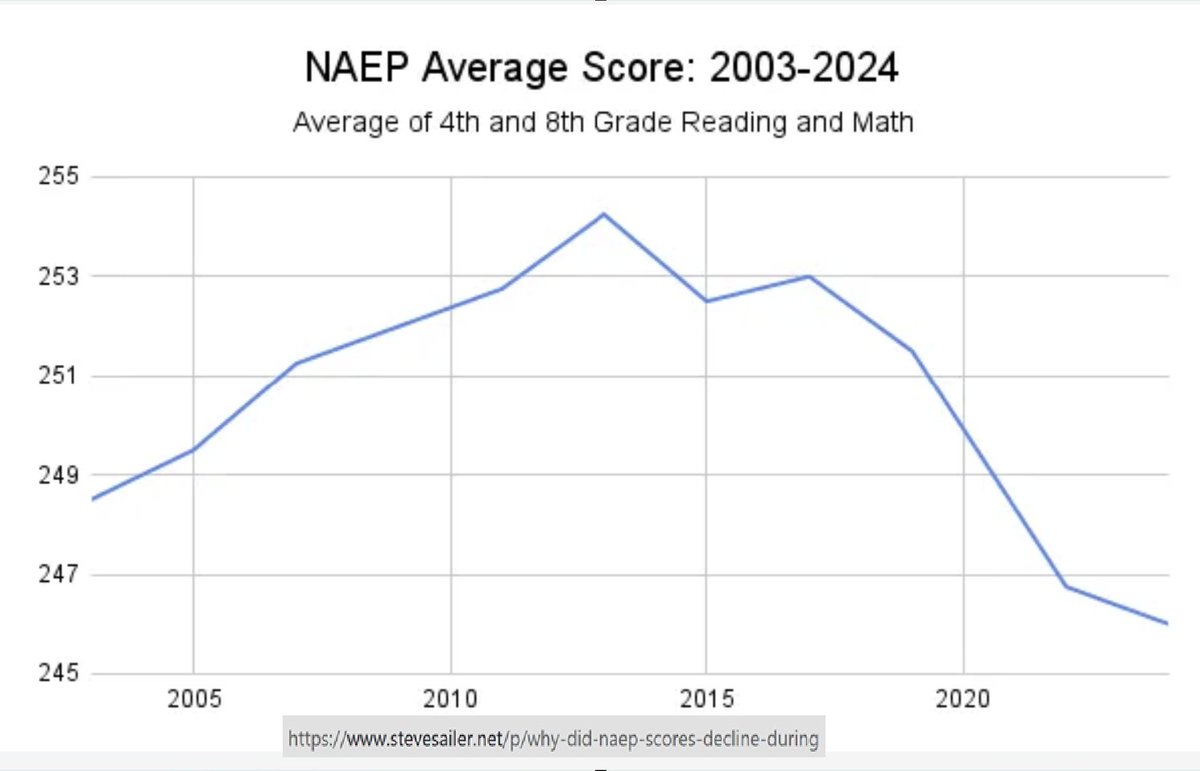
The erosion of K-12 accountability at all levels—districts, schools, teachers & students—since 2016 has corresponded with a drop in outcomes. The fad of the moment in education is "science of reading", but without addressing low standards, curriculum changes alone won't work.
1/n
Food for thought.
Trump, Hormuz and the End of the Free Ride
For half a century, Western strategists have known that the Strait of Hormuz is the acute point where energy, sea power and political will intersect. That knowledge is not in dispute. What is new in this war with Iran is that the United States, under Donald Trump, has chosen not to rush to “solve” the problem. In Hegelian terms, he is refusing an easy synthesis in order to force the underlying contradiction to the surface.
The old thesis was simple: the US guarantees open sea lanes in the Gulf, and everyone else structures their economies and politics around that free insurance. Europe and the UK embraced ambitious green policies, ran down hard‑power capabilities and lectured Washington on multilateral virtue, secure in the assumption that American carriers would always appear off Hormuz. The political class behaved as if the American security guarantee were a law of nature, not a contingent choice. Their conduct today is closer to Chamberlain than Churchill: temporising, issuing statements, hoping the storm will pass without a fundamental reordering of their responsibilities.
Trump’s antithesis is to withhold the automatic guarantee at the moment of maximum stress. Militarily, the US can break Iran’s residual ability to contest the Strait; that is not the binding constraint. The point is to delay that act. By allowing a closure or semi‑closure to bite, Trump ensures that the immediate pain is concentrated in exactly the jurisdictions that have most conspicuously free‑ridden on US power: the EU and the UK. Their industries, consumers and energy‑transition assumptions are exposed.
In that context, his reported blunt message to European and British leaders, you need the oil out of the Strait more than we do; why don’t you go and take it? Is not a throwaway line. It is the verbalisation of the antithesis. It openly reverses the traditional presumption that America will carry the burden while its allies emote from the sidelines.
In this dialectic, the prize is not simply the reopening of a chokepoint. The prize is a reordered system in which the United States effectively arbitrages and controls the global flow of oil. A world in which US‑aligned production in the Americas plus a discretionary capability to secure,or not secure, Hormuz places Washington at the centre of the hydrocarbon chessboard. For that strategic end, a rapid restoration of the old status quo would be counterproductive.
A quick, surgical “fix” of Hormuz would short‑circuit the dialectic. If Trump rapidly crushed Iran’s remaining coastal capabilities, swept the mines and escorted tankers back through the Strait, Europe and the UK would heave a sigh of relief and return to business as usual: underfunded militaries, maximalist green posturing and performative disdain for US power, all underwritten by that same power. The contradiction between their dependence and their posture would remain latent.
By declining to supply the synthesis on demand, and by explicitly telling London and Brussels to “go and take it” themselves, Trump forces a reckoning. European and British leaders must confront the fact that their energy systems, their industrial bases and their geopolitical sermons all rest on an American hard‑power foundation they neither finance nor politically respect. The longer the contradiction is allowed to unfold, the stronger the eventual synthesis can be: a new order in which access to secure flows, Hormuz, Venezuela and beyond, is explicitly conditional on real contributions, not assumed as a right.
In that sense, the delay in “taking” the Strait, and the challenge issued to US allies to do it themselves, is not indecision. It is the negative moment Hegel insisted was necessary for history to move. Only by withholding the old guarantee, and by saying so out loud to those who depended on it, can Trump hope to end the free ride.
My assessment:
1- IRGC made a bet. And the bet was that they would keep the pressure on the Strait of Hormuz, and set the market on fire, as it would be the easiest way to make Trump think twice, withdraw, TACO, or have Gulf countries turn against Trump. But it didn’t work. It won’t work militarily or just in general. UAE is joining the war in a more proactive manner, Bahrain, Kuwait, Saudi are also more eager now than ever. Qataris have completely switched against the IRGC.
But also, Trump himself said "I don’t care about the strait" obviously meaning that others should join the fight, but he denied to IRGC its strategic value. Which absolutely sucks for them given how they are pissing off their own partners, China mainly. The goal of every single military operation is to either enhance posture or change the calculus of your enemy in a way that favors you, blocking the strait isn’t achieving that for them.
2- IRGC thought that Trump given that he kept on saying that "it’s going fast" that dragging and delaying discussions or surrender to Trump’s demands, they would buy time. But they don’t understand that it’s a war, you can’t buy time when you’re being hit at the core of your command and control and your units aren’t being replenished. I’m not sure if they are delusional or if they are in a state of denial and my understanding is that it’s the latter because they constantly underestimate US resolve just like they underestimated Israel last year.
3- Trump, if you haven’t noticed, is ready to escalate, it’s a problem for IRGC because they are so used to being the ones who set the tempo of escalations, (see Iran-Israel April 2025) U.S. options have widened so much compared to just a weak ago.
In other words, doesn’t look good for them. They made too many enemies and too fast.
Yeh, that’s actually a fascinating second order read right there that many aren’t picking up on. They’re getting high on their own supply, is the easy way to put it, but there’s more to it and it cuts both ways. Authoritarian regimes impose fairly heavy controls on media and policy circle outputs. So it’s for them to misread the anti-interventionist narrative on mainstream media and think tank circles as an indication of Washington’s lack of resolve. In a way, their own success at disseminating their narrative of choice is blinding them, so they get caught flat footed when decision makers move rapidly in the opposite direction. But it’s also emboldening them. That same miscalculation is deterrence erosion. Believing the US public and institutions are too fractured or war-averse to go kinetic is leading them to take aggressive actions. So it’s a double edged sword.
There’s room for long format treatment of this entire distortion field. Briefly, most of the regimes we’re at odds with have spent an inordinate amount of bandwidth selling the notion that the US is a declining, corrupt, and weak imperial power to their own public, and exporting it to ours. That whole worldview is couched in a basket of foundational ideologies that both assume and build on that premise. So their own analysts read US media and institutional output in a way that confirms this bias. It’s a structural susceptibility to falling prey to the classic signals-perceptions interpretation gap.
It goes some distance to explaining how shocked Tehran was at the Feb 28 launch of operations. Instead of keeping their eye in the ball (carrier strike groups and logistics) they seem to have relied on public sentiment and political dynamics. It’s likely that they figured the whole Bush, Obama and Biden era, and Trump 1.0 in between, approach would hold, even after their proxies attacked US positions in the region over 170 times post-10/7, after they tried to assassinate the President, after they launched the largest salvos of missiles in history at Israel, after they shut down the Red Sea, and as they were were telling us to go fish at the negotiation table while threatening an unconstrained attack on US presence in response to even a limited strike by the Israelis.
Man did they push their luck. They thought Trump would fold like a cheap suit because he sent a nice, soft spoken envoy who genuinely wanted to avert a war. They misread the whole situation. There’s a lot to unpack at this layer of analysis for sure.
Multipolar propaganda has created a distortion field, portraying the US as declining. It has led competitors and adversaries to misread American media and institutional anti-interventionist output as signals of policy weakness. This is a double-edged sword. On the one hand this has accelerated deterrence erosion, emboldening aggressive miscalculations like post-Oct 7 attacks on US assets. On the other, they’ve fallen prey to a classic signals-perception interpretation gap fueled by confirmation bias. It would seem this analytic layer of how we find ourselves here is under explored.
My latest:
The Iran Question Is All About China
Why Operation Epic Fury Is the Opening Act of the Indo-Pacific Century
The Iran question was never about Iran. Remove the Islamic Republic from the equation and China loses its pawns for a Taiwan contingency. Leave it in place and the Middle East remains what Beijing designed it to be: a second front that Washington can never afford to leave and can never afford to stay in. Trump's strikes are the first move by an American president who appears to understand that the road to the Pacific runs through Tehran.
https://t.co/sDBKn77CYY