There’s pressure across academia: “Publish in Q1 and Q2 journals - anything less is not good enough.”
It’s a familiar mantra in many institutions. But it’s worth asking whether this expectation genuinely serves scholarship?
Here’s why you should not just focus on Q1 and Q2 journals.
1. Quartiles are not a measure of quality - only of journal-level performance.
A Q1 journal can publish weak papers. A Q3 journal can publish groundbreaking ones. Quartiles reflect citation distributions, not journal/article quality. Treating quartiles as a proxy for quality oversimplifies the complexity of research evaluation.
2. “Best fit” often matters more than “best quartile.”
A highly specialised paper may have its natural home in a niche journal that sits outside Q1/Q2. Forcing it into a top-tier venue can dilute its relevance, slow down publication, or push it into journals that are not read by the scholars that should be reading your article.
3. Impact comes from usefulness, not quartile labels.
A paper can transform industry practice or shape local policy, but appear in a Q3 or Q4 journal, or even one that is not indexed. Real-world impact rarely aligns neatly with journal-level metrics.
4. Over-emphasis on quartiles can distort behaviour.
It can encourage scholars to chase metrics instead of questions that genuinely matter. It can push early-career researchers into risk-averse strategies, narrowing creativity and discouraging interdisciplinary work that doesn’t fit the traditional mould.
5. It creates inequities - globally and institutionally.
Not all disciplines have the same availability of Q1/Q2 journals. Not all countries or universities have the same access or resources. The expectation of “Q1 or nothing” often disadvantages scholars working in emerging fields or developing regions.
For an alternative view, see: https://t.co/hWPiMbz1qH
@puddingtobeli@GhiffaryAvernus@bluesunkiss_ Istilah yang benar itu mushroom = cendawan, mold = kapang, yeast = khamir. Untuk jamur itu istilah umum, bisa diganti dengan (Kingdom) Fungi. Kalau ragi itu bahasa Inggrisnya inoculum, karena dipakai sebagai starter makanan fermentasi.
@HalalNation_ Dear brother, the ayaah (Al Baqarah 11 and 12) are not meant for Yahud (jews), instead they are meant for munafiquun according to tafsir by Ibnu Katsir. Wallahu a'lamu bissawaab.
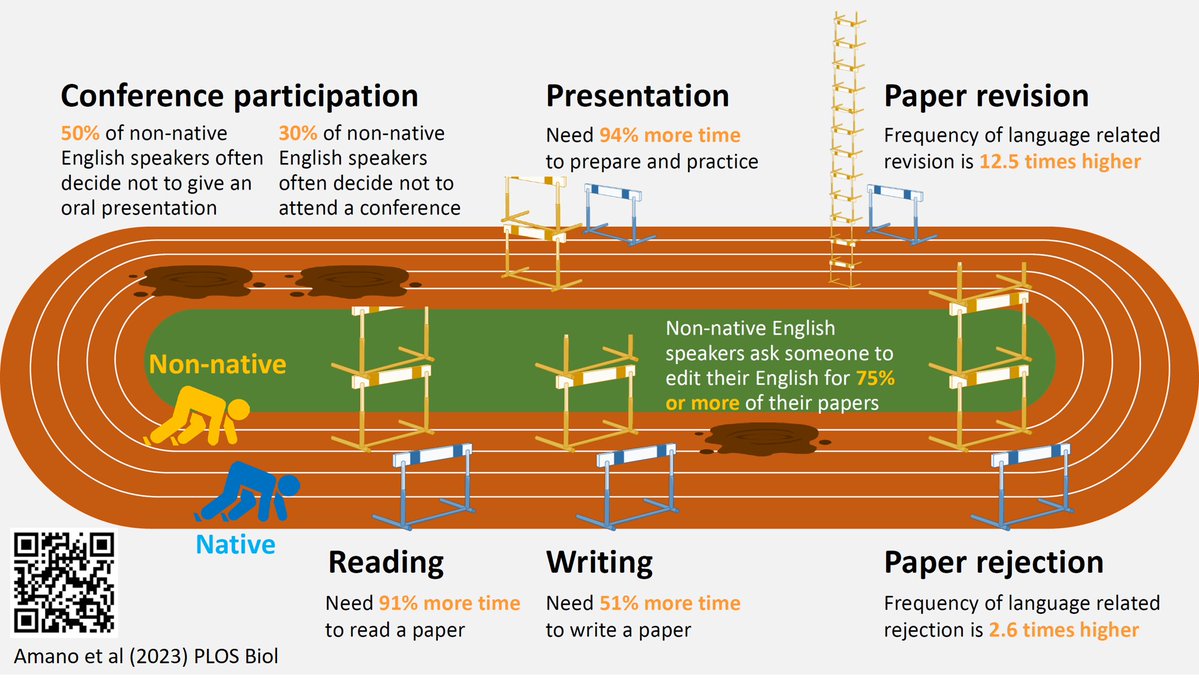
How hard is it to do science in a language that’s not your first language? We quantified the severity of #languagebarriers for non-native English speakers when reading/publishing papers and attending/presenting at international conferences.
https://t.co/Z6za22rMgg
1/9
@nabiylarisfa Semangat Nabila, banyak orang yang tidak mengerti proses penelitian sehingga menghakimi hasilnya tanpa "hujjah". Terus meneliti, terus publikasi, dan terus mengedukasi.