It turns out this 100 year old transformation still has mechanistic details to hide.
This project was a long time in the making and a big team effort across the Smith and Paton groups. If you’re interested in triplet chemistry and reaction mechanisms, this might be a fun read!
Excited to share that our latest Smith/Paton groups collaboration is now online in Chem Catalysis! Here we show that visible light energy transfer catalysis can be used as a mechanistic probe to study the famous Staudinger β-lactam synthesis: https://t.co/alkVOiVCIl
Exited to share that our newest collaboration with the Aggarwal group is now out in Nature! If you’re interested in making tetrasubstituted alkenes with high diastereoselectivity, this could be an interesting read:
https://t.co/kpqwxVd46D
Surprise, surprise: Phenothiazine Sulfoxides as Active Photocatalysts! 💡⚗️💡Exciting 🚀collaboration between @WengerOliver group and @GloriusGroup published in @J_A_C_S :
https://t.co/4PQcflOXKB
Revisiting a classic carbocation – DFT, coupled-cluster, and ab initio molecular dynamics computations on barbaralyl cation formation and rearrangements
https://t.co/ixRavC1aUA
We are working hard to make ORCA (@faccts_orca & MPI Kofo) even better and more accessible. It's great that it is recognized by the community as “one of the most complete toolkits” (@TheAlegreGroup) in Quantum Chemistry.
#ORCAqc#ORCA6#TrendsInChemistry
https://t.co/4LRNckTJcM
Our latest work, in collaboration with @bobbypaton, is out now @angew_chem. We developed a regio- and enantioselective Pt-catalyzed diboration of unactivated alkenes with (pin)B−B(dan), where B(dan) goes to the less hindered carbon. Congrats to team!
https://t.co/zayBhZB3Ek
Alana, Mihai, and Arindam reported a comprehensive synthetic, spectroscopic, and computational study on a general approach to alkene aziridination, now out in @ACSCatalysis! 🔺 https://t.co/LYXzjb9oAG
The group's latest preprint!
@MihaiPopescu94 describes a new computational method for determining the triplet energy of organic molecules inspired by the "hot band" model of energy transfer.
https://t.co/Lc4WWFA66j
Our paper on the modification of polypeptides at selenocysteine using electrochemistry is out now in @angew_chem. Congratulations to Angus who drove the project and thanks to our collaborators @bobbypaton@Malins_Lab! @ARC_CIPPS@SydneyChemistry
https://t.co/xZTQFHqnZZ
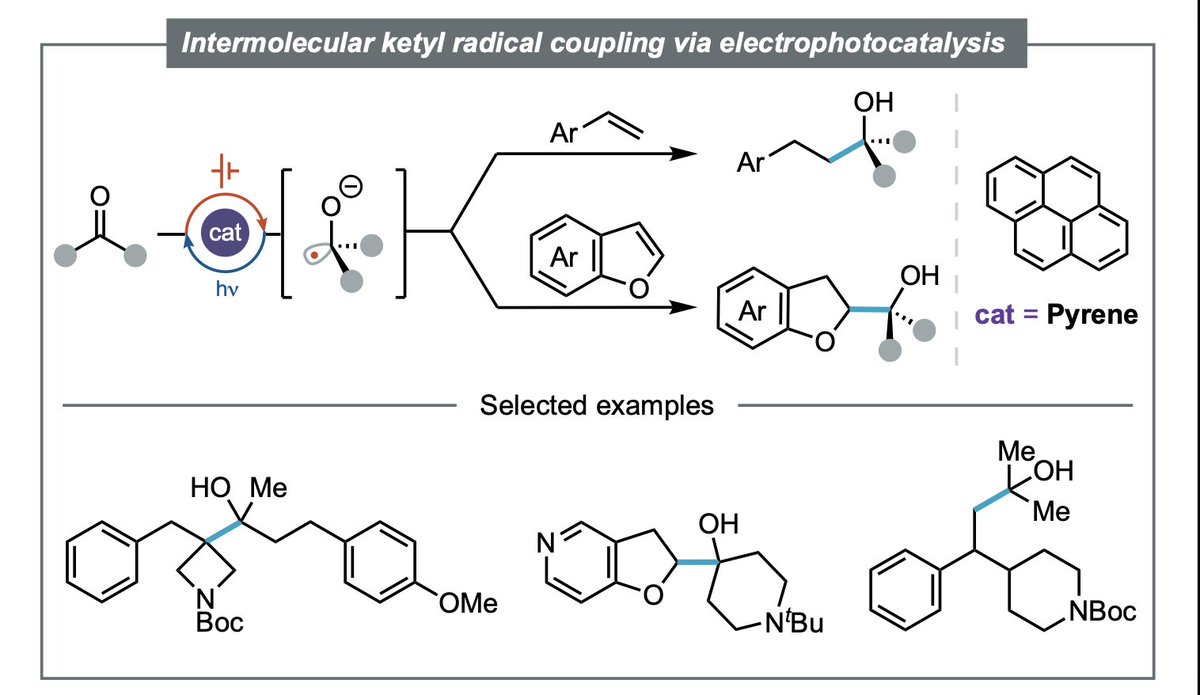
Check out our latest work @J_A_C_S leveraging electrophotocatalysis to access ketyl radicals! We found polycyclic aromatic hydrocarbons are a uniquely competent class of catalysts, which enabled our group's first non-fragmentation based reduction strategy https://t.co/MgGIXLjRJO
�� Explore one of our most read open access articles, "Iridium-Catalyzed Asymmetric Difunctionalization of C–C σ-Bonds Enabled by Ring-Strained Boronate Complexes" from @AggarwalLab.
Read the full article ➡️ https://t.co/VbDTY12fER