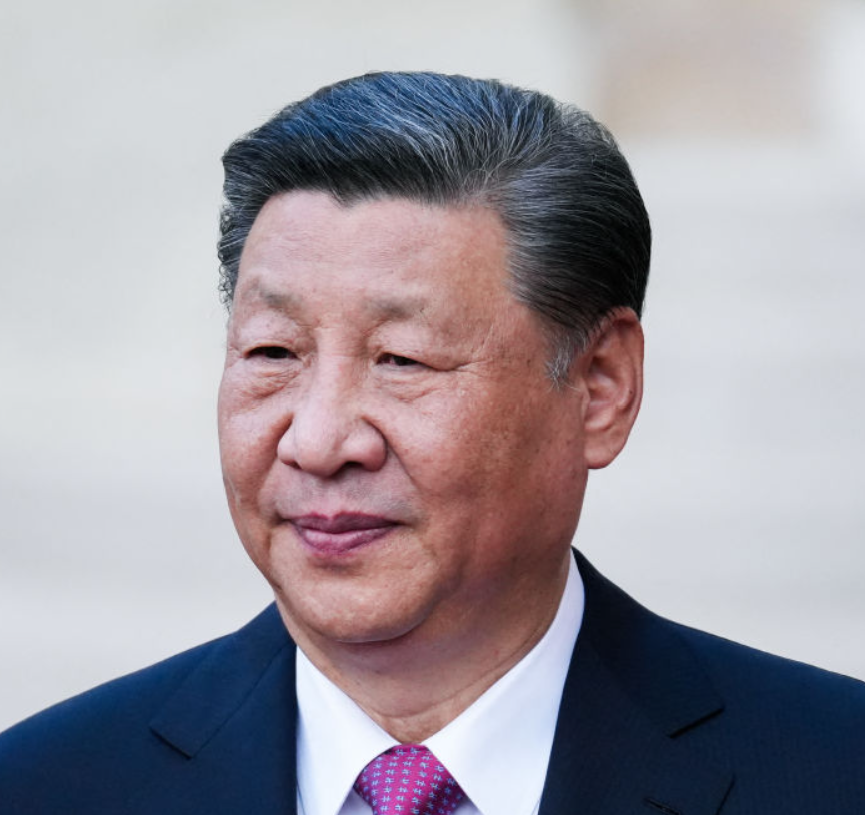
🧵 I find it axiomatic when #Chinese comrades say their #Socialism is Socialism with Chinese Characteristics. Like how else can it be? Every Socialist experiment in history has to be an indigenous experiment. Even the #SovietUnion was just Socialism with Russian Characteristics.
China’s BYD UNVEILS $280,000+ LUXURY BEAST to rival ROLLS-ROYCE — Yangwang Altior
Packing 1,300 HORSEPOWER, autonomous tech and a front grille featuring 137 jewel-cut elements
Finished with 24-carat gold detailing
BREAKING: 🇮🇷🇪🇺🇺🇸 Iran has now officially lifted its self-imposed 2,000-km range limit on ballistic missiles and is going to target US bases in Europe, per AP
IRGC spokesman Brig. Gen. Hossein Mohebbi said the restriction is removed following Supreme Leader Mojtaba Khamenei’s directive without geographical limitations.
An American professor asked when China last voted.
Answer: right now. A billion people are choosing 2.6 million local representatives.
He blocked me after I replied.
HOW CHINA'S ELECTIONS WORK:
I would go so far as to call China's meritocracy a genuine democracy, and that what we in the West call 'democracy' is nothing more than a farcical publicity stunt designed to secure the true hidden power behind a smokescreen of superficiality. Sound and fury signifying nothing.
This is what to expect for the next two years. This is why I say that the system is destined for failure. As long as there are no term limits, there is nobody on either side who will ever address the long-term.
China’s response to the U.S. midterms is almost deliberately cold:
It is America’s domestic affair.
No cheering. No panic.
No fantasy that a change of party will suddenly change Washington’s China policy.
China has watched enough U.S. elections to understand the pattern:
Republicans may be more blunt.
Democrats may be more polished.
The anti-China consensus remains.
So Beijing does not bet on American parties.
Whoever comes, China deals with them.
兵来将挡,水来土掩。
Europe seems to think China is a second Japan and that it can simply recreate a Plaza Accord with Beijing.
That fantasy begins with a basic mistake:
China’s monetary policy is part of China’s economic sovereignty.
Europe’s industrial problems do not give Europe jurisdiction over the renminbi.
When Western economies were dominant, nobody proposed a “European Plaza Accord” to deliberately weaken their own competitiveness.
Now that China has become the world’s strongest industrial power, suddenly the exchange rate itself becomes the problem.
You can compete.
You can improve your own industry.
You can change your own policies.
What you cannot do is demand that China sacrifice its monetary sovereignty to repair your declining competitiveness.
China has already watched what happened to Japan after the Plaza Accord.
It has no reason to volunteer for the sequel.
🚨🇰🇷 Le marché coréen (Kospi) plonge de 6% ce matin.
Idem pour la tech au Japon.
Le déclencheur : la montée en puissance de la Chine dans la mémoire avancée.
C'est le scénario que tout le secteur redoutait.
→ La Chine rattrape son retard sur la mémoire : celle que Samsung et SK Hynix vendaient jusqu'ici à prix d'or aux datacenters IA. 😅
→ Elle promet de compresser les marges 🇰🇷/🇯🇵.
→ Le marché revalorise L'ENSEMBLE de la chaîne asiatique des semi-conducteurs en quelques heures.
Le plus ironique c'est que...
On a déjà vécu ça.
En 1986, c'était le Japon qui mettait à genoux l'industrie américaine des semi-conducteurs.
Les fabricants 🇺🇸 de mémoire DRAM avaient perdu 90% de parts de marché en 10 ans face aux producteurs japonais.
Aujourd'hui c'est la Corée et le Japon qui regardent la Chine faire la même chose (si elle parvient à aller jusqu'au bout).
Tulsi Gabbard warns against the intense war propaganda "to pull the US military into a direct conflict with Russia, which is ultimately what the EU and NATO want".
China Isn't Faking Poor. The 'Developed Country' Label Is Just Broken.
China is Rich Enough to Bully, Poor Enough to Help?
Every few months, some Western pundit rediscovers that China is about to cross the World Bank's high-income threshold, and declares it a gotcha. "See?" they say. "China is rich now. It's just pretending to be poor so it can keep mooching off the Global South."
Is this true? Countries like Seychelles, Mauritius, and Trinidad and Tobago have been "high-income" for years without being treated as developed economies. So does being "high income" make a country more respectable? If Switzerland is high income and Seychelles, Mauritius, and Trinidad are also high income - why do they look so poor and not as well respected internationally?
It sounds clever. It's also wrong, and it falls apart the moment you look at the actual numbers.
Let's start with the big one: being "high-income" and being "developed" are two completely different things. The World Bank's high-income line is a single statistical cutoff—around $14,000 in per capita GNI—used mainly to decide who gets cheap loans. That's it. It is not a certificate of development. Seychelles is high-income. Trinidad and Tobago is high-income. Nobody calls them developed economies.
China's per capita income is still roughly one-sixth of America's. On the UN's Human Development Index, China ranks about 75th—behind countries like Mauritius and Albania. The IMF's list of advanced economies has 41 members. China is not one of them. So when Beijing says "we're still developing," it isn't spinning. It's reading the same data everyone else is.
Now, the "Global South leader" accusation. The Asian country that claim openly it is a leader of the Global South is India's Modi government - not China. Western media like to compare India with China to jab the Modi government into saying ridiculous things.
This one is funny, because it's mostly a Western projection. China doesn't call itself the leader of the Global South. It calls itself a member—one of over 130 countries that share a history of colonialism and a frustration with a global order built before most of them existed. The "leader" label gets slapped on China by people who want to accuse it of hypocrisy. Then they get mad when China doesn't act like a leader.
Here's the part the critics really don't want to talk about: China is already paying up.
In 2025, Premier Li Qiang announced that China will not seek new Special and Differential Treatment in future WTO negotiations. That's a big deal. SDT is exactly the "developing country perk" the critics claim China is clinging to—longer timelines, more flexibility on tariffs and subsidies. China just volunteered to give up future access to it. That's not mooching. That's stepping up.
On climate, China is the world's largest provider of climate finance to the Global South through South-South cooperation—billions poured into solar, wind, and grid projects across Africa, Southeast Asia, and Latin America. It pledged to the Loss and Damage fund. Meanwhile, the actual developed countries—the ones who promised $100 billion a year back in 2009—were late delivering it.
So the free-rider story doesn't hold. China is contributing, and contributing more than many countries that wear the "developed" badge.
But here's the deeper problem with the whole debate: the developed/developing binary is a relic. It was invented for a 20th-century world of rich industrialized North and poor agricultural South. That world is gone. China is the largest manufacturer on Earth and home to hundreds of millions of people still living on less than $5.50 a day. It has bullet trains and billionaires and also villages without running water. Which box does that fit in? Neither.
This isn't unique to China. The entire Global South is a spectrum now. India has a space program and massive poverty. Brazil is a major agricultural exporter with favelas (urban shantytowns). The binary was always a rough shorthand. Now it's just wrong.
And notice who benefits from keeping the binary rigid: the countries that wrote it. If "developed" means you have to pay into climate funds, open your markets, and give up trade protections—while "developing" means you get help—then the rich countries want to keep as many competitors as possible in the "developed" column paying in, while they stay on top. It's not about fairness. It's about locking in advantage.
When China gives cheap development loans to build much needed infrastructure in Global South, it is labelled "Debt Trap" when the West don't even want to compete in this category as it is not profitable like investing in data centers.
China's position isn't "we want free stuff forever." It's "the categories are broken, and we're not going to be sorted into a box designed to extract concessions from us." That's not cheating. That's negotiating. Every great power does it. The US calls itself the leader of the free world while running the world's largest prison population, send thugs to kidnap President Maduro and letting its infrastructure crumble. The EU calls itself a climate champion while still subsidizing fossil fuels, and buying Russian oil from India. Narratives are part of statecraft. The question is whether the narrative matches reality.
For China, it does. Six hundred million people living on under $5.50 a day is not a talking point. It's a fact. Rural-urban income gaps are not a slogan. They're a lived reality for hundreds of millions.
So when someone tells you China is "deliberately resisting" the developed label to keep its perks and its Global South street cred, ask them: which perks? The ones China just voluntarily started giving up? Which street cred? The kind that comes from actually building solar farms and ports across the developing world instead of just talking about it?
The real debate isn't "is China developed or developing." It's "why are we still using a Cold War-era checklist for a 21st-century world." China didn't write that checklist. But it's not going to let itself be graded by it either.
That's not evasion. That's sovereignty. And every country—rich or poor—would do the same.
The PLAAF has more stealth fighters in service (J-20 and J-35) than Russia has Sukhoi in service (Su-27, Su-30 and Su-35).
The Chinese military developed so quickly, it outpaced many people's stereotypes. Most layman still think China is relying on Russian engines for our air force.
China is developing a “six networks” plan, consisting of around 25 trillion yuan ($3.7 trillion) in investment over five years in water, electricity, computing, communications, logistics and urban pipelines.
🌊 Water: 6 trillion yuan on flood defences, restored mangroves and the south-north water transfer.
🔋 Power: 5.5 trillion yuan on smart grids, battery storage and ultra-high-voltage lines to carry solar and wind power across the country.
🛠️ Pipes: 5 trillion yuan to build or renovate 770,000 km of urban gas, water, heating and sewage networks – enough to reach the moon and back.
💻 Computing: 4 trillion yuan, with six of China’s ten data-centre clusters going to poorer western provinces like Ningxia and Gansu.
These networks will work together. The grid and the water system power and cool the data centres. The data centres train AI models that help run the grid more efficiently and manage drones, robots and autonomous vehicles moving freight.
This scale of planning and investment is only possible because China has retained public control of the commanding heights of the economy. The banks, the grid, the telecoms networks, and the land are publicly owned, and they’re all embedded in a planning system that works on a timescale of years and decades.
Meanwhile, Britain’s privatised water companies haven’t built a major new reservoir since the early 1990s, and pump sewage into rivers instead of fixing the pipes. Renewable projects wait years for a grid connection. HS2 has been stripped back to a pretty pitiful state.
Socialism is allowing China to build the economy of the future.
China continues transforming man-made deserts into forests and farms.
Two thousand years of desertification is being turned around.
The world should work together to bring this revolution to every corner of the world.
🇨🇳 The West spent centuries extracting from Africa, ignored it for decades after decolonization, and now panics because China stepped in as an equal partner. Calling China-Africa cooperation "new colonialism" isn't a critique—it’s pure projection and fear. 🌍
🎙️seerealchina
🚨 BOND MARKET IS IMPLODING GLOBALLY.
🇺🇸 US 10Y yield highest since 2002.
🇺🇸 US 20Y yield highest since 2002.
🇺🇸 US 30Y yield highest since 2002.
🇯🇵 Japan 10Y yield highest level in 30 yrs.
🇯🇵 Japan 20Y yield highest level in 30 yrs.
🇯🇵 Japan 30Y yield highest since 1999.
🇬🇧 UK 10Y yield highest since 2007.
🇬🇧 UK 20Y yield highest since 1998.
🇬🇧 UK 30Y yield highest since 1998.
🇫🇷 France 10Y yield highest since 2002.
🇫🇷 France 20Y yield highest level since 2002.
🇫🇷 France 30Y yield highest since 2008.
🇩🇪 Germany 10Y yield highest since 2009.
🇩🇪 Germany 20Y yield near its highest levels since 2008.
🇩🇪 Germany 30Y yield near its highest levels since 2008.
🇮🇹 Italy 10Y yield highest since 2023.
🇮🇹 Italy 20Y yield near its highest levels since 2023.
🇮🇹 Italy 30Y yield near its highest levels since 2023.
🇪🇸 Spain 10Y yield highest since 2014.
🇪🇸 Spain 20Y yield near its highest levels since 2014.
🇪🇸 Spain 30Y yield near its highest levels since 2014.
🇦🇺 Australia 10Y yield highest since 2011.
🇦🇺 Australia 20Y yield highest level 2013.
🇦🇺 Australia 30Y yield highest since 2016.
🇨🇦 Canada 10Y yield around its highest level since 2023.
🇨🇦 Canada 20Y yield near its highest levels since 2007.
🇨🇦 Canada 30Y yield near its highest levels since 2007.
🇮🇳India 10Y yield highest since 2023.
🇮🇳 India 20Y yield near its highest levels since 2023.
🇮🇳 India 30Y yield near its highest levels since 2023.
🇰🇷 South Korea 10Y yield near its highest levels since 2022.
🇰🇷 South Korea 20Y yield near its highest levels since 2022.
🇰🇷 South Korea 30Y yield is near its highest level ever.