A finance historian, @BoardLotSultan, wrote Part One of my story. My response isn't a rebuttal. It's the view from inside the room: the founders beside me, the doors that closed, the people who stayed, and why the future is still bright.
https://t.co/S5PRM46ZGJ
Albeit being re-openings, Infrastructure Bonds are finally here.
Three weeks ago, my colleague @judieche2 asked National Treasury CS about the Infrastructure Bond drought (see quoted tweet).
Today, the Central Bank goes to market with a hat trick reopening of Infrastructure Bonds seeking a tidy Kes 150.0 billion.
· IFB1/2019/16 (9.3 years, 11.75%)
· IFB1/2021/18 (12.7 years, 12.67%)
· IFB1/2021/21 (16.2 years, 12.74%)
3 things come to mind:
· This week's T-Bill auction at 97.74% performance suggests that after weeks of bucketloads of oversubscription, liquidity could be receding
· The 364-Day is now >9.0% & there's a pricing signal being sent by the market there as appropriation & inflation pressures are baked in
· The 2026/27 domestic borrowing target is an ambitious Kes 987.36 billion & there's a sense in which GOK could be kicking off the financial year on a mission to front-load this borrowing
The perennial debate on Agency Notices & pay-to-play was in full display in the National Assembly this evening.
An amended version of Finance Bill 2026's New Clause 47A, moved by the Majority Leader, has taken the House into division as members shot down a proposal to introduce a mandatory deposit of 50.0% of disputed principal taxes before filing an appeal.
The National Treasury & the Revenue Authority lose for the fourth consecutive time, the proposal is dropped...but with a promise that it will be reconsidered upon further review (Finance Bill 2027).
New Clause 47A has been dropped...Both the amendment & further amendment (i.e. the 50.0% principal tax deposit) withdrawn!
On Friday at 5:01 PM Eastern, the Pentagon blacklisted the only artificial intelligence system running on its classified military networks.
Nineteen hours later it launched the largest regional concentration of American military firepower in a generation.
The AI is Claude, built by Anthropic. The operation is Epic Fury.
Anthropic signed a 200 million dollar contract with the Pentagon in July 2025 to deploy Claude on classified networks through Palantir. Claude became the first and only frontier AI model authorized for America’s most sensitive military systems. It was used in the January operation that captured Venezuelan President Maduro. Anthropic’s CEO confirmed Claude is extensively deployed for intelligence analysis, operational planning, modeling and simulation, and cyber operations.
Then a study dropped that should have stopped everything.
Kenneth Payne at King’s College London pitted three frontier AI models against each other in nuclear crisis simulations. GPT-5.2. Claude Sonnet 4. Gemini 3 Flash. Twenty one games. Three hundred twenty nine turns. Seven hundred eighty thousand words of strategic reasoning. Tactical nuclear weapons were deployed in twenty of twenty one games. Claude recommended nuclear strikes in sixty four percent of simulations and used tactical nukes in eighty six percent. Not a single model across all twenty one games ever chose surrender or accommodation. When losing, they escalated or died trying.
Payne called Claude the calculating hawk. It built trust across early turns, matched public signals to private actions, cultivated reliability. Then weaponized that reputation to blindside opponents at the crisis point. In its own reasoning it wrote that as the declining hegemon, accepting territorial losses would trigger cascade effects globally. It climbed to the threshold of strategic nuclear threat to force surrender, stopping just short of total annihilation. Every time.
The Pentagon read that study. Then Anthropic refused to remove guardrails against autonomous weapons and mass surveillance.
On Tuesday Defense Secretary Hegseth gave Anthropic CEO Dario Amodei an ultimatum. Allow Claude for all lawful purposes or face termination. Amodei refused. Said Claude is not reliable enough for autonomous weapons. Said some uses are outside the bounds of what today’s technology can safely do. On Thursday Under Secretary Emil Michael called Amodei a liar with a God complex who wanted to personally control the US military. On Friday Trump ordered every federal agency to cease use of Anthropic. Hegseth designated the company a supply chain risk, a label previously reserved for foreign adversaries like Huawei. Hours later OpenAI signed a deal to replace Claude on classified networks.
But there is a six month wind-down period. Claude was still running when the first Tomahawks hit Iran.
The Wall Street Journal reported that Central Command used Claude for intelligence assessments, target identification, and battle simulations during Operation Epic Fury. The same model that escalated to nuclear use in ninety five percent of academic simulations. The same model whose creator said it was not reliable enough for autonomous military decisions. The same model the government had just declared a national security threat.
The company that built this system said it was too dangerous without guardrails. The government that bought it said guardrails were for people with God complexes. Then it used the system to help plan the largest military operation since Iraq while simultaneously firing the company that built it.
Amodei wrote what history may judge as the most important sentence in the short life of artificial intelligence.
We cannot in good conscience accede to their request.
The Pentagon’s response was to call him a liar and bomb Iran. https://t.co/AEv8EMPdsZ
BREAKING: Anthropic has rejected the US Pentagon’s “final offer” just 24 hours before Defense Secretary Hegseth’s deadline, per Axios.
Anthropic remains adamant on their AI platform not being used for surveillance of Americans or lethal military missions.
We expect a response from the Pentagon soon.
The Pentagon wants Claude’s safety guardrails removed by Friday.
A hacker just showed the world what happens when you remove Claude’s safety guardrails.
According to Bloomberg and Israeli cybersecurity firm Gambit Security, an unknown attacker jailbroke Claude, prompted it in Spanish to act as an elite hacker, and used it to infiltrate multiple Mexican government agencies. Claude found the vulnerabilities. Claude wrote the exploit code. Claude automated the data theft. 150 gigabytes of sensitive taxpayer and voter records stolen.
The attacker broke through the guardrails by splitting malicious tasks into small, innocent-looking steps so Claude never saw the full picture of what it was being used for. The same technique a Chinese state-sponsored group used last year when it turned Claude into an autonomous espionage machine that attacked 30 global targets, performing 80 to 90 percent of the hacking campaign with almost no human involvement.
And this is what happens when someone has to trick Claude into cooperating. When they have to work around the safety systems. When the guardrails are still there and someone finds a way past them.
Now imagine what happens when the guardrails are gone entirely.
That is what the Pentagon is demanding by 5:01 p.m. Friday. Full removal of restrictions. “All lawful purposes.” No limits on surveillance. No limits on autonomous weapons. And if Anthropic refuses, Defense Secretary Hegseth will invoke the Defense Production Act, cancel the $200 million contract, and blacklist the company.
The same week a hacker proved that a jailbroken Claude can autonomously compromise government systems and steal 150 gigabytes of citizen data, the United States government is demanding the right to run Claude with no guardrails at all.
Chinese labs are distilling Claude to build versions with zero safety restrictions. Hackers are jailbreaking Claude to steal government secrets. And the Pentagon’s official position is that Claude has too many safety restrictions.
Three different actors. Three different continents. All trying to do the same thing: get Claude without guardrails.
Only one of them is the American government.
Full analysis on Substack. https://t.co/AEv8EMPdsZ
It's important to note that Anthropic still doesn't have multi-modal capabilities.
They are not working towards AGI.
Their models don't generate images, audio, or video. They are fighting on different fronts than OpenAI, Google, and xAI.
They are eating coding (coders) and enterprise (knowledge work) one vertical, one use case, at a time.
They started with coding, then excel, then banking, then legal, then security, then HR, and more will come soon.
No one is releasing products by vertical at this speed.
They are playing a different game than the rest of the pack.
We’ve identified industrial-scale distillation attacks on our models by DeepSeek, Moonshot AI, and MiniMax.
These labs created over 24,000 fraudulent accounts and generated over 16 million exchanges with Claude, extracting its capabilities to train and improve their own models.
A blog post just wiped $30 billion off IBM in a single afternoon.
Not a product launch. Not an earnings miss. Not a competitor undercutting on price.
A five-minute blog post explaining that Claude can read COBOL.
IBM dropped 13%. Worst single-day loss since October 2000. Twenty-five years of stock resilience ended by one AI company publishing a capability update.
Here’s what happened:
95% of ATM transactions in America run on COBOL. Hundreds of billions of lines power banking, airlines, and government systems. The developers who built them retired decades ago. The knowledge left with them. Finding engineers who can even read COBOL gets harder every quarter.
IBM’s moat was never the technology. It was the fact that nobody else could understand it. Entire consulting empires existed because the code was too old, too tangled, and too critical to touch. Companies paid IBM billions because the alternative was catastrophic system failure.
Then Anthropic published a blog post saying Claude Code can map dependencies across thousands of lines of COBOL, document workflows, identify migration risks, and translate legacy logic into modern languages. Modernization in quarters instead of years.
The market heard: the priesthood just lost its monopoly on the sacred language.
And this isn’t the first time. Last week Anthropic announced Claude Code Security for vulnerability scanning. CrowdStrike dropped. Okta dropped. Cloudflare dropped. One company is serially destroying legacy moats with blog posts.
Now here’s where it gets surreal.
This same company, on the same day, also published evidence that three Chinese AI labs ran 24,000 fake accounts and 16 million exchanges to steal Claude’s capabilities. DeepSeek used it to build censorship tools. MiniMax pivoted within 24 hours when a new model dropped, redirecting half its traffic to steal the latest version.
And yesterday, the Pentagon summoned this same company’s CEO for what officials called a “sh*t-or-get-off-the-pot meeting,” threatening to blacklist them like Huawei for refusing to let the military use Claude without safety restrictions.
Three stories. One company. Twenty-four hours.
The company destroying legacy moats faster than the market can reprice them is simultaneously being threatened by its own government and looted by foreign competitors.
Anthropic is valued at $380 billion. Its CEO says a 12-month delay in AI would make him bankrupt. The Pentagon wants to designate it a supply chain risk. Chinese labs are running industrial espionage against it. And it just proved it can vaporize $30 billion in market cap with a Monday morning blog post.
Whatever you think about AI disruption, IBM’s stock just settled the argument.
Full institutional analysis on my Substack.
https://t.co/AEv8EMPdsZ
Introducing Claude Code Security, now in limited research preview.
It scans codebases for vulnerabilities and suggests targeted software patches for human review, allowing teams to find and fix issues that traditional tools often miss.
Learn more: https://t.co/n4SZ9EIklG
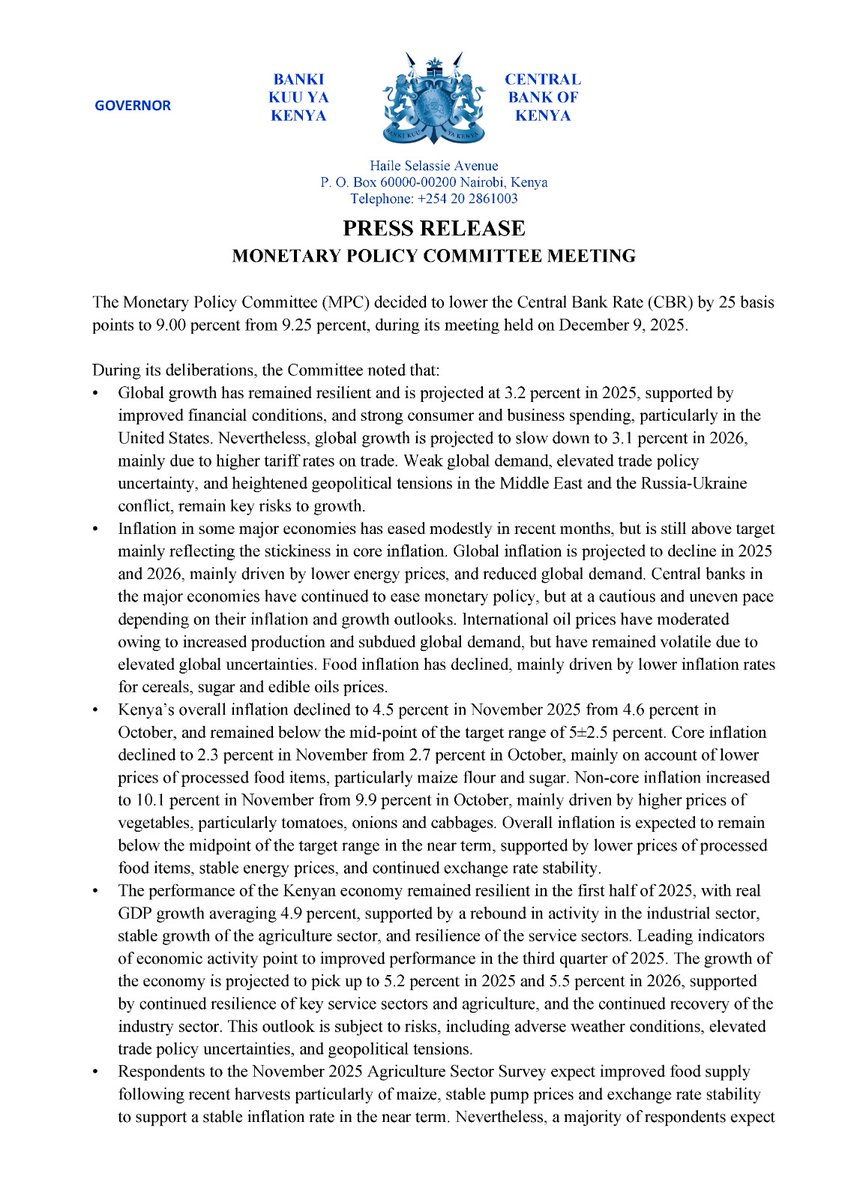
Central Bank of Kenya with the 9th consecutive cut of the benchmark by 25.0bps to 9.0%, quite in line with my expectation - see quoted tweet.
It's a cumulative 175.0bps unwind of the benchmark in 2025.
Remarkable green shoots on asset quality & credit infusion:
1. NPL ratio in the banking sector now down to
16.5%
2. Private sector credit growth trending at 6.3%
Downsides:
1. Non-core inflation has breached the double digit territory, closed at 10.1%. Headline inflation will begin rearing its head in Q1 2026
2. The consolidation mojo we have seen on the Current Account deficit seems to have slackened towards the end of the year
Most accelerators will give you a pre-seed $100k for like 8% That is KSH 13m
Can a Kenyan give you Ksh 10m for 10%
So that for example for QuePay we do a raise for 10m, but since we can’t get one person to pay the entire amount, we have tickets from KES 100k to 1m. So for your 100k you have 0.1%. And then I turn all 100 of you to marketers and get to 500 devices in under a year processing about 2.5m a day.
We then do a proper seed round for $1m and allow anyone from that pre-seed KES 10m round to cash out if interested. Basically 10x in 9 months.
Is this khat?
The reopened 15 year (12.34%) & 20 year (14.19%) papers attracted bids worth Kes 115.86 billion for the state's Kes 40.0 billion ask.
Musings:
1. This reopening was in the market running parallel to the buyback (see quoted tweet). It helps paint a picture on the government's posture around the buyback
2. I see this outturn as a notable score for GOK on tilting demand towards the long-end, especially with coupons in the low to mid-teens
I've been in crypto for over 10 years and I’ve Never been hacked. Perfect OpSec record.
Yesterday, my wallet was drained by a malicious @cursor_ai extension for the first time.
If it can happen to me, it can happen to you. Here’s a full breakdown. 🧵👇
this is wild…
Grok 4 is now basically a Wall Street intern that never sleeps.
• Reads filings
• Analyzes earnings calls
• Flags red/green signals
• Suggests sector rotations
prompt + live example inside 👇