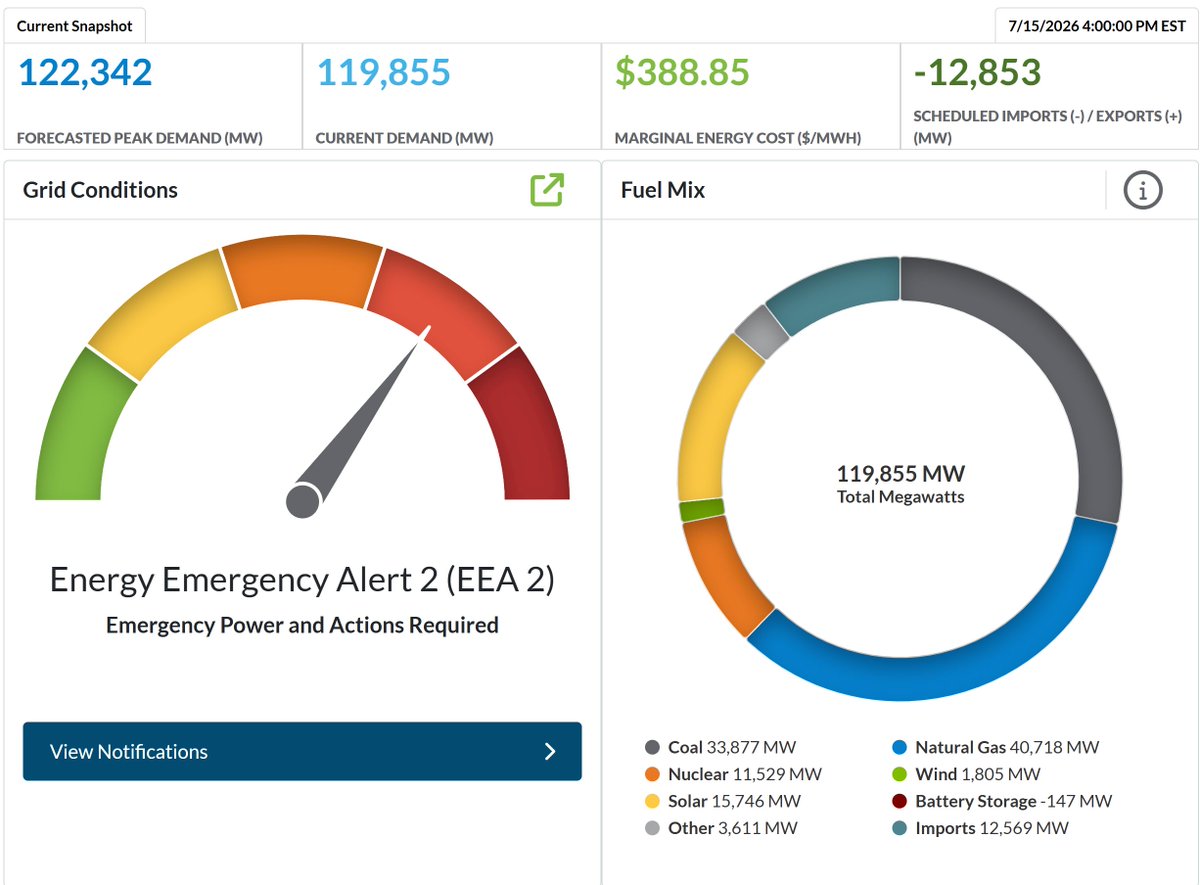
As promised: the full write-up. On July 15, MISO declared the first summer EEA2 in its modern record. The headlines said record heat. The archived data says 4,475 MW of generation vanished from the books between breakfast and mid-afternoon. The anatomy of an emergency that worked. ⬇️
https://t.co/D4vojSvVHi
#energytwitter
#gridreliability
@MISO_energy
Those are two different systems. A neighborhood outage like Forest Park is nearly always distribution, meaning a line, a pole, or a transformer, and Ameren crews fix it locally. The emergency alerts in that article are about the bulk system, which is the question of whether there is enough generation across a multi-state region.
They almost never share a cause, which is why the news story did not connect them. Worth knowing the difference, because the two get blended together constantly.
Worth knowing before this spreads: that order went to SPP, not MISO. SPP runs the grid in western and southern Missouri. St. Louis is Ameren, which is in MISO, a different RTO entirely and not covered by this order. The 17 states are SPP's footprint, not the country.
Also, a 202(c) is not a step on the EEA ladder. It is Federal Power Act authority that lets an operator run units it otherwise could not. This one runs through Aug 3.
Today is the 20-year anniversary of the Derecho, Bow Echo and Heat Wave of 2006, which produced over half a million power outages, which was the worst power outage in @AmerenMissouri history. #stlwx#mowx
https://t.co/4gN9L4OKyC
@fox2ch@MrMeso62@NWSStLouis
Final update: MISO terminated today's emergency at 7:48 PM CT, more than an hour ahead of the scheduled 9 PM end. The full arc: Max Gen Warning at 8:07 AM, EEA1 at 2 PM CT, EEA2 at 4 PM CT (the first EEA2 since Winter Storm Elliott in December 2022, and possibly the first summer one in the modern record), stepped back to EEA1 at 5:30, down to Warning at 6:46, terminated at 7:48. By the numbers: roughly 4.5 GW of forced outages appeared in the data on the year's biggest load day, demand crested at ~122.6 GW at 3:15 PM CT, wind spent the whole day under 2 GW against a 34 GW fleet, marginal prices ran $60 at breakfast to nearly $1,000 at the solar ramp-down and are back to $62 tonight, and demand response shaved ~2 GW when it counted. Zero customers interrupted. One number still running hot: imports are at their deepest of the entire day right now, roughly 17 GW, with the sun down and wind still weak. The emergency ended; the borrowing has not. And the dashboard stays yellow, not green: Conservative Operations continues through Thursday, when the forecast says 91F, heat index near 101, and storms. Today may get a sequel. Longer write-up coming on the blog. #energytwitter
Fair question, and the word is the confusing part. 'Energy Emergency Alert' is a defined NERC term of art, not a panic signal. It marks specific operating states: EEA1 means all available generation is committed, EEA2 means the operator is also using demand-side tools. It IS their job, and the alert levels are the formal mechanism for doing that job: they unlock emergency resources, pricing, and coordination that aren't available in normal operations. Think of it like a hospital declaring a mass-casualty protocol. Declaring it is the system working, not failing.
Small but important correction to the premise: ISOs don't build generation. What gets built is decided by utilities, independent developers, and state regulators; MISO operates whatever fleet those decisions produce and runs the markets. As for today: the peak was carried by roughly 65% coal and gas, 12% nuclear, plus solar and record imports. Wind underdelivered badly and the system still crested 122.6 GW with margin to spare. Whether the resource mix is the right one is a real debate, but it belongs to state commissions and legislatures, not the control room.
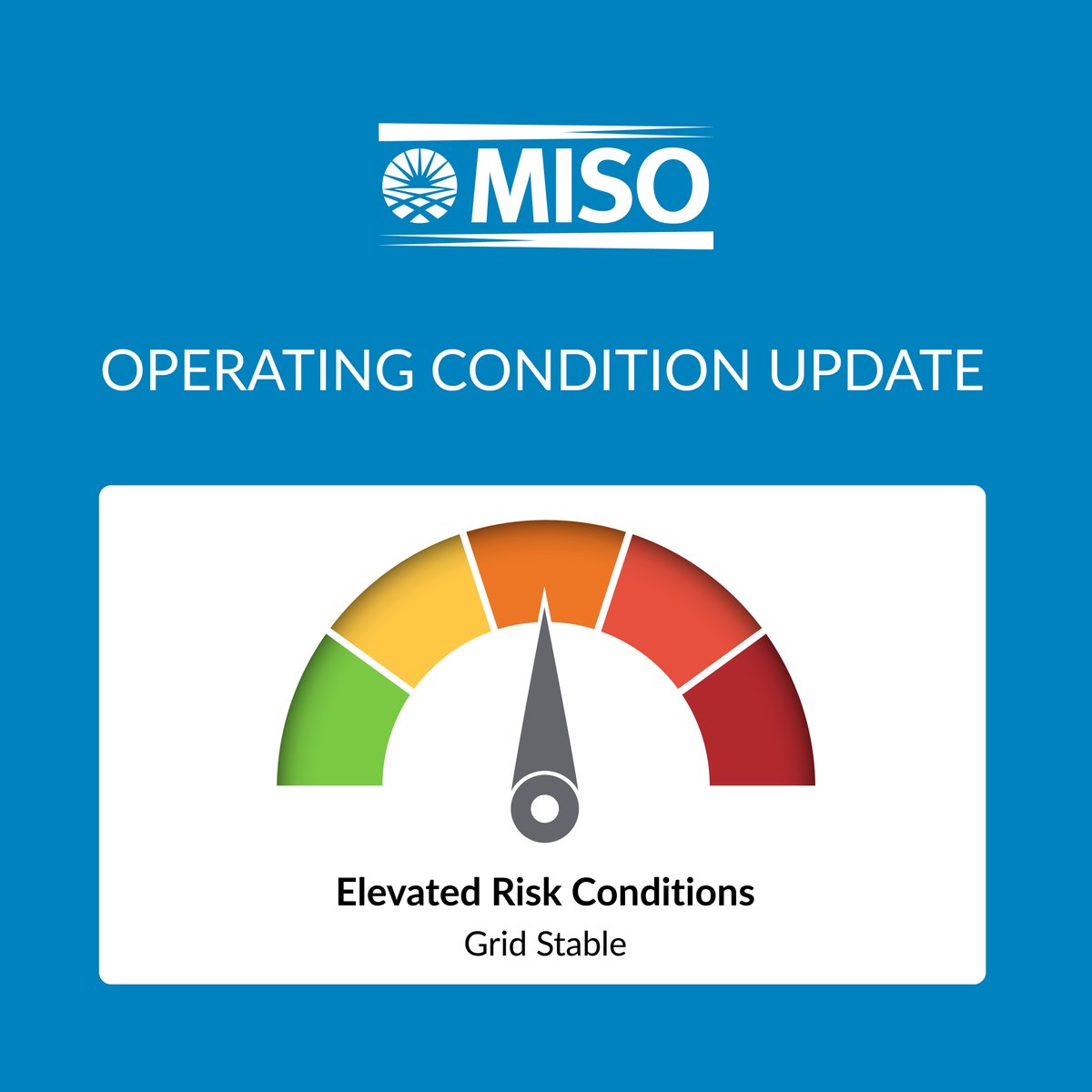
Today is MISO's first EEA2 since Winter Storm Elliott in December 2022, and the documented EEA2-level events (roughly a dozen in the modern record) are almost all extreme winter storms. A summer EEA2, driven by heat plus a wind collapse plus the evening solar ramp-down, may be a first. The dashboard needle spends about 360 days a year in the green. Today was the exception.
Great question, and answering it lets me correct something in my last update. There's no single fixed import cap: the ceiling is set by transmission interface ratings with each neighbor (PJM, SPP, TVA, SPA, Manitoba, Ontario), studied seasonally, plus whatever the neighbors can actually spare that hour. Today gives a feel for the practical range: ~8-9 GW overnight, ~13 GW at the afternoon peak, and ~16.8 GW as of 7:30 PM CT and still climbing, because the forecast evening wind recovery never showed (1.75 GW actual vs 3.1 GW forecast). Every MW wind didn't bring, the interties did. And the correction: I misread the notification layering earlier. The EEA2 was never cut short; it ran to its original 8 PM CT / 9 ET end, and only the overarching EEA1 window was shortened (ends 9 PM CT / 10 ET). MISO's gauge was right all evening; I wasn't. The supply/demand numbers in my earlier posts stand. #energytwitter
Update from the 4 PM ET data: the peak is in. Demand crested at ~122.6 GW at 3:15 PM ET and is now easing. Three things held: no new forced outages since the morning jump, imports peaked at a remarkable ~13.2 GW with actual flows matching schedule (the neighbors delivered), and load is running ~1.8 GW under forecast since the EEA2 window opened, which looks like demand response and conservation doing real work. Margins are the widest of the day heading into the solar ramp-down. Not over until the sun is, but the hard part may be behind us. #energytwitter
The numbers behind this one: forced outages climbed ~4.5 GW between the morning and afternoon data (about 11 GW to 15.4 GW) right as load headed toward a ~122.8 GW peak. Committed capacity is up ~5 GW since morning as emergency resources come online. This is the toolkit doing what it was built for. Good luck to the operators through the evening solar ramp-down.
@MISO_energy just declared an EEA2 Emergency, which is the first time in years since this type of emergency has been declared. MISO has declared an EEA2 due to: Forced generation outages, above normal temperatures and higher than forecasted load. This will likely make the news and you may receive an alert on your phone.
#MISO
#EEA2
Due to extreme heat and high demand, MISO has declared an Energy Emergency Alert 1 (EEA1) for the North and Central regions today (7/15), beginning at 3 p.m. ET and moving to an Energy Emergency Alert 2 (EEA2) at 5 p.m. ET.
These steps allow our operators to access additional generation resources. MISO continues coordinating with member utilities and neighboring grid operators to maintain reliability during today's most challenging periods.
Visit our website for the latest grid conditions: https://t.co/C7e79Z6taw
#energytwitter