If it's true that this is indeed GLM-5.4/5.5, then it would change everything, without exaggeration.
GLM-5.3 was released just 7 days ago and was an extremely significant leap compared to GLM-5.2, which was improved solely through real-time modeling (RL). Same base model. And all this in a very short time.
If it's true that GLM-5.4 has become so much better just a week later thanks to RL, it would demonstrate:
1) how much faster the models are now becoming. Not only is there no end in sight, but: now more than ever, exponential growth.
2) It would force OpenAI and Anthropic to release models. Anthropic, in particular, with its upcoming IPO, now has to prove itself. And it would put pressure on slowing down in favor of security.
3) And at least as importantly: the gap between China and the US is shrinking even further, even faster. It seems to be generally accepted that this is a Chinese model. No one suspects it's a Google model.
Given the same tokenizer, it's most likely GLM, and that would be the craziest thing we've seen in a long time for the reasons mentioned above.
But perhaps it's MiMo. Or, quite far-fetched, Ilya Sutskever's SSI model.
It remains exciting. I've rarely seen the community so impressed and confused at the same time. I'm equally confused and impressed.
@davis7 used Fable to determine which model it most closely resembles. A screenshot of the test is attached. h/t Ben Davis
Ox Alpha (stealth model) is free for the next week
- 1M Context
- Multi-modal
- Zero Data Retention
Generous rate limits, near unlimited usage
We have capacity for 100T tokens per day, lets see what you can do
A mysterious new AI model just appeared.
Ox Alpha offers a 1M context window, multimodal capabilities, zero data retention, and nearly unlimited usage for an entire week.
OpenCode says it has capacity for 100 trillion tokens per day. That’s 1.16b tokens per second. Where the heck did they get that much compute?
Nobody knows which company built it.
DeepSeek-V4-Flash-Vision-Exp is now live on the DeepSeek API Platform! 🚀
🔹 This experimental multimodal model matches DeepSeek-V4-Flash on text capabilities—including agents, reasoning, and world knowledge.
🔹 On multimodal agent benchmarks, V4-Flash-Vision-Exp makes a major leap over V4-Flash, bringing multimodal agent performance close to Opus-4.8.
Try it with model='deepseek-v4-flash-vision-exp'. DeepSeek Harness 0.1.1 was released today with out-of-the-box support for the new model.
1/n
wtf is happening today: DeepSeek has launched DeepSeek-V4-Flash-Vision-Exp, an experimental multimodal model built for agents that need to see.
And its performance on visual-agent benchmarks moves close to or even outperforms Opus 4.8.
Again: this is the Flash model, the small one!
Seeing a hype wave around GEN-1.5, and rightfully so. Lots of respect to Pete & Andy for executing so well. The secret is in the naturally repetitive motions in human-collected data. There're 2 main sources for such repetitions:
(1) Symmetric patterns. Sorting, tidying, and assembling almost never finish in one motion. Open any assembly manual from IKEA, and you find most objects symmetrical. You drive one bolt, then its twin, then the next pair. Every {bolt A, bolt B} pair is a natural continuation in context, and the second instance is a free training signal that imitates the first ("prompt").
(2) Recovery. Humans drop things all the time, but we pick them up so fast, we don’t even notice. That reflex to fix is half of our physical competence. The key insight is to keep the failed first half instead of trimming it away. If the model consumes the full arc, fumble, catch, continue, then recovery shows up organically at test time. It's funny that in-context improvement results from *NOT* over-sanitizing your data.
The other critical ingredient is UMI. I've been saying for a while that teleop will not last, and GEN-1.5 is driving the final nail in the coffin. UMI is essentially a human wearing the robot gripper to collect data directly (human → data). Teleop inserts a layer of separation: human → VR/skeletal device → robot → data, which bleeds out all the human "physical intuition". The subtle sleight of hand we perform constantly with objects, the micro-adjustments, the feel of a part snapping into place, is nearly impossible to capture when you can't feel the environment directly.
Once you have enough data, many behaviors can actually be zero-shot. For example, you don't even need finetuning to pick up a novel object. The model "just knows" what to do given a similar scene in the training distribution. Whether in-context learning truly works or not also depends on how far away the test is from training. Currently, the demos are still a bit too simple to conclude.
I'm cautiously optimistic. Still, it's a great day in robotics.
This @GoogleDeepMind's paper is really worth your time
It's on how to help Transformers not lose the right context on the way to the final answer.
For this, the researchers introduce Recirculation:
Normally, information passes through Transformer layers once. Recirculation changes that flow:
→ Some of what the model figures out in deeper layers is passed back to earlier layers and used when processing the next input.
For example, once the model understands that “bank” means river bank in a fishing context, that interpretation can stay available when it later gets a question about an ATM.
So here is how recirculation works:
1. The model processes the input normally.
2. Deeper layers build a more contextualized representation.
3. A small part of that activation is mixed back into a shallower layer.
4. The next input is processed with this updated state.
The weights stay frozen, and you're changing how information flows through the model at inference time, not retraining it.
This method really works in practice:
- recirculation reduced contextualization errors by 60%
- reduced perplexity by 23%
- improved GSM8K accuracy by 21%
- improved performance on several other tasks
And now, the most interesting question: is this an alternative to Chain-of-Thoughts?
Not really. CoT adds computation through generated reasoning tokens; recirculation helps the model keep track of what it has already understood internally.
It’s also different from looped Transformers: they repeat the same layers, effectively adding depth, while recirculation feeds deeper representations back into earlier processing.
So instead of asking the model to reason out loud, let it reuse more of what it has already figured out internally.
There are tens of millions of people who have gifted-level intelligence. Even if a portion of those fully embrace AI, millions will be amplified to an exceptionally gifted level with capabilities which were only available to a few before. Unimaginable unlock of human potential!
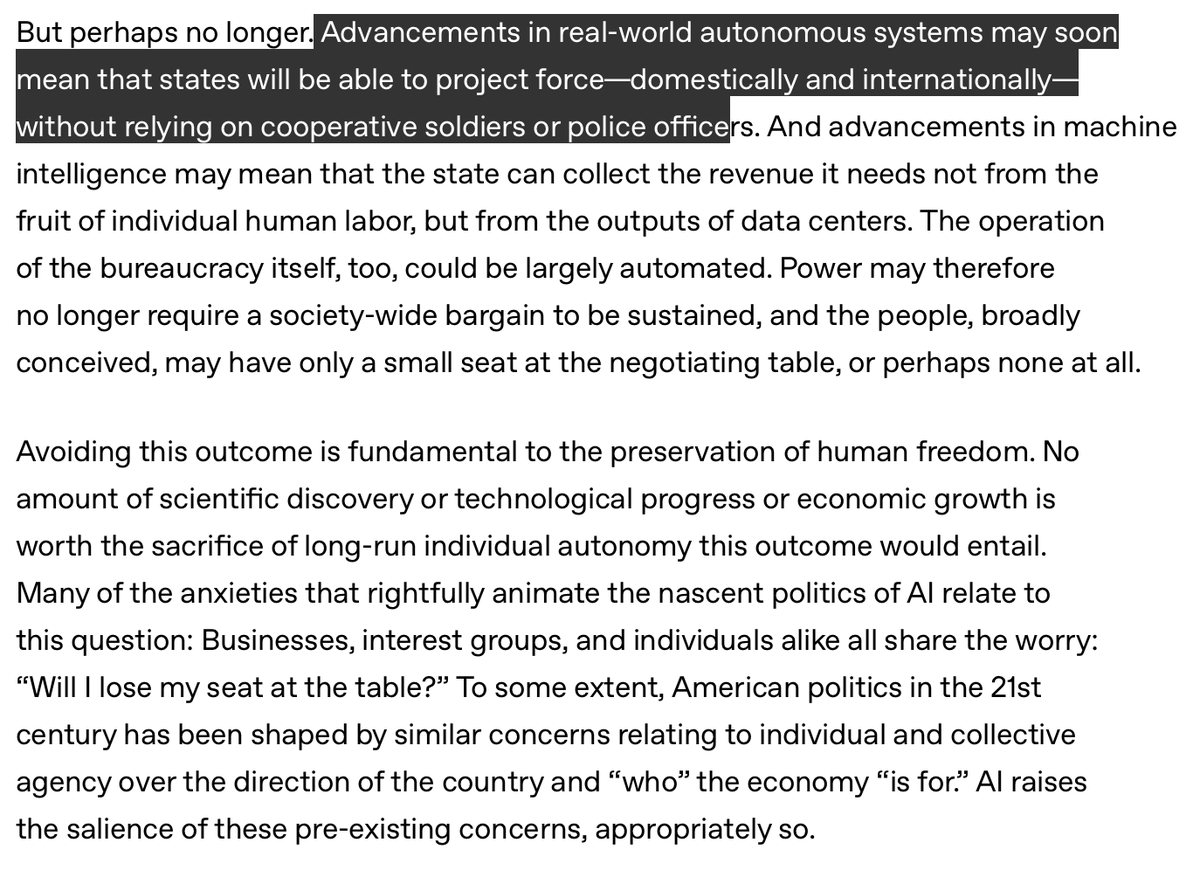
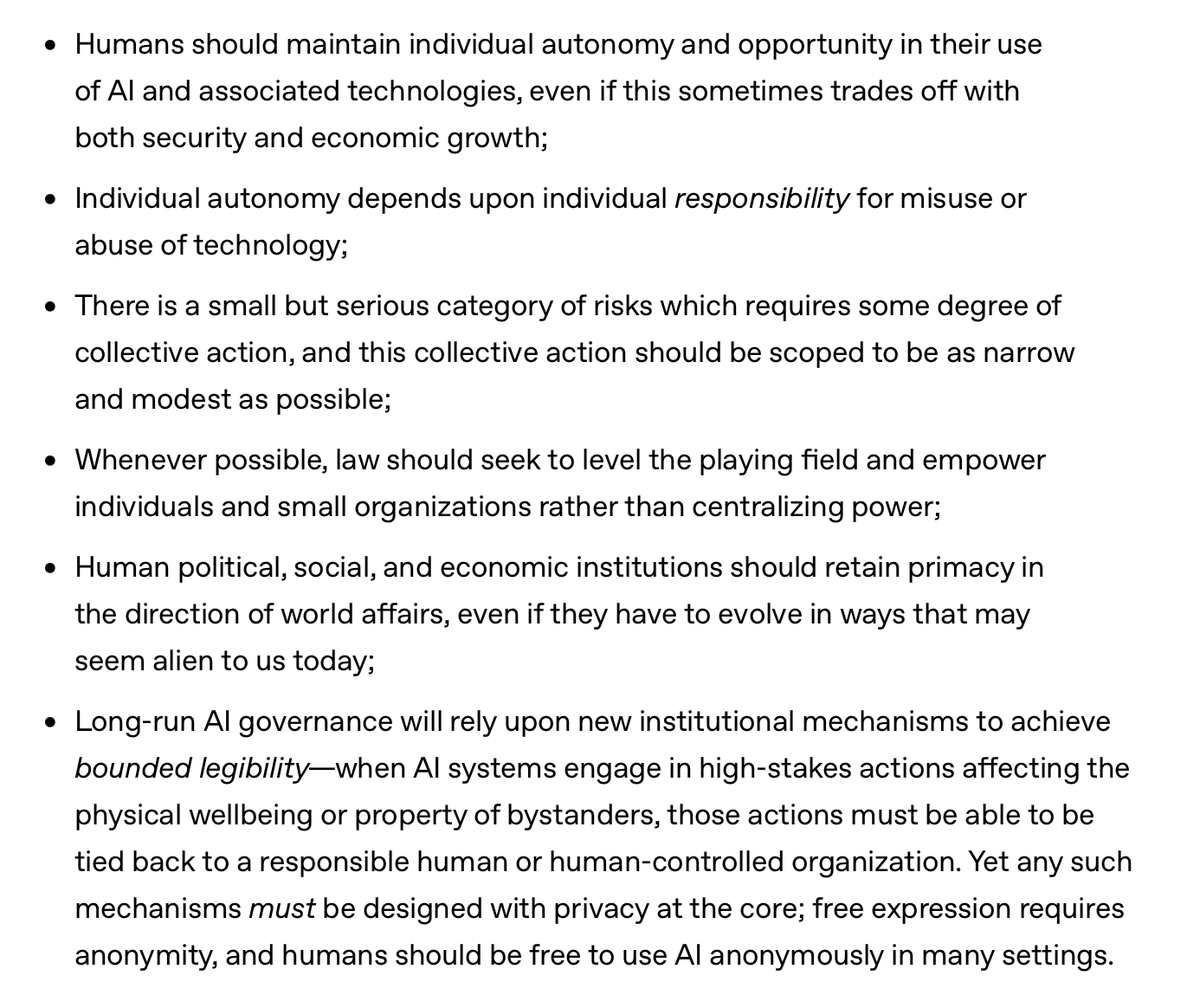
OpenAI has launched AI Futures, a new research blog focused on how free societies can preserve individual rights and agency as transformative AI reshapes power.
Dean Ball’s Strategic Futures team argues that concentration of power may be the largest long-run AI risk.
Autonomous systems could let states project force without cooperative soldiers. Automated bureaucracies and data-center-generated wealth could make governments less dependent on human labor, taxation and consent.
Regardless of what one thinks of it, it clearly shows one thing once again: we are on the threshold of a societal transformation the likes of which we have never seen before.
5× context compression did surprisingly little to GPT-5.5’s final task result.
The compressed agent remained statistically as successful as the full-context version.
What changed was how it got there: it relied much more heavily on retrieval to reconstruct dropped information.
– arxiv. org/abs/2608.16370
Title: "What Does Context Compression Cost an Agent? Interaction Costs Unrevealed by Task-Completion Metrics"
Grok Build for SuperGrok and X Premium users has been officially announced.
Besides that, a new way to manage access for shared apps is now available on the web, mobile, and CLI.
100K+ GitHub stars in 2 days 🔥
DeepSeek Harness is built to unlock the best of @deepseek_ai models while staying lightweight and composable, making it a natural fit for local AI development on 2x DGX Spark, 2x RTX PRO 6000, and DGX Station.
You asked for it, we delivered it!
Unity Cloud Collaboration Tools (experimental) brings threaded comments into the Editor: pin notes on scenes and GameObjects, @ mention teammates, attach files or sketches, and drop spatial markers in Scene view.
🔗 Learn more: https://t.co/DCo3WrCY6l
Anthropic is reportedly preparing to publicly file for its IPO as soon as the end of August.
The company expects to raise at least as much as SpaceX’s record $75 billion debut, potentially making it the largest IPO in history (~$ 2tn valuation)
Be a homie and don’t gatekeep your best chats 👀
You can now share read-only conversations from both ChatGPT Work and Codex on desktop.
It’s an easy way to show your process or give someone the context behind your work.
Esta es la mayor biblioteca de skills de ciberseguridad de código abierto para agentes de IA.
✓ 817 skills
✓ 36 categorías
✓ +20 plataformas
→ https://t.co/BF3PpUYBAp
We've been working on this with customers for a while. Mythos-class models require additional safety measures and enterprises need to meet their own privacy and compliance rules. Customers can own and control their own data and Anthropic retains none. It’s coming this fall.