Is Canary Wharf cool now?
Since 2022, a load of glitzy new bars and restaurants have opened in the financial district. New swimming spots and green spaces have made it less oppressively grey.
Strange things are happening at Canary Wharf.
People seem to be going there of their own free will. We spent a few weeks on the Wharf, speaking with partygoers and new residents descending upon the area. Full story below.
Our first official edition is here - and it’s a big one.
A council deadlock that’s left Kirklees without a leader, a £100m bus order reshaping transport across West Yorkshire, and a look at whether Leeds is losing its independent beer edge.
Plus peregrine falcons picking Bradford over Leeds.
Is Andy Burnham in trouble in Makerfield? @joshi and The Mill’s newest staff writer Lucy McLaughlin discuss her two days of reporting on the by-election, where we’ve mapped which areas should lean Labour and Reform.
https://t.co/ciPhx3SdYl
A very powerfully sad story of mental illness and falling through the cracks.
A decayed corpse was found being wheeled through the centre of Walthamstow. Who was she? And who is to blame for her death? https://t.co/QN1IRyR8sC
In November 2023, police found the decayed corpse of Tracey Turnell in Walthamstow Market.
She had no phone, job, passport, friends or lovers. There wasn’t a single photo of her.
It was as if, in her death, she entered the record for the first time.
https://t.co/dPmuSqzcw0
The body in the wheelchair: How did a troubled family get lost by the state?
On the morning of 7 November 2023, 77-year-old Joan Turnell dressed her daughter Tracey in her bright red raincoat, sat her in her wheelchair and set out from their block of flats in Whitehouse Mews, Leyton. It could have been like any other day if, instead of heading left towards Walthamstow’s town centre, they had made the usual turn right to the nearby park. And if it wasn’t for the look of panic on Joan’s face, the pair of housing officers following the pair discreetly and the smell seeping from the wheelchair, a mix of faeces and decay.
Grey clouds had blocked out the sun by the time she pushed the chair the mile and a half to Walthamstow’s bustling street market. There, in between the Peacocks and the police station, they were joined by a police squad, who asked Joan to stop and escorted her to a secluded car park. When the officers pulled back Tracey’s hood, they discovered a near-skeletal corpse. She had been dead for over a year.
Tracey had no phone, no job, no GP registration, no passport, no friends or romantic partners. There wasn’t a single photo of what she looked like. It was as if, in her far too public death, she had entered the public record for the first time. Police were only able to identify her using her mother’s DNA.
I first encountered their case in February last year, when I read a local news report of the coroner’s inquiry into the death. A few months later, I set out to learn who Tracey and Joan were, and what had led to the tragic events of that mild November day. But I also wanted to know why the sequence of profound failures by the authorities that had resulted in this tragedy have gone unaddressed in the years since Tracey’s death, so much so that a senior coroner investigating the case called for those responsible to be brought to account. “Unless and until somebody actually feels the flames at their feet about the consequences of their actions or inactions,” he explained, “not a great deal changes.”
Via months of interviews with dozens of friends, family members and social care experts — and by obtaining exclusive access to council and coroner’s records — I endeavoured to uncover the reality of Tracey and Joan’s lives, hoping to return a shred of humanity to two people who had long been denied it. It was an effort that would eventually lead me to a rubbish-strewn graveyard on the outskirts of east London.
I just subscribed to @ManchesterMill who have done some great investigative work and are running a series 'Burnham Blueprint'. This is part 2. I love the writing of course, but big kudos to Jake Greenhalgh who does all the artwork. https://t.co/ap8JnlxOpX
This is a superb but v sad article. Well worth a read. It reminds me of pre-internet journalism when writers had time to research and form a story rather than having to supply rolling news.
In November 2023, police found the decayed corpse of Tracey Turnell in Walthamstow Market.
She had no phone, job, passport, friends or lovers. There wasn’t a single photo of her.
I pieced together who she was and who was responsible for @_TheLondoner
https://t.co/Jxv5fnW0u3
My latest for the Liverpool Post. Inspired by pure envy and loathing — always the best reasons for going out for your tea — I decided to tackle the Lovecraftian horrors of Crabbish on Duke Street. https://t.co/g8iXrfTmFa
Three murders by knife in the space of three years at the start of the 1960s, all on Glasgow Green. Was this the work of the notorious Moors Murderer Ian Brady, during his peripatetic killing era?
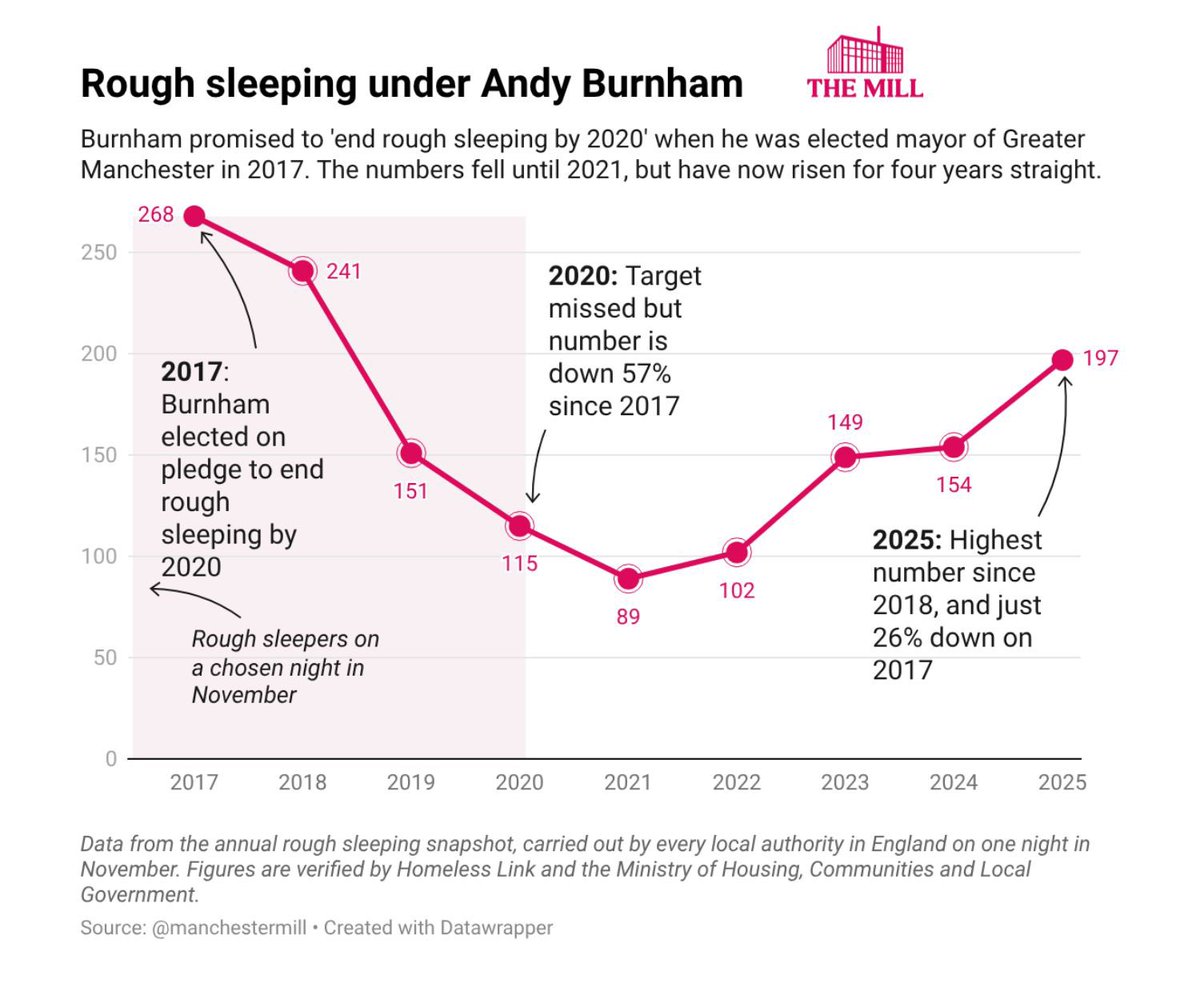
Andy Burnham used to talk about homelessness a lot. Less so recently.
This might be why: rough sleeping fell after he promised to end it in Greater Manchester by 2020. But it’s now risen four years in a row and last year was the highest since 2018, the year after he was elected.
In the @NewStatesman, Andrew Marr says it’s “a win for the north, and Britain’s resurgent non-metropolitan journalism” that our reporting is being read in Westminster.
Coming up tomorrow morning on The Mill: @jackdulhanty delves deep into one of @AndyBurnhamGM's most important areas: homelessness and housing.
How has Burnham performed? And what can it tell us about how he'd run the country?
In your inboxes at 7am (paying members only).
Read this. As a former cub reporter on the Sheffield Telegraph - I failed my probation at the first attempt - I can only admire the great work of @sheffieldtrib and wish them the best for the @PrivateEyeNews Paul Foot Award.
I won that a while back.
Must have been a mistake.